
Did Christianity Copy Pagan Religions? Part 4 — What About Evolution & The Flood?
Many modern objections to Christianity argue that the faith is not original at all.
Note: Due to margins from the dropdown list, this blog is easier to read on tablet or computer.
Some claim Christianity borrowed its beliefs from older pagan myths and mystery religions. Others argue that Christian holidays like Christmas and Easter are simply repackaged pagan festivals. And many believe science—especially evolution—has completely disproven the Bible.
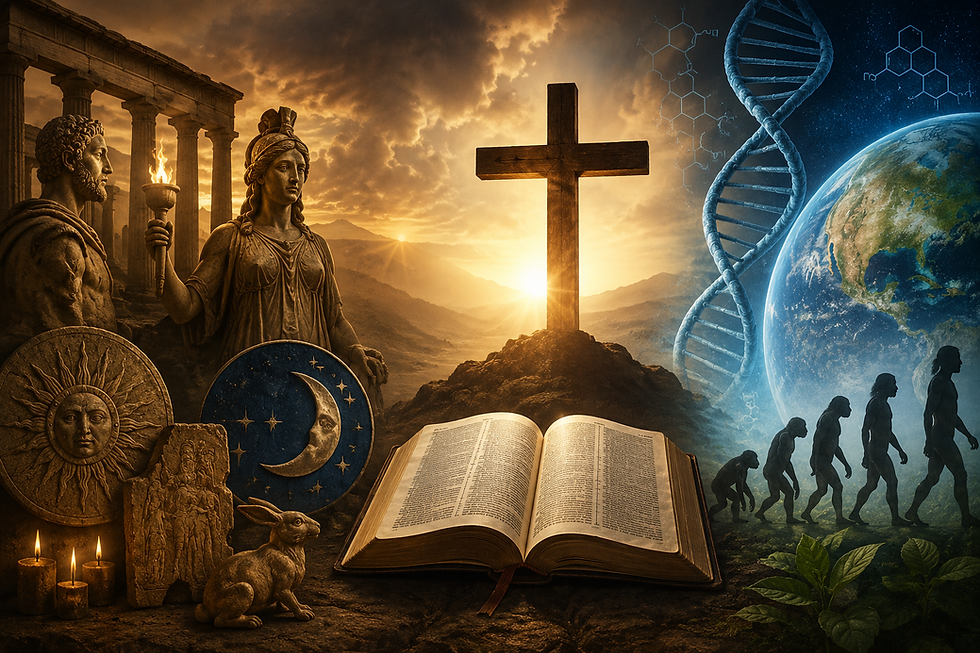
These claims are widespread online, in documentaries, social media discussions, and popular culture—but are they historically accurate?
This article examines common claims about pagan parallels, Christian holidays, science, Genesis, evolution, and whether Christianity is truly opposed to scientific understanding.
Rather than relying on assumptions or internet slogans, the goal is to examine the historical evidence, context, and arguments carefully and honestly.
In This Article
Is Christianity copied from pagan religions?
Are Christian Holidays spin offs of Pagan holidays?
Christmas trees
Easter
What about evolution?
Is the Bible anti-science?
What about dinosaurs?
The flood narrative
🧠 Quick Definitions (for clarity)
Manuscripts → handwritten copies of ancient texts
Textual variants → differences between copies
Textual criticism → comparing manuscripts to recover original wording
Scripture → sacred writings regarded as inspired by God and authoritative for faith
Canon → the recognized books of Scripture
AD → after death of Jesus Christ—we mark our current year from this event
Sin → Anything that goes against God’s nature, will, or commands—whether in action, thought, or intention.
Repent → A deliberate turning away from sin and turning toward God—resulting in a real change of mind, heart, and direction.
1. Is Jesus and Christianity copied from pagan religions?
💬 Short answer:
Claims that Christianity directly borrowed its core beliefs from pagan religions are usually based on selective comparisons, modern reinterpretations, and broad pattern-matching rather than clear historical evidence of direct influence. While religions can share similar themes, similarity alone does not prove borrowing or dependence.
📋 Expanded: 🛑The claim
A common modern argument suggests:
Jesus is a copy of earlier “dying and rising gods
Virgin birth, resurrection, and miracles were borrowed from pagan mythology
Christianity is a reworked version of earlier religions
👉 This idea appears frequently in modern skeptical literature and online media.
📌 1. Where this idea comes from
This argument is not from a single source, but developed through several streams:
🔹 19th–early 20th century comparative religion scholarship
Early scholars like Sir James Frazer (The Golden Bough) studied similarities between ancient myths and proposed broad patterns across religions, including “dying and rising god” themes.
👉 Later scholarship has often criticized these comparisons as too broad or not historically precise.
🔹 The “dying and rising god” framework
This category was used in early religious studies to group mythic patterns across cultures.
👉 However, many modern scholars argue the category is often misapplied, because the figures compared do not share consistent or equivalent resurrection narratives.
🔹 Modern skeptical and mythicist writers
More recent popular arguments have been advanced by writers such as:
Richard Carrier (Jesus myth theory arguments)
Tom Harpur (The Pagan Christ)
Other internet-era writers who reinterpret ancient myths through a symbolic or allegorical lens
👉 These views are influential in online discussions but remain highly debated and not widely accepted in mainstream historical scholarship.
🔹 Internet documentaries and viral media
Popular media has also amplified the idea, including:
Zeitgeist: The Movie
YouTube compilations and “Jesus copy” comparison videos
👉 These sources often compress complex ancient religions into simplified lists of parallels.
📌 2. Common examples and historical issues
🔹 Mithras (Roman mystery religion)
Claim: Mithras was born on December 25th, had 12 disciples, and rose from the dead.
Reality:
No primary evidence of a virgin birth
No “12 disciples” in Mithraic texts
No clear resurrection narrative comparable to Christianity
Most detailed Mithras material is later than early Christianity
👉 Many popular claims come from later interpretations or reconstruction, not original sources.
🔹 Horus (Egyptian mythology)
Claim: Horus had a virgin birth, death, and resurrection similar to Jesus.
Reality:
Egyptian mythology has multiple versions across centuries
“Virgin birth” is not accurately represented in primary texts
No unified resurrection narrative matching the Gospel accounts
👉 Many comparisons rely on simplified modern summaries rather than ancient texts.
🔹 Osiris, Attis, Dionysus
Claim: These are “dying and rising gods” like Jesus.
Reality:
Their myths vary widely by region and time period
“Death and return” often refers to seasonal or symbolic cycles
No literary or historical dependence on Christian texts
👉 Similar themes do not equal shared origin or borrowing.
📌 3. Key historical issue: what would be required for borrowing
To demonstrate direct borrowing, historians would expect:
Clear earlier source material
Evidence of contact or transmission
Textual dependence or adaptation
Shared meaning and function, not just imagery
👉 These conditions are not met for core Christian beliefs.
📌 4. Jewish context matters
Christianity emerged from:
Second Temple Judaism
Strict monotheism
Strong rejection of pagan worship systems
👉 Early Christians were Jewish believers interpreting Jesus through Hebrew Scripture, not adopting pagan myth systems.
This makes wholesale borrowing of pagan theology historically unlikely.
📌 5. Why similarities still exist
Across cultures, religions often share themes like:
Birth narratives
Moral teachings
Death and hope beyond death
Symbolic language
👉 These similarities are better explained by shared human experience and storytelling patterns than by direct copying.
📖 Key takeaway:
The idea that Christianity directly borrowed its core beliefs from pagan religions comes from a mix of early comparative religion theories, modern skeptical writers, and internet-era media (including documentaries like Zeitgeist).
👉 While surface-level similarities exist across religions, they do not demonstrate direct borrowing, shared origin, or textual dependence.
👉 Christianity’s core claims are best understood within its Jewish historical context, not as adaptations of pagan mythology.
✍️“See to it that no one takes you captive through hollow and deceptive philosophy, which depends on human tradition and the elemental spiritual forces of this world rather than on Christ.” -Colossians 2:8
2. "All Christian Holidays are spin offs of pagan holidays"
💬Short answer:
This claim is mostly oversimplified and often misleading. While some Christian holidays overlap in timing with older cultural festivals, there is no strong historical evidence that core Christian holidays like Christmas or Easter are “borrowed pagan celebrations.” In most cases, the similarities are either coincidental, cultural adaptation of calendar timing, or later traditions—not replacement of pagan worship.
📋Expanded:
📌Where this claim comes from
This idea is usually based on:
Similar dates between holidays
Later cultural traditions (trees, eggs, lights)
Assumptions about religious “replacement”
Internet-era summaries that blend facts with speculation
👉 The problem: similarity ≠ origin.
3. "Christmas is pagan"
👉What does the evidence point to?
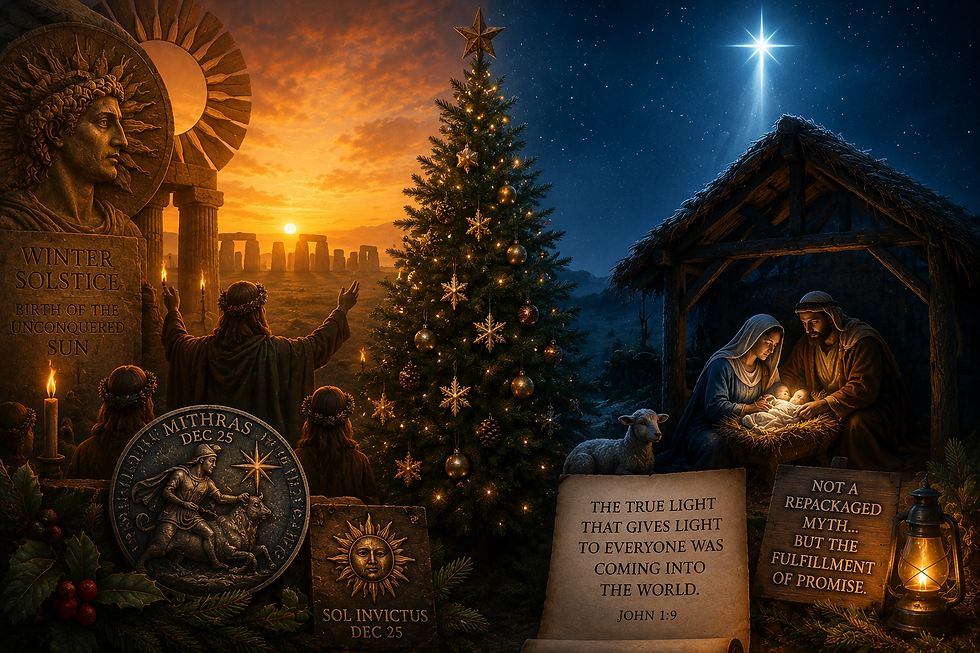
📖 Core historical reality:
Christmas celebrates the birth of Jesus Christ
Evidence shows Christians were discussing Jesus’ birth no later than the 2nd–3rd century, with evidence of nativity observance emerging clearly by the 4th century.
December 25th became widely used in the Roman church by the 4th century
📊Sources:
Clement of Alexandria (c. AD 200) records Christians proposing dates for Jesus’ birth (20 May, 19/20 April, etc.), showing the nativity was already a subject of Christian interest.
Hippolytus of Rome (often dated c. AD 204, though debated) is frequently cited as an early witness connecting Christ’s birth with December 25.
John Chrysostom preached in AD 386 that the December 25 feast in Antioch had already been observed there for about ten years.
Christians were reflecting on and even proposing dates for Christ’s birth by the late 2nd century, with documented liturgical celebration clearly established by the 4th century.
-3.1 Is Christmas based on pagan festivals like Saturnalia or Sol Invictus?
🛑 The common claim
“Christians put Jesus’ birth on December 25 to replace the pagan festivals of Saturnalia or Sol Invictus.”
This is often presented as settled fact.
It isn’t.
📜 Saturnalia doesn’t fit very well
Saturnalia (festival of Saturn) was a Roman feast marked by feasting, gift-giving, and role reversals.
⚠️But:
It was typically observed December 17–23, not December 25.
Ancient Christians never clearly said, “We chose Christmas to baptize Saturnalia.”
There is no early primary Christian source saying Christmas was created from Saturnalia.
The earliest Roman record of Dec 25 as Christ’s nativity appears in the Chronography of 354 (AD 336)
That connection is often assumed later, not demonstrated.
⚠️Key point:
There is no direct evidence early Christians chose Dec 25 to replace these festivals
Early Christian writers gave theological reasoning instead
☀️ What about Sol Invictus?
The feast of Dies Natalis Solis Invicti (“Birthday of the Unconquered Sun”) is associated with December 25 and Emperor Aurelian in AD 274.
Many claim:
Pagans had Dec. 25 first
Christians copied it
But many scholars argue the evidence may point the other way—or at least that the issue is not that simple.
📊Good scholarly works with stronger citations than web sources:
Thomas J. Talley, The Origins of the Liturgical Year
Andrew McGowan, “How December 25 Became Christmas” (Biblical Archaeology Society)
Steven Hijmans, scholarship on Sol Invictus and Christmas dating (disputes simplistic “borrowed from paganism” claims)
-3.2 Was Jesus really born December 25?
💬 Short answer:
We do not know the exact date of Jesus’ birth, and the Bible does not give it.
📋 Expanded:
The Bible never commands or records a birthday for Christ. Early Christians discussed possible dates, but certainty was never the point.
What matters is:
The fact of the Incarnation, not the calendar precision
Celebration is remembrance, not historical reconstruction
📖 Principle: Romans 14:5–6
“He who observes the day, observes it to the Lord; and he who does not observe the day, to the Lord he does not observe it.”
📌Believers have liberty regarding days, as long as it is done unto the Lord.
📊 Historical irony
Some evidence suggests:
Christians may have had December 25 traditions very early (often linked to Hippolytus of Rome, though debated)
The pagan “Unconquered Sun” feast may have developed in rivalry with Christianity rather than vice versa.
👉So the usual story may be backwards.
✝️ Even if a date overlapped, that wouldn’t prove pagan worship
This is important.
Using a date once associated with pagan culture does not make Christian worship pagan.
Christians routinely transformed cultural forms:
Greek philosophical vocabulary
Roman roads for missions
Pagan temples repurposed as churches in some places
Common symbols given Christian meaning
✝️Christianity often converts, not merely copies.
🚫 The “Christmas is pagan” argument often overstates the evidence
What can be said honestly:
✅ Some pagan festivals occurred near the same season.
✅ December 25 overlapped with pagan observances.
❌ It is not historically proven Christmas was simply stolen from paganism.
❌ Many scholars dispute that popular claim.
That distinction matters.
📖Colossians 2:8
“Beware lest anyone cheat you through philosophy and empty deceit, according to the tradition of men…”
📖Romans 14:5–6
“One person esteems one day above another… let each be fully convinced in his own mind.”
Parallels do not equal borrowing, overlap does not equal origin, and shared dates do not make Christian worship pagan.
✍️ “And we know that all things work together for good to those who love God, to those who are called according to His purpose.” -Romans 8:28
-3.3 Why was December 25 chosen?
Early Christian explanations include:
Belief in “integral age” theory (prophets dying on same date as conception)
Symbolism of light entering the world in winter darkness
Liturgical calendar development within early Church tradition
📌Early Christians often believed prophets died on the same calendar date as their conception (“integral age” idea).
Jesus’ crucifixion was associated with March 25 in Western calculations.
Add nine months…
You get December 25.
👉 In short: theological + calendrical reasoning, not documented pagan borrowing.
-3.4 Should Christians reject Christmas if Jesus wasn't born on December 25?
💬 Short answer:
The Bible does not tell us Jesus was born on December 25—but Christianity has never stood or fallen on knowing His exact birth date. Celebrating Christ’s birth does not require knowing the exact day.
🛑 The claim — Some argue:
“Jesus wasn’t born on December 25, therefore Christmas is false or unbiblical.”
But that does not logically follow.
Not knowing the exact date of an event does not make commemorating the event wrong.
We may not know the exact day Jesus was born.
We absolutely know He was born.
And that is what Christmas celebrates.
📜 The early church did not claim infallible certainty on the date
Historically, December 25 was understood as a traditional date of celebration—not a dogma saying, “This must be the literal birthday.”
That distinction matters.
The celebration centers on the Incarnation:
God the Son entered history.
That is the point.
✝️ Christmas celebrates a fact, not a proven calendar date
Commemoration does not require exact chronology.
🌙 “But shepherds wouldn’t be in fields in December…”
This is often overstated.
Some argue Gospel of Luke 2 rules out winter.
But scholars debate this.
Shepherding practices could continue in some regions and seasons.
At best, this may question the exact date.
It does not condemn celebrating the birth.
And even if Jesus was born in spring or fall—
that still would not make December commemoration sinful.
📊 Historically, the exact date was never the center
The center was:
Incarnation
Nativity
Worship of Christ
Not precision dating.
The holiday is theological before it is calendrical.
🎄 Christmas is about who, not merely when
The power of Christmas is not:
“Jesus was certainly born December 25.”
⚠️It is: “Unto you is born this day a Savior.”
(Gospel of Luke 2:11)
That remains true no matter what date one commemorates it.
📖Romans 14:5–6
“One person esteems one day above another… let each be fully convinced in his own mind… He who observes the day, observes it to the Lord.”
That verse alone answers much of this.
📖Luke 2:10–11
“I bring you good tidings of great joy… For there is born to you this day… a Savior…”
That is the heart of Christmas.
-3.5 Should Christians reject Christmas because it isn’t commanded in Scripture?
💬 Short answer:
No. The Bible does not command Christians to celebrate Christmas—but not everything permissible or beneficial for Christians must be explicitly commanded in order to be lawful.
🛑 The claim — Some argue:
“The Bible never commands Christmas, so Christians should not celebrate it.”
Sometimes this is expanded to:
“If God didn’t command it, man invented it, so it is wrong.”
But that goes beyond what Scripture says.
⚠️ The hidden assumption — This objection often assumes:
Only what is explicitly commanded in Scripture is allowed.
But that is not how Scripture itself operates.
📖 Scripture distinguishes between commands and lawful Christian liberty
The question is not merely: “Is it commanded?”
But: “Is it forbidden?”
Those are not the same question.
And Scripture nowhere forbids remembering Christ’s birth.
📖Romans 14:5-6 matters here:
“One person esteems one day above another; another esteems every day alike. Let each be fully convinced in his own mind… He who observes the day, observes it to the Lord.”
That strongly supports liberty in matters like this.
A Christ-centered observance can be done unto the Lord.
✝️ Christmas can be an act of worship, not invention opposed to God
Celebrating the Incarnation through:
prayer
worship
Scripture reading
generosity
remembering Christ’s coming
is not rebellion against God — It can be devotion to God. That matters.
📜 Scripture gives examples of faithful observances not explicitly commanded in Mosaic law—A huge example:
Hanukkah
The Feast of Dedication (Hanukkah) is not commanded in the Torah.
Yet Jesus is present at it in
Gospel of John 10:22–23.
That is significant. A commemorative religious observance not directly instituted in Mosaic law existed—and is not condemned.
That weakens the objection considerably.
🚫 “Man-made” does not automatically mean sinful
👉Sometimes people quote Jesus condemning “traditions of men.”
👉But Scripture condemns traditions that nullify God’s word, not every human tradition. Human tradition becomes a problem when it contradicts God.
⚠️Not merely because humans developed it.
🎄 Christmas is not adding doctrine to Scripture
Celebrating Christmas does not add:
a new gospel
a new sacrament
a new revelation
It is a remembrance.
That is a major difference.
📊 The real issue is how Christmas is observed
Could Christmas be corrupted by:
materialism
consumerism
distraction
Of course—Anything can.
But abuse of something does not prove right use is sinful.
The answer to worldly Christmas is not necessarily no Christmas—
but redeemed Christmas.
📖1 Corinthians 10:31
“Whatever you do, do all to the glory of God.”
A Christian may celebrate Christmas unto the Lord,
or abstain unto the Lord.
⚠️Note: The world known celebration of Christmas provides countless openings for Gospel conversations, especially opportunities to introduce Jesus and the good news to children and non-believers.
-3.6 Didn’t the Puritans reject Christmas—and doesn’t that mean Christians should?
💬 Short answer:
Some Puritans did oppose Christmas, but largely because of concerns about abuses, superstition, and unbiblical church traditions—not because Christ’s birth should never be remembered. Their objections do not settle the issue for all Christians.
🛑 The claim — Some argue:
“The Puritans banned Christmas, therefore faithful Christians should reject it.”
But that skips a lot of history.
📜 Yes, some Puritans opposed Christmas
Historically, many English Puritans in the 1600s objected to Christmas observance.
Even in England, Christmas restrictions were imposed during parts of the Puritan/Commonwealth period under Oliver Cromwell.
Some early New England Puritans also discouraged or even penalized Christmas observance — That much is true.
⚠️ But why they objected matters
Their concerns were often not: “Celebrating Christ’s birth is inherently pagan.”
Often it was about:
opposition to Roman Catholic feast traditions
concern over practices lacking biblical warrant
resistance to superstition
reaction against drunken revelry and disorder associated with some Christmas customs
And frankly… some of those abuses were real concerns.
But objecting to abuses is not the same as condemning all possible observance.
🎄 They often opposed how Christmas was practiced, not merely the idea of honoring Christ’s birth
That distinction matters.
Much of what they criticized looked more like public disorder than modern family worship centered on Christ.
That is very different from:
reading the nativity story
singing hymns
gathering for worship
celebrating the Incarnation
Those are not what many Puritans were reacting against.
📊 Also—Puritans are not the final authority
Important point: Puritans were serious Christians.
But they were not Scripture.
Their disagreements do not determine doctrine.
If “the Puritans rejected it” settles the matter, then by the same logic Christians would also have to adopt every Puritan conclusion on many other disputed issues —Few arguing this do that consistently.
Our authority is Scripture.
Not one movement in church history.
✝️ Many faithful Christians embraced Christmas too
Church history is not one-sided.
Many deeply orthodox believers celebrated Christ’s nativity for centuries.
That includes believers long before and long after the Puritans.
So history itself does not speak with one voice here.
🚫 Historical dissent does not equal biblical prohibition
Some Christians abstaining from a practice does not prove the practice sinful.
It may simply show liberty of conscience.
📖Which fits well with Romans 14:
“One person esteems one day above another… another esteems every day alike… let each be fully convinced in his own mind.”
That almost sounds written for this discussion
One may abstain.
Another may observe unto the Lord.
Both can honor God.
⚠️Interesting historical irony: Many who cite Puritans against Christmas would disagree with Puritans on numerous other doctrines and practices—showing the appeal is often selective.
That’s worth noticing.
-3.7 Is Christmas wrong because it’s commercialized and materialistic?
💬 Short answer:
No. The presence of commercialism or misuse does not make the celebration itself sinful. The Bible evaluates practices by their moral content and intent, not by how culture later distorts them.
🛑 The claim — Some argue:
"Christmas is bad because it’s become commercialized, greedy, and materialistic."
That critique is understandable—but it’s a critique of culture, not necessarily of the observance of Christ’s birth itself.
⚖️ A key distinction: abuse vs use
A consistent biblical principle is:
The abuse of something does not determine the legitimacy of its proper use.
Otherwise:
food is wrong because of gluttony
money is wrong because of greed
music is wrong because it can be sensual
phones are wrong because they can be addictive
The issue is not the thing—it’s the heart and use.
Scripture addresses the heart, not the calendar
📖Gospel of Matthew 6:21:
“Where your treasure is, there your heart will be also.”
That applies at Christmas—or any time.
The Bible’s concern is not whether people exchange gifts, but whether:
greed rules the heart
Christ is forgotten
worship is displaced by consumption
🎁 Gift-giving itself is not condemned in Scripture
Gift-giving is actually a deeply biblical concept:
The Magi bringing gifts to Christ (Matthew 2:11)
God giving the greatest gift (John 3:16)
Believers encouraged to give generously (2 Corinthians 9:7)
So the practice itself is not the issue.
While gift exchange existed in many cultures, Christianity attaches its own meaning👉 The most important biblical association is:
📖 Matthew 2:11
The Magi presenting gifts to Jesus (gold, frankincense, myrrh)
📌 In Christian theology:
Gifts symbolize honor and recognition of Christ’s kingship
They reflect the idea that God gave the ultimate gift
📖 John 3:16
“For God so loved the world that he gave his one and only begotten Son…”
👉 This creates a central Christian meaning:
Human gifts → symbolic
God’s gift → sacrificial salvation through Jesus
🩸 Therefore:
Christmas gift-giving can be understood (in Christian interpretation) as a reflection of God giving Christ, not a borrowed pagan ritual.
👉 Important distinction:
Cultural customs ≠ the origin of the holiday itself.
📊 Commercialism is a modern cultural distortion, not the origin
Historically:
Early Christian celebration of the Nativity focused on worship, not retail systems
Large-scale commercial Christmas culture developed much later (especially 19th–20th centuries with industrialization and advertising)
So what people often criticize is not “Christmas as a theological remembrance,” but modern consumer capitalism attached to it.
Those are not the same thing.
⚠️ Logical issue in the argument
This objection often assumes:
“If something becomes corrupted in culture, the whole practice is invalid.”
But that doesn’t hold consistently.
Example:
Marriage exists in a culture with divorce → marriage is still good
Food exists in a culture with gluttony → food is still good
Music exists in a culture with lustful lyrics → music is still good
Corruption doesn’t erase original meaning.
✝️ What Scripture would actually critique at Christmas
The Bible would not target “Christmas” as a date or tradition.
It would target things like:
greed
idolatry
lack of gratitude
neglecting Christ
Which can happen any day of the year.
📖 1 Timothy 6:10
“For the love of money is a root of all kinds of evil…”
Not money itself—but the love of it.
And: 📖Romans 14:6
“He who observes the day, observes it to the Lord…”
Focus: intention toward God.
🎄 A helpful framing
Christmas can function in very different ways depending on the heart:
It can be a consumer holiday
It can be a family tradition
It can be a Christ-centered remembrance
Same external day—different spiritual reality.
📖Key Takeaway:
The commercialization of Christmas is a cultural distortion, not a biblical indictment of celebrating Christ’s birth.
The real biblical question is not “Is Christmas corrupted in culture?”
but “Is Christ honored in the heart?”
That applies every day—not just December.
-3.8 What about the claim that Christmas is from Nimrod or Babylonian religion?
💬 Short answer:
No. This theory largely comes from later speculative writings, not ancient historical sources.
📋 Expanded:
The idea often traces to The Two Babylons (1853), which argues Christianity is derived from Babylonian religion.
However:
historians widely critique its methodology
it relies heavily on speculative parallels
it lacks strong primary-source support
Biblically:
Book of Genesis 10 describes Nimrod as a ruler, not the origin of Christmas symbolism.
Conclusion:
The “Babylon → Christmas” connection is not supported by solid historical evidence.
✝️ Final Summary
Christmas is not:
proven to be a pagan festival in disguise
condemned by Scripture
dependent on an exact historical birth date
invalid because of cultural misuse
Instead, it is:
a later Christian commemoration of the Incarnation
practiced in liberty across Christian history
judged biblically by how Christ is honored, not by calendar disputes
📖 Key guiding principle:
Epistle to the Romans 14 — each believer acts unto the Lord in matters not commanded or forbidden.
4. Are Christmas trees pagan?
💬 Short answer:
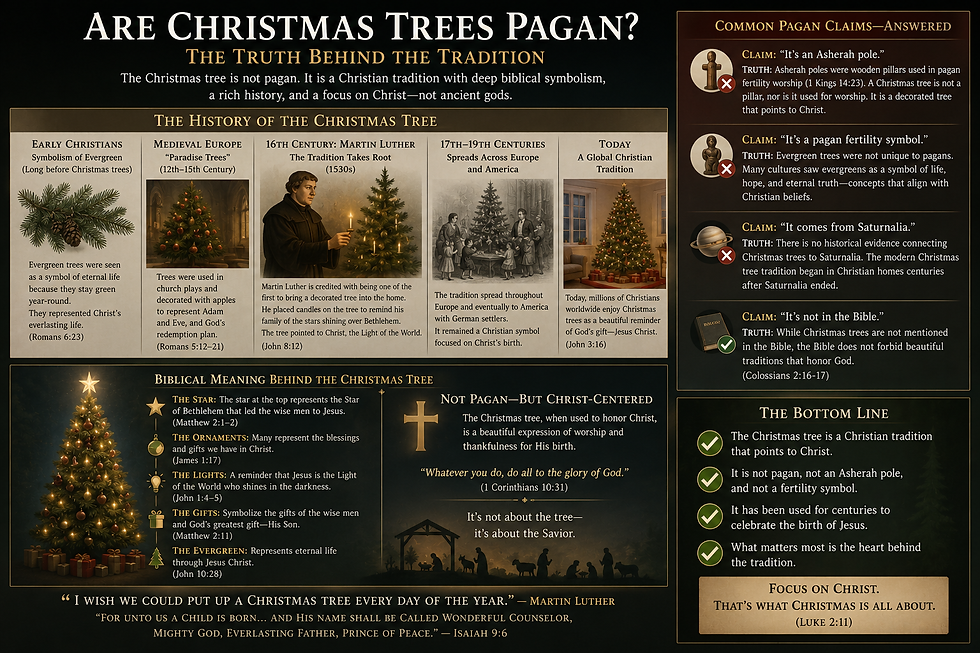
No direct historical line proves Christmas trees came from pagan worship, and equating Christmas trees with Ashram poles is historically weak mixing two very different things.
📋 Expanded:
Evergreens were used in many cultures as symbols of:
life in winter
endurance
hope
Some Germanic “Yule” customs existed, but:
there is no clear evidence of a direct continuity into Christian Christmas trees
the modern decorated tree appears prominently in 16th-century Christian Germany
📖 Key distinction:
Shared symbolism ≠ shared worship
Christians often repurposed cultural symbols to point to Christ, not pagan gods.
🛑 The claim
Some argue Christmas trees are condemned in the Bible because of passages about Asherah poles (like Deuteronomy 16:21) or Jeremiah 10:1–5, and therefore Christians should reject Christmas.
But this misunderstands both passages and history.
🌳 Asherah poles were idols—not Christmas trees
Asherah poles were objects of actual worship in Canaanite religion—cultic symbols tied to the goddess Asherah, often used alongside Baal worship. They were not decorative evergreens brought into homes for celebration.
The sin was never “having a tree.”
The sin was idolatry.
📖 What about Jeremiah 10?
This passage is often quoted against Christmas trees:
“They cut a tree out of the forest… they decorate it with silver and gold…”
But read the context—Jeremiah is mocking idol-making, not describing Christmas decorations. The craftsman cuts a tree, shapes it into an idol, fastens it upright so it won’t fall over, and worships it.
That is carved idol manufacture.
It is not a family decorating a fir tree.
🎄 The actual history of Christmas trees
The modern Christmas tree comes much later and has a very different background.
Evergreens had long symbolized life enduring through winter in many cultures.
Christians later used evergreen symbolism to point to eternal life in Christ.
The decorated Christmas tree as we know it is strongly traced to German Christians in the 1500s.
Tradition often connects Martin Luther with adding candles to a tree to reflect the beauty of the stars.
By the 1800s, Christmas trees spread widely through Europe and North America.
Their popularity surged after Queen Victoria and Prince Albert were illustrated with a Christmas tree in 1848, helping normalize the custom in the English-speaking world.
📊 A little historical perspective
If Christmas trees were really disguised Asherah poles, we’d expect:
Early Christians to denounce them as pagan survivals
The Reformers to reject them as idolatry
Historic Christian theology to treat them as suspect
But historically, that’s not what happened.
👉Instead, Christians largely understood the tree as:
a symbol of life
a reminder of Eden / the Tree of Life
sometimes linked to Christ bringing life in a fallen world
a teaching symbol for children
⚠️ A common mistake
This objection often assumes: “Pagans once used trees in worship, therefore any later Christian use of a tree is pagan.”
That logic doesn’t hold.
Pagans used:
candles
weddings
singing
incense
temples
feast days
But common things are not pagan merely because pagans used them.
Christianity often redeems symbols rather than surrendering them.
✝️ The real issue is worship
A Christmas tree can be meaningless decoration… or sentimental tradition… or a Christ-centered symbol.
It becomes a problem only if it becomes an idol—which can happen with anything.
The Bible condemns idol worship, not evergreen decorations.
⚠️Bonus point for people citing “Christmas is pagan”
Even many groups that reject Christmas because of alleged pagan origins often rely on arguments popularized in the 19th–20th centuries, not on strong primary historical evidence. A lot of those claims are much newer than people realize.
5. "Easter is pagan" — what it actually is
📖 Core meaning:
Easter celebrates the resurrection of Jesus Christ from the dead—the central claim of Christianity.
👉 Unlike many cultural traditions, Easter is not primarily about customs or symbolism. It is rooted in a specific historical claim: that Jesus physically rose from the dead in space and time.
📌 1. Historical basis:
Rooted in 1st-century Christianity
Based on early proclamation of Jesus’ resurrection
Observed very early in Christian communities
👉 The earliest Christians did not begin with a “spring festival.”

⚠️They began with a proclamation: “Jesus has been raised.”
👉 The “Eostre” reference appears:
700+ years later
In a specific region (Anglo-Saxon England)
📌 That timeline matters.
👉 You cannot derive a 1st-century global Christian belief from a much later, localized reference.
📌 The original term used across early Christianity was: 👉 Pascha
Derived from Passover (Pesach)
Rooted in the Jewish context of Jesus’ death and resurrection
Used across Greek, Latin, and most global Christian traditions
👉 This strongly anchors Easter in Jewish history, not pagan seasonal religion.
📌 Language matters (this is key):
Most of the world does not call the holiday “Easter”
Instead, they use forms of Pascha:
Latin: Pascha
Greek: Pascha
Spanish: Pascua
French: Pâques
👉 Even today, the majority of Christians globally use a name tied to Passover, not a pagan deity.
📌 Conclusion:
“Easter” is an English/Germanic word choice
The celebration itself is rooted in Passover and the resurrection of Jesus
📍 2. Claim: “Easter comes from a pagan goddess Eostre”
This is one of the most common objections surrounding Easter.
📌 Where the claim comes from:
The claim mainly traces back to The Venerable Bede, an 8th-century monk who mentioned that an Anglo-Saxon month called Eosturmonath may have been named after a figure called Eostre.
⚠️However, this is where the evidence is much weaker than many assume.
📌 Historical problems with the claim:
Bede is the only known early source connecting Eostre to a goddess
There is little archaeological or historical evidence showing widespread worship of Eostre
No early Christian writings connect Jesus’ resurrection celebration to pagan rituals involving Eostre
Christians were celebrating the resurrection of Christ centuries before the English word “Easter” existed
👉 Because of this, many historians view the Eostre connection as a possible linguistic influence on the English name “Easter,” not proof that the Christian celebration itself came from paganism.
📌 Important distinction:
The name Easter in English may have Germanic linguistic roots, but the resurrection celebration predates Anglo-Saxon England by centuries.
In fact, most languages do not even use the word “Easter.” They use variations of Pascha, derived from the Hebrew Passover.
“A name adopted in one language is not the same thing as the origin of the event itself.”
🛑 3. Claim: “Easter is a Christian version of pagan spring fertility festivals”
This objection is usually based on two ideas:
Easter occurs during spring
Common modern symbols include eggs and rabbits, which are associated with fertility
📌 Response:
The central Christian celebration of Easter predates many later European customs and is rooted in the resurrection of Jesus Christ and the Jewish Passover (Pascha), not pagan fertility rituals.
📖Historical context:
The timing of Easter is connected to Passover, because Jesus’ death and resurrection occurred during Passover week
Early Christianity emerged from a Jewish religious environment, not pagan fertility cults
The earliest Christians focused on the death and resurrection of Christ long before rabbits, eggs, or medieval folk customs became associated with the holiday
There is no historical evidence that Christians borrowed the resurrection belief from pagan spring religions
📌 About eggs and rabbits:
Some cultural traditions connected to Easter developed centuries later in parts of Europe and may reflect seasonal spring symbolism or folk customs.
However, later cultural additions are not the same thing as the origin of the Christian celebration itself.
👉 Sharing seasonal themes like spring, life, or renewal does not prove Christianity borrowed its core beliefs from pagan festivals.
📌 Important distinction:
A holiday can accumulate local customs over time without changing the historical origin of what it commemorates.
The resurrection celebration began with early Christians proclaiming Jesus rose from the dead — not with fertility rites.
🛑 4. Claim: “The Church merged Christianity with pagan holidays to convert people”
📌 Response:
Early Christianity began as a small, often persecuted movement within the Roman Empire.
During the 1st–3rd centuries:
Christians had little political or cultural power
Roman authorities frequently opposed Christianity
Christians did not control imperial calendars or public religious festivals
Most importantly, the resurrection of Jesus was being preached and commemorated long before Christianity became legally accepted under Emperor Constantine in the 4th century.
📌 Historical context:
The resurrection message appears in the earliest Christian writings of the 1st century
Christians were already gathering to commemorate Jesus’ death and resurrection generations before Christianity became dominant in Rome
👉 This makes it historically difficult to argue that Easter began as a later political strategy to absorb paganism.
📌 Important distinction:
Christianity may have later interacted with surrounding cultures as it spread through Europe, but interaction with culture is not the same thing as inventing the resurrection celebration from pagan religion.
🛑 5. Claim: “Eggs and rabbits prove pagan origins”
📌 Response:
Eggs and rabbits are often cited as evidence that Easter originated from pagan fertility festivals.
However, these symbols are better understood as later cultural traditions rather than the source of the Christian celebration itself.
🥚 Eggs
Eggs have symbolized life and renewal in many cultures throughout history.
Within Christian tradition, eggs became associated with Easter partly because:
Eggs were commonly restricted during Lent in parts of medieval Christianity
Families would save eggs during the fasting season
Eggs later became part of Easter meals and celebrations
Christians also adopted the egg symbolically as a representation of new life and resurrection.
🐇 Rabbits
Rabbits and hares have long been connected with springtime and fertility in European folklore. The “Easter Hare” tradition became especially popular in German regions centuries after Christianity had already spread throughout Europe.
📌 Historical issue with the objection:
There is no evidence that the earliest Christians used eggs or rabbits when proclaiming the resurrection of Jesus. These customs appeared much later as regional folk traditions attached to an already existing Christian celebration.
👉 A later symbol attached to a holiday does not determine the historical origin of the holiday itself.
🛑 6. Claim: “Easter was invented in the Middle Ages”
📌 Response:
The resurrection of Jesus was not a medieval invention.
⚠️The belief itself originates in the earliest Christian movement of the 1st century.
📌 Historical evidence:
The Apostle Paul wrote about Jesus’ death, burial, and resurrection within decades of the events themselves (1 Corinthians 15)
Christians were already gathering weekly in honor of Jesus’ resurrection during the 1st century
By the 2nd century, Christians were annually commemorating the resurrection in connection with Passover (Pascha)
Historical debates in the early church were not about whether to celebrate the resurrection, but about when it should be observed.
For example:
The Quartodeciman controversy (2nd century) involved disagreements over the dating of the celebration
The Council of Nicaea (AD 325) later worked to standardize Easter’s timing across the Christian world
📌 Important distinction:
Medieval Europe contributed many customs, foods, and traditions associated with Easter. But the core resurrection celebration existed centuries before the Middle Ages.
👉 The historical evidence points to development of traditions over time — not invention of the event itself.
🛑 7. Claim: “Different Easter dates prove it’s not authentic”
📌 Response:
Different Christian traditions calculate Easter using different calendar systems and methods for determining the date.
The main differences involve:
The Julian calendar
The Gregorian calendar
Variations in calculating the relationship between Passover, the spring equinox, and the full moon
📌 Historical context:
Disagreements over dating Easter existed very early in Christian history — not because Christians doubted the resurrection, but because different regions used different methods of calculation.
Despite calendar differences:
Christians across traditions commemorate the same event
The core belief remains unchanged
👉 The date variation affects when Easter is celebrated, not what Christians believe.
📖Key takeaway
The historical evidence does not support the idea that Easter originated from pagan goddess worship, fertility mythology, or a medieval invention.
👉Instead, the celebration is historically connected to:
The Jewish Passover context surrounding Jesus’ crucifixion
The earliest Christian proclamation of the resurrection
The belief that Jesus physically rose from the dead
📌 Many modern objections arise from confusing later cultural customs — such as eggs, rabbits, English terminology, and regional traditions — with the historical origin of the celebration itself.
⚠️Final takeaway
The central question is not:
“Where did certain Easter customs come from?”
But rather:
“What explains the earliest Christian claim that Jesus rose from the dead?”
Because long before medieval traditions, spring imagery, or English terminology existed, the earliest Christians were already proclaiming:
“He is not here; He has risen.” — Luke 24:6
⚠️ A practical caution for Christians
Even if later Easter customs like eggs and rabbits do not historically prove pagan origins, Christians should still be careful not to let cultural traditions overshadow the central focus of the celebration.
The resurrection of Jesus is the foundation of Easter — not commercialism, entertainment, or seasonal symbolism.
📌 A tradition may be culturally harmless while still becoming spiritually distracting.
For this reason, many Christians choose to:
Keep the emphasis on Christ’s resurrection
Prioritize Scripture, worship, and remembrance
Avoid traditions they feel blur or dilute the meaning of the celebration
👉 The issue is ultimately not whether a rabbit or egg exists, but whether Christ remains central.
6. OTHER HOLIDAYS (brief clarity)
📌 All Saints’ Day (November 1)
Originated within Christian tradition as a commemoration of martyrs and faithful believers
Some note that its timing overlaps with older seasonal observances in parts of Europe
However, the content and purpose of the day are distinctly Christian
👉 Similar calendar timing does not automatically prove shared religious origin.
📌 Christmas traditions and winter festivals
Many cultures throughout history have held winter celebrations connected to seasonal change, light, or harvest cycles
Some Christmas customs developed within broader European cultural settings
However, the Christian celebration itself centers on the birth of Jesus Christ
📌 Important distinction:
Shared seasonal themes do not erase the specifically Christian theological meaning attached to Christmas.
📌 Valentine’s Day
Valentine’s Day has several historical layers:
It is traditionally associated with Saint Valentine, an early Christian martyr who is believed to have been persecuted and eventually executed for remaining faithful to Christ during the Roman Empire. One widely preserved tradition says he defied imperial decrees that restricted or banned marriages for young men, continuing to perform Christian marriages in secret because he believed marriage was a sacred covenant established by God. His willingness to stand against the culture and suffer martyrdom for his faith became one of the reasons his name remained connected to love, marriage, and sacrificial devotion.
Medieval Europe later connected the day with romance and courtship
Modern culture heavily commercialized the holiday
Some critics suggest Valentine’s Day directly evolved from the Roman festival of Lupercalia—However:
Historians debate how strong that connection actually is
The modern holiday is not considered a direct continuation of pagan Roman worship practices
Much of what people associate with Valentine’s Day developed centuries later within Christian and medieval European culture
👉 The historical development is far more complex than a simple “pagan replacement” narrative.
⚠️Important:
Historical overlap, seasonal timing, or later cultural customs do not automatically determine the origin or meaning of a religious celebration.
Many holidays developed through layers of:
historical context,
regional traditions,
and cultural adaptation over time.
⚠️The important question is not merely whether cultures interacted, but what the celebration ultimately commemorates and teaches.
📊Key principle historians use:
Similarity in timing or symbolism does NOT equal origin.
To prove “borrowing,” you would need:
Evidence of direct adoption
Early Christian writers stating replacement intent
Documented transfer of worship practices
👉 That evidence is not present
📖Biblical foundation:
Luke 2:10–11 → Jesus’ birth is announced as real historical event
1 Corinthians 15:3–4 → resurrection is central historical claim of Christianity
👉 Christianity is built around claimed historical events, not seasonal myth cycles.
🌍Why this matters:
The claim “all Christian holidays are pagan copies”:
Blends real cultural overlap with assumptions of origin
Ignores early Christian historical development
Overstates weak or debated connections
Does not account for documented theological origins
📖Key takeaway:
Christian holidays developed primarily from historical Christian beliefs about Jesus, later expressed through cultural traditions that sometimes overlapped with surrounding societies—but they are not simply “repurposed pagan festivals.”
👉 Similarity in culture does not equal shared origin or meaning.
✍️ “See to it that no one takes you captive by philosophy and empty deceit, according to human tradition…” — Colossians 2:8
7. Isn’t the Bible anti-science? What about evolution?
💬Short answer:
The Bible is not written as a science textbook, so it does not directly address scientific mechanisms. Many Christians see science as explaining “how” things work, while Scripture addresses “why” things exist and who created them. Views on origins, timelines, and details vary among believers, but the central claim remains that God is the Creator of all life.
📋Expanded:
📌1. The Bible is not framed as a scientific manual
Scripture’s primary purpose is theological, not technical:
It focuses on meaning, purpose, and origin
It does not use modern scientific categories
It communicates in ancient literary forms
👉 So tension often comes from reading it as a science textbook rather than theological narrative.
📌2. “Science explains how, the Bible explains why” (general framework)
Within many Christian perspectives:
Science explores mechanisms and processes (“how life develops”)
Scripture addresses ultimate origin and purpose (“why anything exists at all”)
👉 These are seen as different categories of explanation, not necessarily competing ones.
📌3. What about evolution? (Christian interpretive spectrum)
Christians hold different views, including:
Young Earth creation (literal six-day interpretation)
Old Earth / day-age or literary frameworks
Theistic evolution (God working through evolutionary processes)
“Created kinds” model (often called baraminology in some circles)
👉 So this is not a single unified doctrine issue within Christianity.
📚Scholarly framing:
John Walton: emphasizes Genesis should be read in its ancient literary and theological context rather than modern scientific categories
Francis Collins: represents the view that scientific evolution and belief in God are compatible for many Christians
📖Key takeaway:
The Bible is not written to function as a scientific explanation of mechanisms, but as a theological account of origins and meaning.
👉 Within Christianity, there are multiple interpretations of how scientific processes like biological change relate to divine creation—but all generally agree on the core claim:
God is the Creator of all life.
📖Biblical foundation:
Genesis 1:1 → God as the source of creation
Genesis 1:24–25 → life created “according to its kinds”
Hebrews 11:3 → the visible world originates from what is not visible
✍️ “Oh, the depth of the riches of the wisdom and knowledge of God! How unsearchable his judgments, and his paths beyond tracing out!” -Romans 11:33
-7.1 Does Scripture point to time before the 6 days of creation?
💬 Short answer:
Some interpretations of Book of Genesis understand the “six days” of creation as beginning after an initial act where “the heavens and the earth” were already created. On this reading, there may be an unspecified gap of time between the initial creation and the structured six-day ordering that follows.
📋 Expanded:
📌 1. The structure of Genesis 1
The opening verse states:
📖 Genesis 1:1 “In the beginning, God created the heavens and the earth.”
👉 Then verse 2 describes the earth as:
Formless
Empty
Covered in darkness and water
📌 Only after this does the text begin the structured sequence:
“And God said…” (Day 1 onward)
📌 2. The key interpretive question:
👉 Does Genesis 1:1 describe part of Day 1, or does it describe an initial act of creation before the six-day framework begins?
📌 3. The “gap” or pre-framework view
Some interpretations (found in both young-earth and old-earth discussions, though for different reasons) propose: 🧭 That Genesis 1:1 is a general statement of creation, and Genesis 1:2 begins the condition of the early earth before the six-day ordering.
👉 On this view:
The initial creation of matter (“heavens and earth”) occurs first
Then an undefined period of time may exist
The six days describe the later ordering and structuring of creation
📌 This means: The text does not explicitly state how much time passes between verse 1 and the start of the six-day sequence.
📌 4. Why this interpretation is considered
Supporters of this view often point to:
🪶 Hebrew narrative structure
Ancient Hebrew writing can summarize events broadly before zooming into detail
A general statement is sometimes followed by a more focused account
🌌 The language of “formless and empty”
Suggests an unstructured initial state
Which some interpret as prior to the ordered creative acts of the days
📖 Isaiah 45:18 “He did not create it to be empty, but formed it to be inhabited.”
👉 This is sometimes used to argue that “forming and filling” is a distinct stage from initial creation.
📌 5. What this view does NOT claim
This interpretation does not necessarily determine:
The age of the earth
The length of time between Genesis 1:1 and 1:3
Or whether the “days” are literal 24-hour periods or symbolic frameworks
👉 It simply notes that: The text itself does not explicitly define the timing between the initial creation and the structured sequence that follows.
📖Key takeaway:
Some interpretations of Genesis distinguish between:
The initial creation of “the heavens and the earth” (Genesis 1:1)
And the structured six-day ordering that follows
👉 On this reading, there may be an undefined period of time between these stages, meaning the “six days” do not necessarily begin immediately at the absolute beginning of creation.
✍️ “In the beginning, God created the heavens and the earth.” – Genesis 1:1
-7.2 Six Day Creationist argument on biological interdependence
💬 Short answer:
Some creation arguments point to the interdependence of ecosystems (such as plants, insects, and pollinators) as evidence of intentional design in the order of creation. While this is a philosophical and theological interpretation, it is not a scientific proof of a specific timeline or mechanism of creation.

📋 Expanded:
📌 1. The argument being made
A common presentation (often seen in short-form videos and apologetics content) argues:
Plants require insects (especially pollinators like bees)
Insects depend on plants for food and habitat
Many ecosystems rely on tightly linked biological cycles
Therefore, nature appears “designed in complete systems rather than isolated parts”
👉 This is often used to support the idea that the creation account in Book of Genesis reflects intentional ordering rather than random development.
📌 2. The biological reality behind the observation
From a biological standpoint, the observation of interdependence is generally accurate:
🐝 Pollination systems:
Angiosperms (flowering plants) often rely on insects, birds, or wind for reproduction
Many insects co-evolved with flowering plants over long timescales
🌿 Ecological networks:
Plants form the base of most terrestrial food webs
Insects function as pollinators, decomposers, and primary consumers
These systems operate through feedback loops (energy and nutrient cycling)
📌 Modern biology describes this using terms like:
coevolution (mutual evolutionary adaptation between species)
mutualism (both species benefit)
ecosystem interdependence (network-based ecological stability)
📌 3. Where the interpretation differs
👉 The key distinction is not whether interdependence exists, but how it is explained.
Two interpretations are typically presented:
🧠 A) Naturalistic explanation (biology):
Interdependence emerges through evolutionary processes over long periods
Random mutation + natural selection + environmental constraints
Systems appear integrated because non-integrated systems fail to survive
📖 Framework: evolutionary biology (Darwinian synthesis + modern ecology)
🧭 B) Theological/design interpretation:
Interdependence reflects intentional structuring of life systems
Order suggests purpose rather than undirected emergence
Complexity is seen as evidence of a designing intelligence
📖 Framework: teleological argument (design inference)
📖Key takeaway:
The argument from plants–insects–ecosystem interdependence highlights real biological relationships described in modern ecology, particularly coevolution and mutual dependence.
✍️ “The earth is full of the steadfast love of the Lord.” – Psalm 33:5
-7.4 The Created Kinds Debate: God’s Design vs Evolution
One interpretation of Genesis suggests that God created life in foundational categories often described as “kinds”:
📖Genesis 1:24–25 → “according to their kinds”

👉In this interpretive framework, the biblical “created kinds” described in Genesis are understood as original biological categories created by God with built-in genetic diversity.
👉Some researchers within creation biology propose that these original “kinds” were designed with the capacity for adaptation, variation, and diversification over time, allowing life to fill many ecological niches.
👉Core ideas in this model:
God created distinct original “kinds” of animals rather than a single universal ancestral lineage
Each kind contained significant genetic potential for variation
Natural processes such as adaptation, selection, and geographic separation contributed to diversification within those boundaries
Over time, this could produce the variety of species observed today without requiring unlimited transformation between fundamentally unrelated biological groups
👉Illustrative examples (not universal doctrine):
A “bear kind” diversifying into polar bears, grizzlies, and other bear species
A “canine kind” diversifying into wolves, foxes, coyotes, and domestic dogs
A “feline kind” diversifying into lions, tigers, leopards, and house cats
In this view, diversity is explained as branching variation within created limits, rather than unrestricted transformation from a single universal ancestor.
1.📌 Created Kinds vs Evolutionary Interpretation of the Fossil Record
This model is often connected to an alternative interpretation of the fossil record.
👉Proponents argue:
Fossil layers show groups of organisms appearing suddenly in distinct layers
Many fossil forms appear fully developed rather than gradually transitional
Some major biological categories appear relatively stable throughout geological strata
Extinction patterns and fossil “bursts” (such as the Cambrian Explosion) are viewed as consistent with rapid diversification events
👉From this perspective, the fossil record is interpreted as:
evidence of rapid ecological sorting and diversification following a major catastrophe, rather than slow, continuous transformation across deep time.
2.⚠️ Mainstream Scientific Interpretation (for context)
The majority of geologists and evolutionary biologists interpret the fossil record differently:
Fossil sequences are seen as documenting change over long periods of time
Transitional forms are identified across multiple lineages (though not always complete or linear)
Radiometric dating methods consistently place fossil layers across millions of years
The fossil record is understood as consistent with common descent and branching evolution
👉Large-scale datasets from paleontology, genetics, and comparative anatomy are widely interpreted as supporting evolutionary relationships among all living organisms.
🧑🔬 Researchers Associated with Created Kinds Models
A number of scientists with advanced degrees have contributed to research or writing in this framework, here are a few worth following:
Andrew Snelling (PhD, Geology – University of Sydney)
John Baumgardner (PhD, Geophysics – UCLA)
Kurt Wise (PhD, Paleontology – Harvard University)
Marcus Ross (PhD, Geosciences – University of Rhode Island)
Nathaniel Jeanson (PhD, Cell and Developmental Biology – Harvard University)
Michael Behe (PhD, Biochemistry – University of Pennsylvania; critiques aspects of evolutionary mechanisms, though not a Flood geologist)
📌 These researchers represent a minority position within the broader scientific community, but are often cited in creationist literature as evidence that the model has academically trained proponents.
3.🧠 Why This Debate Continues
👉The difference between models often comes down to:
how the fossil record is interpreted
assumptions about timescales (short catastrophic vs deep time gradualism)
how “species change” is defined biologically
and philosophical or theological starting points
Both frameworks analyze the same physical evidence but differ in interpretation of mechanism and timescale.
4.🔬 Fossils Often Discussed in These Debates
👉Certain fossils are frequently referenced in discussions between evolutionary and creationist interpretations:
“Cambrian Explosion” fauna (rapid appearance of diverse animal groups in the fossil record)
Fossilized forests and polystrate fossils (tree fossils spanning multiple sediment layers)
Well-preserved marine fossil beds found across continental interiors
Dinosaur fossil assemblages in large bone beds
👉Creationist interpretations often emphasize rapid burial scenarios, while mainstream interpretations typically attribute these patterns to a combination of long-term deposition, environmental change, and occasional catastrophic events.
5.🧠 Fossil Record Comparison (Two Interpretive Frameworks)
Feature | Creationist “Created Kinds” Interpretation | Mainstream Scientific Interpretation |
Fossil order | Rapid burial and ecological sorting | Progressive change over millions of years |
Complexity appearance | Sudden appearance of major groups | Gradual emergence through evolution |
Transitional fossils | Limited or debated transitions | Multiple transitional sequences across lineages |
Geological timescale | Short timescale (often tied to Flood model) | Deep time (hundreds of millions of years) |
Biodiversity | Diversification within created kinds | Common descent from shared ancestors |
-7.5 The Flood Debate: Fossils, Canyons, and Catastrophic Geology
Some Christian interpretations of Genesis 6–9 suggest:
A global or massive flood event
Survival of animal “kinds” aboard the ark
Post-Flood repopulation and diversification of species
📖 Genesis 7–8 describes the preservation of life through the ark narrative.
📌In this interpretive model:
Modern biodiversity may reflect rapid diversification from smaller post-Flood populations
Geographic isolation, climate shifts, and environmental pressures contributed to adaptation and variation over time
Species diversity can arise within broader created “kinds”
⚠️ Important note: This is one interpretive model among several within Christianity and is debated even among believers.
1.🌎Historical Flood Traditions Across Civilizations
One reason the Flood narrative continues to be discussed is because flood stories appear across many ancient cultures worldwide.
Researchers and historians have documented major flood traditions in:
Mesopotamia
Ancient Greece
India
China
Native American cultures
Polynesian cultures
Aboriginal Australian traditions
Mesoamerican civilizations
Norse traditions
African tribal histories
Some estimates suggest hundreds of flood traditions exist globally.
📚Notable examples include:
📜 The Epic of Gilgamesh (Mesopotamia)
Describes a catastrophic flood
A large boat preserving life
Birds sent out to find land
Waters covering the earth
📜 The Atrahasis Epic
Another ancient Mesopotamian flood account predating some later manuscripts
📜 Greek tradition
The story of Deucalion and Pyrrha surviving a great flood
📜 Hindu traditions
Manu preserved through a devastating flood
📜 Chinese traditions
Ancient flood legends describing widespread destruction and recovery
👉 Supporters of the biblical Flood argue these similarities may preserve fragmented cultural memories of a real ancient catastrophe remembered differently across civilizations.
⚠️Critics argue flood stories are common because floods were naturally frequent and traumatic events in early human history.
2.📌Geological Features Often Cited as Flood Evidence
Flood geology proponents point to several large-scale geological observations they believe are consistent with rapid catastrophic processes.
👉Huge sedimentary layers stretch across continents:
North America
Europe
Africa
The Middle East
👉These layers sometimes extend for thousands of kilometers with remarkable flatness and continuity.
👉Flood proponents argue:
Massive water movement could rapidly deposit enormous sediment layers
Catastrophic conditions can create large-scale stratification quickly
⚠️Mainstream geology generally interprets these layers as forming gradually over millions of years through repeated environmental changes.
3.📌Marine Fossils Found on Mountains
👉Marine fossils have been discovered in high elevations, including:
The Himalayas
Andes Mountains
Alps
👉Flood advocates argue:
These fossils indicate massive water coverage over land regions
👉Mainstream geology explains this primarily through:
Plate tectonics
Uplift of ancient seafloors over long periods
4.📌Polystrate Fossils
Some fossils, especially fossilized trees, extend vertically through multiple sedimentary layers. These are often called: “polystrate fossils”
👉Flood geology proponents argue:
Rapid burial is necessary before the organism decays
👉Critics respond:
Many such formations can occur in localized rapid sediment environments like volcanic deposits, river deltas, or swamps without requiring a global flood.
5.⚠️Rapid Formation Arguments
👉Many advocates of Flood geology include trained geologists, engineers, paleontologists, and other researchers who argue that catastrophic processes may explain certain geological formations more rapidly than traditionally assumed.
👉Mainstream geology generally rejects young-earth Flood geology models and interprets most large-scale geological formations as developing over millions of years through gradual processes combined with occasional catastrophes.
Flood Geology / Rapid Formation Researchers
John Baumgardner
PhD in Geophysics (UCLA)
Known for catastrophic plate tectonics models related to the Flood
Andrew Snelling
PhD in Geology (University of Sydney)
Researches sedimentary rock layers, the Grand Canyon, and Flood geology
Steven Austin
PhD in Geology (Pennsylvania State University)
Known for work involving Mount St. Helens and rapid canyon formation
Kurt Wise
PhD in Paleontology (Harvard University)
Former student of Stephen Jay Gould
Advocates young-earth creationism and Flood geology interpretations
John Whitcomb
ThD (Grace Theological Seminary)
Co-author of The Genesis Flood, influential in modern Flood geology
Henry Morris
PhD in Hydraulic Engineering (University of Minnesota)
Major founder of modern scientific creationism
Terry Mortenson
PhD in History of Geology (Coventry University)
Writes extensively on Flood geology history
Marcus Ross
PhD in Geosciences (University of Rhode Island)
Studies dinosaur fossils from a creationist framework
Danny Faulkner
PhD in Astronomy (Indiana University)
Discusses cosmology within young-earth creationism
Nathaniel Jeanson
PhD in Cell and Developmental Biology (Harvard University)
Works on post-Flood diversification models
Michael Oard
MS in Atmospheric Science (University of Washington)
Known for Ice Age and Flood-related climate models
Tasman Walker
PhD in Mechanical Engineering
Researches erosion and sediment transport models
6.📌The Grand Canyon
Grand Canyon is frequently discussed in Flood geology debates.
👉Some catastrophic models propose:
Rapid erosion from retreating Flood waters
Massive water release after natural dam failures
High-energy sediment transport
👉Supporters often point to:
The canyon’s enormous scale
Evidence of water erosion
Large sediment movement patterns
👉Mainstream geologists generally conclude:
The canyon formed primarily through long-term erosion by the Colorado River over millions of years combined with uplift processes.
7.📌Mount St. Helens and Rapid Geology
The 1980 eruption of Mount St. Helens is frequently cited because it demonstrated that catastrophic events can rapidly produce geological features previously thought to require long timescales.
👉Observed effects included:
Rapid canyon formation
Layered sediment deposits
Massive landscape alteration in days or months
👉Flood proponents argue:
This demonstrates that some geological processes can happen much faster than previously assumed.
Most geologists agree catastrophic geology exists, but currently maintain this does not overturn broader evidence for deep geological timescales.
8.📌Fossil Graveyards and Mass Burial
Large fossil beds containing enormous numbers of animals are also frequently discussed.
👉Examples include:
Dinosaur bone beds
Marine fossil layers
Mixed-species fossil deposits
👉Flood proponents argue:
Rapid burial by catastrophic sediment movement explains large fossil concentrations well
👉Mainstream paleontology often explains these through:
Local floods
Drought cycles
River systems
Tsunamis
Volcanic activity
Long-term depositional environments
9.📌Soft Tissue and Preservation Debates
👉Some researchers have reported:
soft tissue structures,
proteins,
and flexible biological material inside certain dinosaur fossils.
👉Flood proponents sometimes argue:
This challenges assumptions about extremely ancient ages
👉Mainstream researchers generally maintain:
preservation mechanisms involving iron, mineralization, and chemical stabilization can explain such findings over long timescales.
10.📌Why the Debate Continues
👉The Flood discussion ultimately involves:
theology,
geology,
paleontology,
ancient history,
and worldview alterations.
👉What remains undeniable is that:
catastrophic flooding has shaped Earth’s history,
many civilizations preserved major flood memories,
and geology shows catastrophic processes
For many believers, the Flood narrative remains a powerful explanation for both judgment and preservation within the biblical storyline.

-7.6 What about dinosaurs?
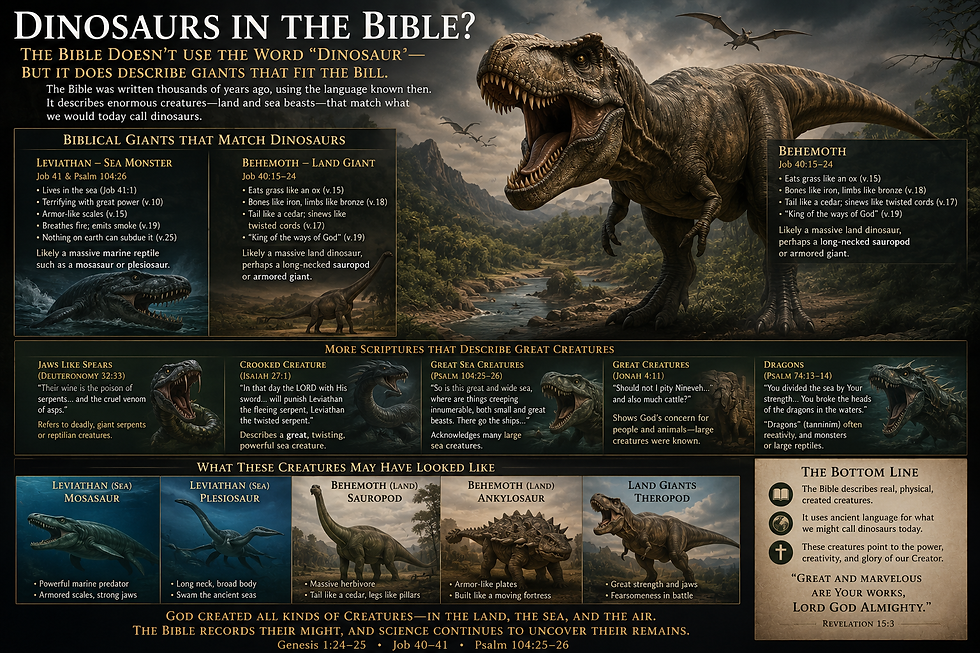
📌The Bible does not use the modern term “dinosaurs,” since it was coined in the 19th century. Instead, ancient Hebrew and Greek texts describe animals using broader categories such as “beasts,” “creatures,” or specific descriptive names that do not directly map onto modern biological classification.
👉Because of this, some readers and creationist interpreters suggest that certain passages may describe large or unfamiliar creatures that could be consistent (in description, not identification) with dinosaurs or other extinct animals.
Christian interpretations vary:
👉 In all views, dinosaurs are generally understood as part of God’s created world, not outside it.
📖 Key Biblical Passages Often Discussed
🐘 Behemoth (Job 40:15–24)
This is the most commonly cited passage in discussions of “possible dinosaur references.”
Described as a massive land creature
“Bones like bronze tubes” and “limbs like iron rods”
Feeds on vegetation like an ox
Described as extremely powerful and difficult to overpower
📌 Some interpret this as a poetic description of a large known animal (such as a hippopotamus or elephant), while others suggest it could reflect memory or description of an unknown large creature.
🐉 Leviathan (Job 41; Psalm 104:26; Isaiah 27:1)
Leviathan is described as a powerful sea creature with dramatic imagery:
Cannot be easily captured or subdued
Described with strong, fearsome characteristics
Associated with the sea and chaos imagery in poetic texts
In Job 41, it is portrayed with armor-like scales and immense strength
📌 Interpretations vary widely:
Some see it as symbolic language for chaos or evil
Others suggest it may reflect a large marine animal (like a crocodile or whale)
A minority view proposes it could resemble unknown prehistoric marine creatures
🦅 “Great Sea Creatures” (Genesis 1:21)
“So God created the great sea creatures…”
Hebrew term tanninim can refer broadly to large sea animals or serpentine creatures
📌 This term is general and does not identify a specific species.
🐾 “Beasts of the Earth” (Genesis 1:24–25)
Refers broadly to land animals created by God
Not specific in classification
Sometimes discussed in relation to “created kinds” frameworks
🧠 Important Context
👉Mainstream biblical scholarship generally understands these passages as:
poetic or symbolic descriptions
references to known ancient animals (hippopotamus, crocodile, whales, etc.)
theological imagery rather than zoological classification
👉However, within some creationist interpretations:
Behemoth and Leviathan are sometimes viewed as descriptions of unknown or extinct large creatures, potentially consistent in appearance with dinosaurs or prehistoric animals
These interpretations are speculative and not universally held
📌 Summary
While the Bible does not explicitly describe dinosaurs, it does contain vivid descriptions of large and powerful creatures. Some readers interpret these passages symbolically, while others suggest they may reflect encounters or traditions involving animals that resemble what modern science classifies as extinct prehistoric species.

Comments