
Can We Trust the Bible? — Part 1 of The Bible Under Fire Series: Lost Books, Corruption & Translations
Note: Due to margins from the dropdown list, this blog is easier to read on tablet or computer.
The Bible Under Fire: A Six Part 50+ Objection & Question Series
Many people today aren’t rejecting truth—they’re searching for it.
→Through spirituality.
→Through philosophy.
→Through science.
→Through skepticism.
→Through religion.
→Through psychedelics
→Through consciousness and modern spiritual movements.
At the same time, many Christians believe the Bible is true—but struggle to explain why in a way that stands up to difficult questions.
→Questions about suffering.
→Contradictions.
→Lost books.
→Science.
→Hell.
→God’s jealousy and wrath.
→The divinity of Jesus.
→The reliability of Scripture.
→And whether Christianity has been distorted over time.
This series was created as a reference resource examining more than 50 of the most common objections to the Bible and Christianity—including historical claims, manuscript evidence, philosophical objections, modern spiritual ideas, and major controversies surrounding Christian belief.
The goal is not blind belief or blind skepticism.
It is to examine the evidence honestly, carefully, and in context.
I once thought I had done enough research to dismiss the Bible entirely. But when I dug deeper, I encountered historical evidence and arguments I could not easily explain away. That journey forced me to rethink many assumptions I once held with confidence.
You're invited to examine the evidence for yourself and come to your own conclusions.
📚 Full Series Index Overview
Part 1 — Can the Bible Be Trusted?
Bible corruption
translations
contradictions
Nicaea
King James
lost books
eyewitnesses
canon formation
Part 2 — Moral Objections to God & the Bible
suffering
hell
slavery
homosexuality
violence in the Old Testament
free will
animal sacrifices
Part 3 — Denominations, Hypocrisy & Religious Systems
Catholics
Jehovah’s Witnesses
Mormonism
Ethiopian Bible
hypocrisy
oppression
religious violence
Part 4 — Science, Evolution, The Flood & Paganism
pagan claims
Christmas/Easter objections
evolution
the flood
Genesis
dinosaurs
Part 5 — Who Was Jesus Really?
Jesus as God
manifestation
Christ consciousness
The Trinity
“Jesus was just a teacher”
getting his name right
Gnosticism
the lost years
the jealous God
"but Jesus said"
Part 6 — Faith, Truth & Spirituality
why the deep feeling something is wrong with the Bible
faith and evidence
what happened to the apostles
resurrection
myth theory
“truth within”
all religions lead to God
hiddenness of God
sin is an illusion
the Bible suppresses spiritual awakening
Paul is a fake apostle
series conclusion
Part 1 —
Translations, Lost Books, Contradictions & Corruption: Can We Trust the Bible?

Few books in history have been more criticized, challenged, or debated than the Bible.
Some say it has been corrupted through translation. Others claim powerful rulers manipulated it for control. Many believe the “real” books of the Bible were hidden, removed, or rewritten over time.
And even many Christians struggle to answer questions about contradictions, lost books, manuscript evidence, and whether the Gospels can truly be trusted.
So what does the evidence actually show?
This first article out of the series examines some of the most common objections surrounding the reliability of the Bible—including translations, canon formation, alleged contradictions, eyewitness testimony, the Council of Nicaea, and claims that Scripture was altered by political powers.
The goal is not blind belief or blind skepticism.
It is to examine the evidence honestly, carefully, and in context.
🧠 Quick Definitions (for clarity)
Manuscripts → handwritten copies of ancient texts
Textual variants → differences between copies
Textual criticism → comparing manuscripts to recover original wording
Scripture → sacred writings regarded as inspired by God and authoritative for faith
Canon → the recognized books of Scripture
AD → after death of Jesus Christ—we mark our current year from this event
Sin → Anything that goes against God’s nature, will, or commands
Repent → A deliberate turning away from sin and turning toward God—resulting in a real change of mind, heart, and direction.
1. Is the Bible historically reliable, or has it been corrupted over time?
💬Short answer:
The facts do not leave much room for dispute, if any—The Bible is one of the most well-preserved ancient texts in existence, and its original content can be reconstructed with very high confidence. With thousands of manuscripts that overwhelmingly agree, variations are minor and don’t affect core teachings. Archaeology consistently confirms its people, places, and events.
📋Expanded:
📜Manuscript evidence:
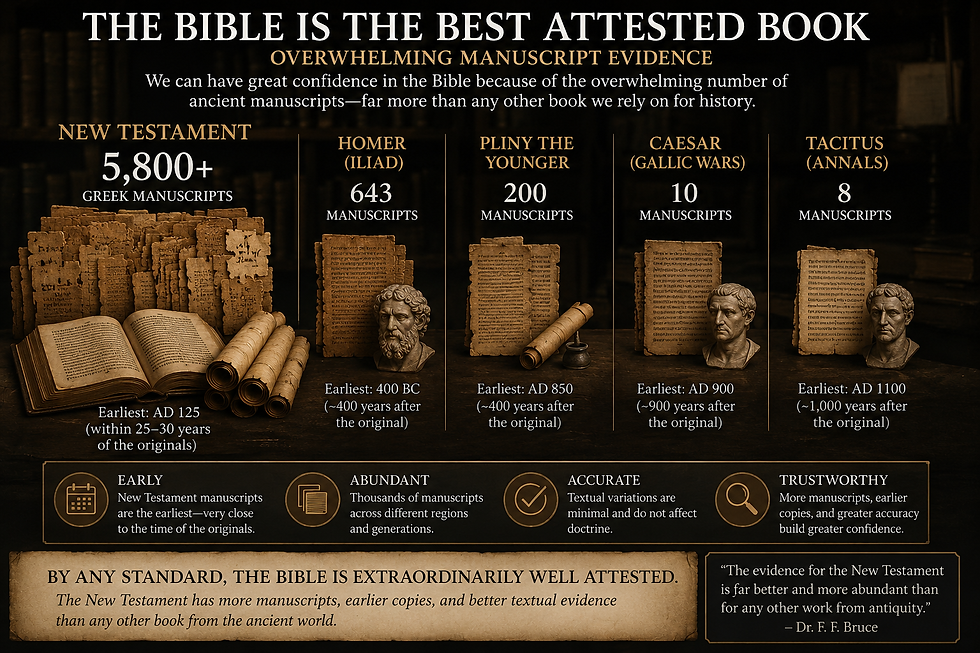
~5,800+ Greek New Testament manuscripts
~25,000+ total manuscripts
Earliest fragments (~125–150 AD)
📊Comparison:
The Iliad → ~600 manuscripts (~400-year gap)
Plato → ~7 manuscripts (~1,200-year gap)
Julius Caesar → ~10 manuscripts (~1,000-year gap)
Tacitus → ~20 manuscripts (~800–1,000-year gap)
⚠️Why the Iliad matters
The Iliad is also famous not just for its story, but for how well it has been preserved. It survives in hundreds of ancient manuscripts (including papyri and medieval copies), which is unusually high for a work of that age. This large manuscript tradition allows scholars to compare copies and reconstruct the text with relatively high confidence.
📌When people talk about the Iliad having an exceptional number of manuscripts, remember this:
The New Testament has far more surviving manuscripts overall (thousands in Greek alone, plus many in other languages), making it the most well-attested ancient text in terms of sheer quantity.
Compared to other ancient works (like those of Plato or Aristotle), both the Iliad and the New Testament stand out dramatically.
The Iliad has ~600 manuscripts vs. The Bible at ~25,000+
👉Why this comparison comes up
This comparison is often used in discussions about textual reliability:
If scholars trust the general stability of the Iliad based on its manuscript evidence,
then, by comparison, the New Testament—with even more extensive evidence—has a very strong textual foundation as well.
🛑What about “corruption”?
Yes—there are 300,000–400,000 textual variants amongst the manuscripts.
⚠️But:
Most are spelling or grammar differences
Many are repeated across manuscripts
No core doctrine depends on a disputed passage
📚Scholarly conclusion (Metzger; Wallace):
The original text can be reconstructed with ~95–99% confidence
👉 Why this matters:
This doesn’t prove the Bible is true—but it shows we are reading what was originally written with high accuracy. And the Bible has far more copies and earlier copies than any text we trust for history.
📖Key takeaway:
The question is not “has it changed?”—all ancient texts have variants.
The real question is:
👉 “Can we recover the original message?”
And in the case of the Bible, the answer is yes, with extremely high confidence.
✍️”The grass withers, the flower fades, but the word of our God will stand forever.” -Isaiah 40:8
2. It’s been translated through too many languages, how could it be accurate?
💬Short answer:
Modern Bibles are translated directly from the earliest available Hebrew, Aramaic, and Greek manuscripts—not from other translations. While wording can vary slightly between versions, the meaning remains consistent, and no core teaching is affected.
📋Expanded:
📜What are modern translations based on?
Modern Bible translations are not copied from other translations (like a game of “telephone”). They are translated directly from:
Hebrew (Old Testament)
Aramaic (small portions of the Old Testament)
Greek (New Testament)
📚These come from critical editions like:
Biblia Hebraica Stuttgartensia (Hebrew Bible)
Nestle-Aland Novum Testamentum Graece (Greek New Testament)
👉 These are compiled using thousands of ancient manuscripts to reconstruct the original wording as accurately as possible.
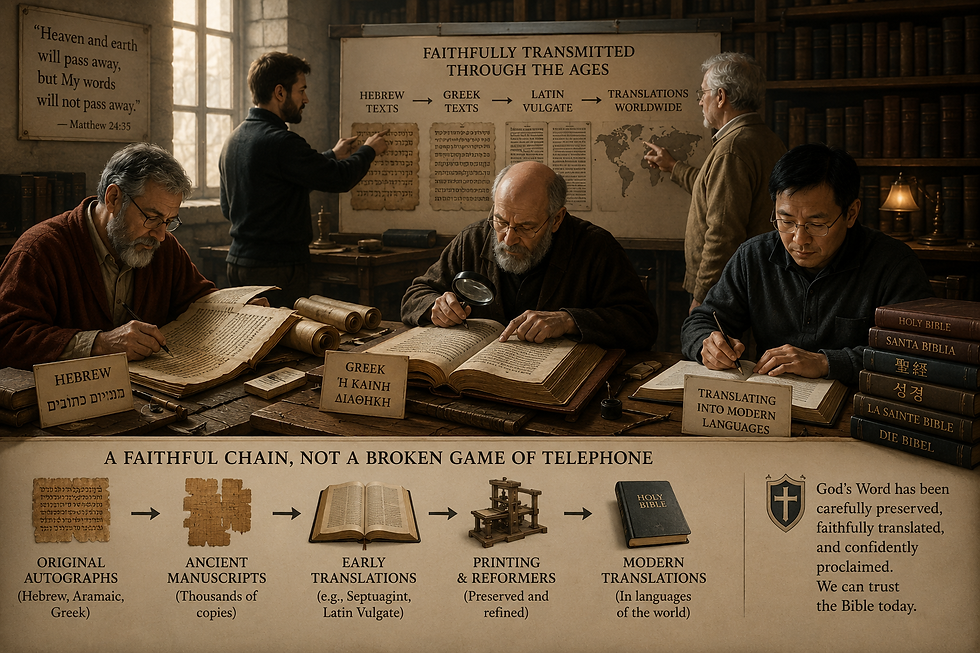
📊Common misconception: “It’s been translated over and over”
🚫False idea:
Original → Latin → English → Modern English (stacked translations)
✅Reality:
Original languages → Modern English (direct translation)
👉 Each major translation goes back to the earliest sources available, not previous English versions.
📖Key takeaway:
The Bible has not been passed down through layers of unreliable translations.
👉 It has been carefully translated from ancient source texts using rigorous scholarship.
So the real question becomes:
👉 “Are modern translations faithful to the original manuscripts?”
And based on mainstream scholarship—the answer is yes.
✍️”Forever, O Lord, your word is firmly fixed in the heavens.” -Psalm 119:89
3. Why are there so many different versions/translations of the Bible?
💬 Short answer:
Different Bible translations exist to faithfully express the original Hebrew, Aramaic, and Greek Scriptures in different styles of modern language. While wording may vary, reliable translations are based on the same ancient manuscripts, and the core message and doctrines remain consistent.
📋 Expanded:
📜 Why do multiple translations exist?
The Bible was originally written in:
Hebrew (Old Testament)
Aramaic (small portions)
Greek (New Testament)
👉 Since most people today do not read these languages, translation is necessary so the original meaning can be clearly understood across cultures and time.
📊 Different translation styles (not different meanings)
⚖️ Main approaches:
Formal equivalence (word-for-word): Closely follows original wording and structure
Dynamic equivalence (thought-for-thought): Focuses on conveying meaning clearly in modern language
Paraphrase: Restates ideas in simplified or expanded modern wording
👉 These are translation philosophies, not competing messages.
🛑 Do different translations change what the Bible teaches?
❌ Common assumption:
“Different wording means different doctrine”
✅ Reality:
Major Bible translations are based on the same manuscript tradition
Differences are usually linguistic expression, not theological content
Core doctrines (God, Jesus, salvation, resurrection, sin) remain unchanged across all reliable translations
👉 You will not find a credible translation that fundamentally changes the Christian message.
📖 Example of variation
One translation may say: “Love is patient”
Another may say: “Love shows patience”
👉 Same idea, same doctrine—just different wording choices.
📚 Why variation can actually help understanding
Different translations can:
Highlight subtle meanings in the original languages
Help clarify difficult or poetic phrases
Provide cross-reference notes where wording is debated
👉 Instead of reducing reliability, this actually helps reveal depth and nuance in the original text.
📜 What are translations based on?
Modern translations are built from:
Thousands of ancient manuscript copies
Careful textual comparison (Textual Criticism)
Established academic reconstruction of the earliest available texts
👉 Translators are not inventing new content—they are working from the same source material with high consistency across manuscripts.
📌 Why updated translations are necessary
Languages naturally change over time.
👉 Words that meant one thing centuries ago may shift in meaning today, so updated translations:
Preserve accuracy
Improve readability
Reduce misunderstanding caused by archaic language
📚 Scholarly conclusion:
📖 Bruce Metzger: Translation differences do not affect essential Christian doctrine
📖 Daniel Wallace: Variations reflect language and style choices, not changes in meaning
📖Key takeaway:
Different Bible translations do not mean different messages.
👉 They exist to communicate the same original revelation clearly and faithfully across languages, cultures, and time.
So the real question is not: “Why are there so many translations?”
⚠️But: “Are these translations faithfully reflecting the original manuscripts?”
And based on manuscript evidence and scholarly consensus—the answer is yes.
👉 From the beginning, Scripture was meant to be understood—not obscured by language barriers.
✍️ “They read from the Book of the Law of God, making it clear and giving the meaning so that the people understood what was being read.” -Nehemiah 8:8
4. Who decided which books belong in the Bible?
💬Short answer:
Documented history and preserved manuscripts show that the books of the Bible were not arbitrarily chosen by a corrupt council or king. The early church recognized books that were already widely accepted as authoritative—based on apostolic connection, consistency with known teaching, and widespread use. The Council of Nicaea did not decide the Bible’s contents, and king James did not alter its message—he commissioned a translation from existing manuscripts.
📋Expanded:
📜How were the books of the Bible recognized?
The “canon” (official list of books) developed over time as early Christians identified writings that carried divine authority.
📌Key criteria used by the early church:
Apostolic connection (written by apostles or close companions)
Consistency with established teaching (no contradictions)
Widespread usage across churches
Early origin (close to the time of eyewitnesses)
👉 These weren’t random decisions—they reflected what believers were already using and trusting.
⚠️Important distinction:
📊Recognition vs. invention
🚫False idea:
Church leaders created or voted in the books of the Bible
✅Reality:
Church leaders recognized books that were already functioning as Scripture
👉 By the late 2nd century, the core of the New Testament—especially the four Gospels, Acts, Paul’s letters, and several other books—was already widely recognized as authoritative, though a few books remained disputed until later.
📊Strong historical resources:
1. The Muratorian Fragment (c. AD 170–200)
Often considered the earliest surviving canonical list. It includes most of the New Testament books (though a few were still disputed). It shows a substantial core was already recognized.
2. Irenaeus of Lyons (c. AD 180)
In Against Heresies he strongly affirms:
The four Gospels (and only four)
Acts of the Apostles
Most of Pauline Epistles
Several General Epistles
Book of Revelation
This is huge evidence for widespread recognition of a core canon.
3. Justin Martyr (c. AD 150–165)
Describes Christian worship where the “memoirs of the apostles” (Gospels) were read alongside the prophets—showing these writings were functioning as Scripture very early.
4. Tatian and the Diatessaron (c. AD 160–175)
Combines Matthew, Mark, Luke, and John into one harmony—strong evidence the fourfold Gospel was established.
Excellent scholarly books to cite:
Bruce Metzger — The Canon of the New Testament
F. F. Bruce — The Canon of Scripture
Michael Kruger — Canon Revisited
Lee Martin McDonald — The Formation of the Biblical Canon
Early Christian Witnesses to a Recognized New Testament Core
1. Irenaeus of Lyons (c. AD 180)
Against Heresies 3.11.8
On the four Gospels:
“It is not possible that the Gospels can be either more or fewer in number than they are… there are four…”
This is one of the clearest 2nd-century affirmations that Matthew, Mark, Luke, and John were already uniquely recognized.
He also cites or alludes to:
Acts
Romans
1–2 Corinthians
Galatians
Ephesians
Philippians
Colossians
1–2 Thessalonians
1–2 Timothy
Titus
1 Peter
1–2 John
Revelation
⚠️That is most of the New Testament.
2. Justin Martyr (c. AD 155)
First Apology 67
“The memoirs of the apostles or the writings of the prophets are read…”
“Memoirs of the apostles” refers to the Gospels, being read in worship alongside Old Testament Scripture, implying scriptural authority.
3. Tertullian (c. AD 200)
Against Marcion 4.5
Defending the four Gospels:
“We lay it down as our first position, that the evangelical Testament has apostles for its authors…”
Shows the Gospels already treated as authoritative apostolic writings.
4. Muratorian Fragment (c. AD 170–200)
The surviving list includes:
Four Gospels
Acts
13 Pauline letters
Jude
1–2 John (likely)
Revelation
⚠️That is remarkably close to the modern New Testament.
👉Scholars often call it the earliest surviving canon list.
📌Long before church councils formally recognized the canon, the core New Testament was already functioning as Scripture. By the late second century, writers like Irenaeus, Justin Martyr, and the Muratorian Fragment show that most New Testament books were already widely recognized and used in the churches. Councils later affirmed what Christians had largely received, rather than inventing the canon.
✍️F. F. Bruce:
“The New Testament books did not become authoritative because they were formally included in a canonical list; the church included them because it already regarded them as inspired.”
✍️Bruce Metzger:
“The canon was not so much imposed by councils as recognized by them.”
-4.1 What about the Council of Nicaea (325 AD)?
The Council of Nicaea is often misunderstood.
⚠️Common claim:
“Nicaea decided the books of the Bible”
✅Historical reality:
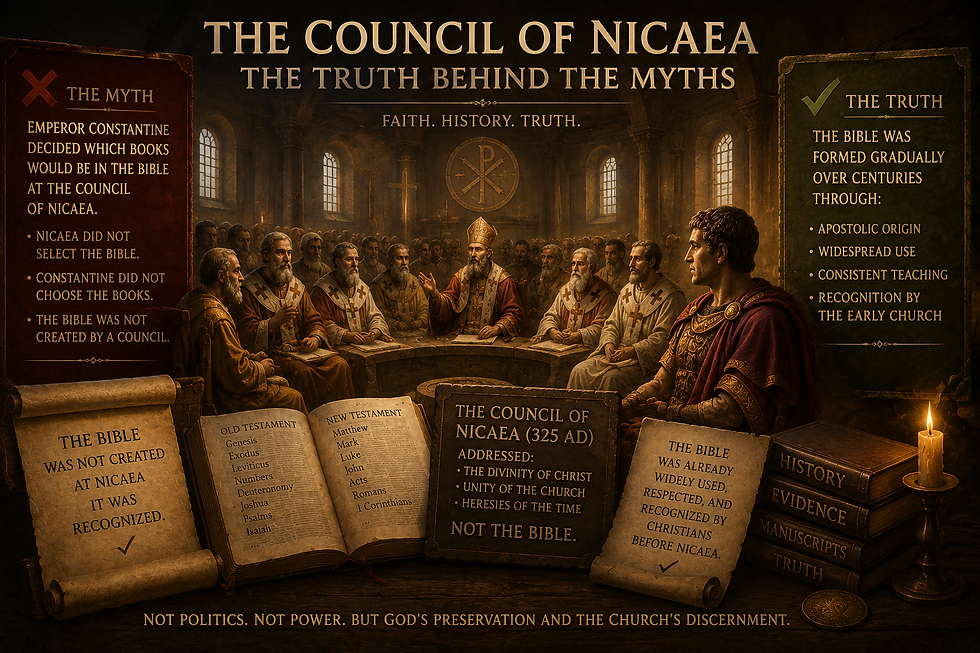
Nicaea addressed the nature of Christ (Arian controversy)
It did not determine the biblical canon
No records from the council discuss selecting books of the Bible
👉 The canon was largely recognized before and independently of Nicaea.
📊The surviving historical records from the Council of Nicaea are actually pretty clear—and they don’t support the popular idea that the council decided the Bible or removed books.
📌Here’s what the documents and primary sources show:
📜 1. The official decisions (the canons)
The council produced about 20 canons (church rules) dealing with things like:
Church leadership structure
Qualifications for bishops
Handling disputes and discipline
Readmitting people who had denied the faith under persecution
👉 None of these canons mention choosing, removing, or editing books of the Bible.
📖 2. The Nicene Creed (main outcome)
The central theological result was the Nicene Creed, which addressed the nature of Jesus Christ.
It affirmed that Jesus is:
“Begotten, not made”
Of the same essence (homoousios) as the Father
👉 This was in response to the teachings of Arius (the Arian controversy), not a debate about Scripture.
📚 3. Writings from people who were there
We have accounts from early church historians and participants of the council of Nicaea, including:
Eusebius of Caesarea
Athanasius of Alexandria
Their writings describe:
The debate over Christ’s nature
The emperor’s involvement in calling the meeting
The outcome of the creed
👉 None of them report any discussion about selecting or rejecting biblical books.
📂4. What’s missing is important
There are no surviving records from Nicaea that:
List biblical books
Show a vote on Scripture
Suggest books were removed or add
👉 For such a major decision, this absence is significant—especially since other council decisions were carefully recorded.
📚 Scholarly consensus:
Across mainstream historians (religious and secular alike):
👉 The Council of Nicaea:
Did address: the nature of Christ
Did NOT address: the biblical canon
📖 Key takeaway:
The actual documents from Nicaea show a council focused on who Jesus is—not what books belong in the Bible.
👉 The idea that Nicaea “created” or “edited” the Bible isn’t supported by any primary historical records.
-4.2 Did the council of Nicaea set the belief that Jesus is God?
⚠️Did Nicaea invent the divinity of Jesus?
📌Historical evidence shows that belief in the divinity of Christ existed long before 325 AD. Early Christian writers like Ignatius of Antioch (c. 35–107 AD) explicitly referred to Jesus as God in his letters.
Archaeology also supports this:
The Megiddo mosaic (3rd century) contains a dedication referring to Jesus as God, predating Nicaea.
The Alexamenos graffito (c. 200 AD) depicts a crucified figure being mocked as a god, suggesting that even critics of Christianity understood that Christians worshipped Jesus.
👉In summary: The Council of Nicaea did not invent new beliefs about Jesus. Rather, it clarified and formally articulated what many Christians already believed, in response to serious theological disagreement. Drawing on scripture and longstanding teaching, the council helped define what would become orthodox Christian doctrine.
-4.3 What about Emperor Constantine?
Constantine the Great:
Called the council to unify the church
Supported its conclusions
Commissioned copies of Scripture afterward
👉 But there’s no evidence he:
Chose which books made up the Bible
Suppressed alternative gospels
Edited Scripture content
🛑“Did Constantine convert to Christianity for the wrong reasons?
💬Short answer:
It’s possible. Records show Constantine’s conversion appears to have been a gradual process influenced by a claimed experience before battle, but even if his motives were mixed, that does not undermine the truth of Christianity or the reliability of the Bible. Scripture itself teaches that God works through imperfect people and most often chooses to do so.
📋Expanded:
📌What actually happened historically
Before a major battle in AD 312 (Battle of the Milvian Bridge), Constantine reported:
A vision or sign associated with Christ
Instructions to mark his soldiers’ shields with a Christian symbol (Chi-Rho)
👉 After winning, he attributed victory to the Christian God.
📌This is the origin of the claim:
“He converted because he won a battle.”
🛑Was his conversion instant and complete?
👉 Likely not—similar to most people.
Historical evidence suggests:
He continued to grow in understanding over time
He supported Christianity politically
He was only baptized later in life (common in that era)
👉 His faith appears to be:
Gradual, not momentary perfection.
🛑Common objection: “He converted for power”
Some argue:
He used Christianity to unify the empire
His motives were political
📌Reality:
The empire was still largely pagan at the time
Aligning with Christianity was not the obvious “power move” early on
He ended persecution of Christians (Edict of Milan, 313)
👉 Even if political factors existed, they don’t fully explain his actions.
📌Important: Constantine did NOT create Christianity
👉 By the time of Constantine:
Christianity had already spread across the Roman Empire
The New Testament writings were already in circulation
Core beliefs (like the resurrection and divinity of Christ) were already established
👉 He influenced the legal status of Christianity—not its origin or message.
🛑What about his character?
Constantine was:
A Roman emperor
A political and military leader
A man with flaws (like all men)
👉 He made decisions that are criticized:
Violence in warfare
Complex political actions
📌This is important:
The Bible never teaches that leaders must be morally perfect to be used by God.
📌Biblical pattern:
⚠️God uses imperfect people
Throughout Scripture:
David → committed serious sin, still used by God
Solomon → flawed leadership later in life
Peter → denied Jesus, later redeemed and became a leader
👉 God’s work is not dependent on human perfection.
✍️ “…My grace is sufficient for you, for My strength is made perfect in weakness...” -2 Corinthians 12:9
📌Mixed motives don’t invalidate truth
📖 Philippians 1:15–18
Paul acknowledges some preach Christ from wrong motives—but still affirms the message.
👉 The truth of Christianity does not depend on the purity of every person who supports it.
📌Why this objection doesn’t overturn Christianity
Even if someone argues:
Constantine’s motives were imperfect
👉 It does NOT change:
The life and teachings of Jesus
The early eyewitness testimony
The existence of Christianity before Constantine
The content of Scripture
👉 At most, it critiques a political figure—not the truth of the faith.
📊Key clarification:
❌ Claim:
“Constantine’s conversion proves Christianity is manipulated”
✅ Reality:
Constantine entered an already existing movement and supported it politically—he did not create or control its core beliefs.
🌍Why this matters:
This objection often shifts focus from: Christ and early evidence
To: A later political figure
👉 But Christianity stands or falls on:
Jesus
The resurrection
Early testimony
—not Constantine.
📖Key takeaway:
Constantine’s conversion may have been imperfect or gradual, but that aligns with the biblical view of human nature. His story does not undermine Christianity—it reflects the consistent pattern that God works through flawed people.
👉 The real question is not:
“Were Constantine’s motives perfect?”
👉 But: “Was Christianity already true before Constantine—and did he simply respond to it?”
-4.4 Important history leading to the council of Nicaea
By the late 3rd century, the Roman Empire had become too vast and unstable for a single ruler to govern effectively. In response, Emperor Diocletian established the Tetrarchy around 293 AD—dividing imperial authority among four rulers. While this system brought temporary stability, it ultimately broke down, leading to competing claims to power and a series of civil wars.
Amid this conflict, Constantine the Great emerged as a key figure. In 312 AD, he marched toward Rome to confront his rival Maxentius. Their forces met at the Battle of the Milvian Bridge, a turning point in Roman history.
On the eve of the battle, Constantine reportedly had a profound religious experience—an event often associated with the beginning of his conversion to Christianity. Two primary accounts survive:
According to Lactantius, Constantine dreamed that Christ instructed him to mark his soldiers’ shields with the Chi-Rho symbol (formed from the first two Greek letters of “Christ”).
Eusebius of Caesarea later wrote that Constantine saw a vision in the sky—a cross of light accompanied by the words often rendered as “In this sign, conquer.” He also records that Christ appeared to Constantine in a dream, confirming the sign and promising victory.
👉After defeating Maxentius, Constantine, along with his co-emperor Licinius, issued the Edict of Milan, which legalized Christianity and granted religious tolerance throughout the empire.
However, political tensions soon resurfaced. Licinius eventually turned against Constantine, and relations deteriorated—accompanied by renewed, though debated, pressures on Christians in the eastern empire. After years of conflict, Constantine defeated Licinius at the Battle of Chrysopolis, becoming the sole ruler of the Roman Empire.
👉In 325 AD, seeking unity in both church and empire, Constantine convened the First Council of Nicaea in the city of Nicaea. This gathering brought together hundreds of Christian bishops from across the Roman world—likely between 220 and 318—many of whom bore visible scars from earlier persecutions.
👉The council was called to address a major theological dispute sparked by Arius of Alexandria. Arius questioned the nature of Jesus Christ, asking, “Was there a time when the Son was not?” He argued that the Son was created by the Father and therefore not eternal in the same way. His teachings spread widely—reportedly even through songs—fueling division among Christians.
📌In response, the council gathered to clarify this issue. According to later tradition, even Nicholas of Myra (better known as Saint Nicholas) was present—though the famous story of him striking Arius comes from much later sources and is not considered historically certain.
⚠️What is clear is that both sides appealed to scripture as authoritative. The council was not deciding what the Bible was, but using what was already widely regarded as sacred writings to resolve the dispute.
-4.5 Where did the rumours of the council of Nicaea begin?
The idea that the Council of Nicaea “created” or “edited” the Bible didn’t come from the actual historical documents—it developed much later through a mix of speculation, anti-church polemics, and modern media.
📌Here’s where those claims come from:
📜 1. Enlightenment-era skepticism (1600s–1700s)
During the Enlightenment, some writers became highly critical of church authority and tradition:
They questioned miracles, Scripture, and institutional power
Some speculated that church leaders must have shaped or controlled the Bible
👉 These ideas weren’t based on new historical discoveries about Nicaea—they were philosophical reactions against authority.
📚 2. 18th–19th century historical speculation
Before modern textual criticism was fully developed, historians had:
Limited manuscript access
Less clarity on how the canon developed
👉 Into that gap, some speculative theories emerged suggesting:
Councils imposed decisions
Power structures determined Scripture
These ideas often assumed central control rather than demonstrating it from evidence.
🛑 3. Conflating real councils with the wrong purpose
There were real councils that discussed church matters, such as:
Council of Nicaea
Council of Carthage
👉 Over time, people blurred the distinction:
Nicaea (Christology)
Later councils (recognizing canon)
➡️ Result: A simplified—but inaccurate—story that “a council decided the Bible.”
🎭 4. Modern popularizers (books, TV, internet)
This is where the idea really exploded.
A major influence was:
The Da Vinci Code
It popularized claims that:
Constantine controlled the Bible
Books were voted in/out
Alternative gospels were suppressed
👉 The problem: it’s historical fiction, not scholarship—but many people took its claims as fact.
📺 5. Internet, YouTube, and “documentary-style” content
In recent decades, the claim has spread because:
It’s simple and dramatic
It fits a “hidden truth” narrative
It challenges authority (which attracts attention)
👉 Many videos and posts:
Repeat claims without primary sources
Mix partial truths with speculation
Sound confident but lack documentation
📌 6. Why the claim sounds believable
The idea sticks because:
Councils did exist
Church leaders did debate theology
Some books were discussed over time
Men are flawed
The church has done terrible things
👉 So people assume: “If they debated theology, they must have voted on the Bible too.”
⚠️ But that leap isn’t supported by historical records.
📚 What actual historians rely on instead
Primary sources like:
Writings of Eusebius of Caesarea
Writings of Athanasius of Alexandria
Early manuscript evidence and citations
👉 These consistently show:
Nicaea focused on the nature of Christ
The canon developed through widespread recognition—not a single decision
📖 Key takeaway: The “Nicaea created the Bible” idea didn’t come from ancient evidence—it grew out of:
👉 Later skepticism + speculation + modern storytelling—not from the actual records of the council itself.
📚When do we actually see the canon listed?
One of the earliest complete New Testament lists appears in:
Athanasius of Alexandria (367 AD)
Later councils affirmed what was already widely accepted:
Council of Hippo
Council of Carthage
👉These councils didn’t invent the canon—they confirmed it.
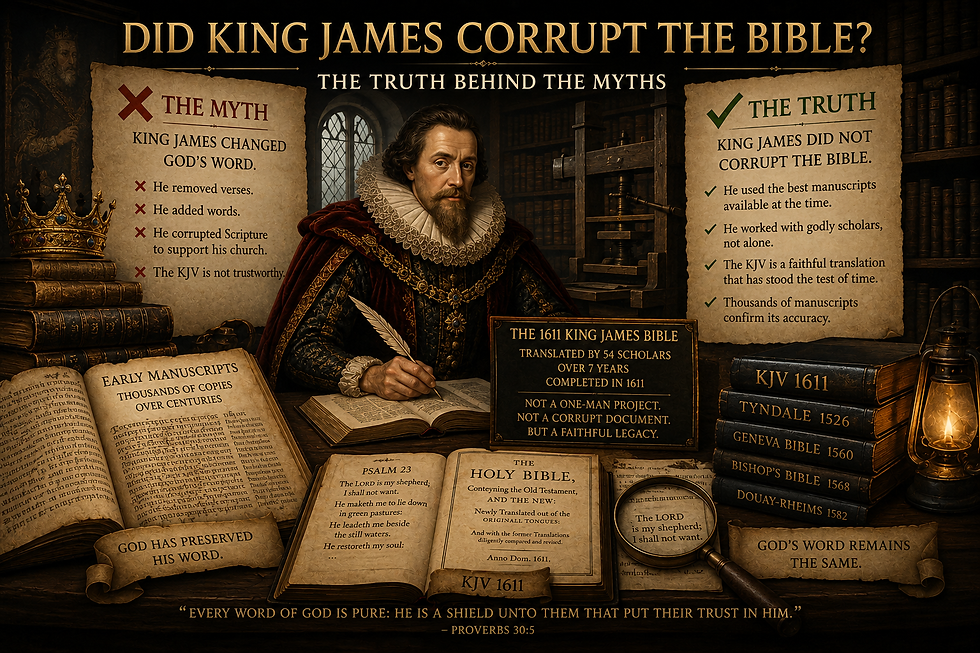
-4.6 What about King James—did he corrupt the Bible?
King James I (early 1600s) authorized the King James Version (KJV).
⚠️Common claim:
“He changed the Bible for political control”
✅Historical reality:
The KJV is a translation, not a rewrite
It was produced by ~50 scholars
It relied on existing Greek and Hebrew manuscripts
Earlier translations (like William Tyndale’s work) heavily influenced it
👉 Modern translations don’t depend on the KJV—they go back to even earlier manuscripts.
📖Biblical evidence of early recognition:
Luke 1:1–4 → shows careful historical sourcing and eyewitness grounding
1 Thessalonians 2:13 → refers to teachings received as the “word of God”
👉 Even within the New Testament, writings were already being recognized as authoritative.
📚Scholarly conclusion:
F. F. Bruce: The canon was not imposed by councils but recognized by the community of believers
Bruce Metzger: The process of canonization reflects widespread agreement, not top-down control
👉 There was no moment where a group “invented” the Bible.
🌍Why this matters:
If the Bible were the result of political manipulation:
We would expect major disagreements in early sources
We would see evidence of forced inclusion/exclusion
We would find radically competing “canons”
👉 Instead, we see remarkable consistency across regions and centuries.
📖Key takeaway:
The Bible’s books were not chosen by a corrupt council or altered by a king.
👉 They were recognized over time based on authorship, consistency, and widespread acceptance.
So the real question becomes:
👉 “Were these writings already trusted as authoritative from the beginning?”
And the historical evidence says yes.
-4.7 Major Councils That Addressed the Canon
📌Several early church councils are often cited when discussing how the biblical canon was recognized. It’s important to understand: these councils did not “create” Scripture—they affirmed and recognized books already widely used in the early Church.
📌Here are the key documented councils:
1. Council of Rome (382 AD)
Associated with Pope Damasus I
Produced one of the earliest known lists matching the modern New Testament (27 books)
Also included Old Testament books (including what Catholics call Deuterocanonical)
👉 Often considered the first formal listing close to the current canon
⚠️They didn’t decide what would be included and excluded, they recognized what was already considered Scripture.
2. Council of Hippo (393 AD)
Regional council in North Africa
Affirmed a canon consistent with Rome (382)
Included 27 New Testament books
👉 Important because it reflects widespread agreement, not a new decision
3. Council of Carthage (397 AD)
Reaffirmed the same canon as Hippo
Clearly listed all 27 New Testament books
Requested confirmation from the Church in Rome
👉 One of the most commonly cited councils for canon recognition
4. Council of Carthage (419 AD)
Reconfirmed earlier recognitions
Reinforced the same canon list again
👉 Shows consistency over time
📌 What about the Old Testament?
This is where differences arise:
Hebrew canon (used by Jews):
Does NOT include the Apocrypha
Greek Septuagint tradition:
Includes additional books (Apocrypha)
👉 Early councils (Rome, Hippo, Carthage) generally followed the broader Greek tradition
📌 Later (Major) Council
Council of Trent (1546)
Roman Catholic council during the Reformation
Formally declared the canon (including Deuterocanonical books)
Response to Protestant rejection of Apocrypha as Scripture
👉 This is the first time the canon was dogmatically defined in response to dispute
📊 Key Clarification
👉 These councils did NOT:
Invent the books
Write the Scriptures
Randomly choose texts
👉 They DID:
Recognize what was already widely accepted
Confirm usage in churches
Respond to disagreements and heresies
🌎 Why this matters
The canon developed through:
Early widespread usage
Apostolic connection
Consistency of teaching
Recognition across regions
👉 The councils reflect confirmation, not creation
📖 Key takeaway:
The biblical canon was not decided in a single moment—it was recognized over time and later affirmed by councils like:
Rome (382)
Hippo (393)
Carthage (397, 419)
Trent (1546)
👉 The real question is not “Who chose the books?”
👉 But “Which books were consistently recognized as authoritative from the beginning—and why?”
✍️”And we also thank God constantly for this, that when you received the word of God, which you heard from us, you accepted it not as the word of men but as what it really is, the word of God, which is at work in you believers.” -1 Thessalonians 2:13
5. What about the excluded books, ‘lost books’ like the gospel of Thomas, the gospel of Mary, or apocrypha?
💬Short answer:
These books were not “removed” from the Bible—they were known but not accepted as Scripture. They lacked apostolic authority, were written later, and often contained teachings inconsistent with the rest of the Bible.
📋Expanded:
📜What are these “lost” or excluded books?
This category usually refers to:
“Gospels” like the Gospel of Thomas or Gospel of Mary or Gospel of Phillip
Writings discovered in places like the Nag Hammadi discovery
The Apocrypha (additional Old Testament-era writings found in some traditions)
👉These were real writings—but not all ancient writings were considered Scripture.
📊Key question: why weren’t they included?
The early church used consistent criteria (same as canon recognition):
🛑They asked:
Was it written by an apostle or close associate?
Is it consistent with known, earlier teaching?
Was it widely used across early churches?
Was it written close to the time of eyewitnesses?
👉 Many of these “lost books” did not meet these standards.
📌1. Apostolic authority
❌Many excluded texts:
Were written in the 2nd–4th centuries
Used the names of apostles, but were not actually written by them
👉 This is called pseudepigraphy (false attribution).
📌2. Date (too late to be eyewitness-based)
✅New Testament books:
Written roughly 40–100 AD
❌Many “lost gospels”:
Written 100–300+ AD
👉 That gap matters—they are removed from the original eyewitness period.
📌3. Consistency of teaching
Many excluded texts (especially Gnostic writings) include ideas like:
Secret knowledge for salvation
A distorted view of creation or the physical world
Teachings that conflict with earlier Scripture
👉 This contradicts the consistent message found across accepted books of the old and new testaments.
📖Example: Gospel of Thomas
The Gospel of Thomas is one of the most frequently cited “lost gospels.”
It is a collection of 114 sayings attributed to Jesus, discovered among the Nag Hammadi discovery.
👉 Unlike the New Testament Gospels, it is not a narrative—it contains no account of Jesus’ life, death, or resurrection.
📌Why wasn’t it included?
🛑1. Late date and lack of eyewitness connection.
Most scholars date Thomas to the 2nd century or later, well after the time of the apostles.
👉 This places it outside the eyewitness period of Jesus’ ministry.
🛑2. False attribution (pseudepigraphy).
It is attributed to Thomas the Apostle, but there is no credible evidence he actually wrote it.
👉 Attaching an apostle’s name was a known practice in later writings to gain authority.
🛑3. Theological differences (Gnostic influence).
Some sayings reflect ideas associated with later Gnostic thought, such as:
Salvation through discovering hidden knowledge
Emphasis on self-discovery rather than repentance
Less focus on sin, grace, and redemption
✍️ Example (paraphrased idea): The kingdom is found by “knowing yourself” and uncovering what is within.
👉 This contrasts with the public, historical message found in the canonical Gospels, where salvation is tied to Jesus’ life, death, and resurrection.
🛑4. Lack of early widespread use.
The Gospel of Thomas was not widely used or recognized across early Christian communities.
👉 It does not appear in early authoritative lists of Scripture and was not consistently treated as such by early church leaders.
📌Key takeaway:
The Gospel of Thomas preserves some interesting early traditions, but:
It is later in date
Not apostolic in origin
And reflects theological developments outside the earliest Christian message
👉 For these reasons, it was not recognized as Scripture.
📖Example: Gospel of Mary
The Gospel of Mary (often associated with Mary Magdalene) is another commonly referenced excluded text. It survives only in partial manuscripts and was likely written in the 2nd century.
📌Why wasn’t it included?
🛑1. Late composition.
Like many apocryphal texts, it was written well after the apostolic period.
👉 This disconnect makes direct eyewitness authorship highly unlikely.
🛑2. Questionable authorship.
Although linked to Mary Magdalene, there is no strong historical evidence she authored the text.
👉 The attribution appears to be symbolic or literary rather than historical.
🛑3. Emphasis on private revelation.
The Gospel of Mary focuses heavily on:
Personal visions
Inner spiritual knowledge
Secret teachings given privately
👉 In the text, Mary receives special revelation not shared openly with the other disciples.
This creates tension with the consistent pattern in the New Testament, where:
Teachings are public
The message is proclaimed openly
Authority is shared among the apostles
🛑4. Reflection of later theological debates.
Some passages portray disagreement between Mary and other disciples (such as Peter), reflecting later disputes about authority and leadership, not the earlier unified apostolic witness.
👉 This suggests the text is engaging with issues that arose after the first century.
🛑5. Limited use and recognition.
The Gospel of Mary was not widely circulated or accepted among early Christian communities.
👉 It was known in some circles but never gained broad recognition as Scripture.
📌Key takeaway:
The Gospel of Mary is valuable for understanding later spiritual movements, but:
It is late
Not tied to verified apostolic authorship
And emphasizes private, esoteric revelation
👉 For these reasons, it was not included in the biblical canon.
📌4. Internal evidence of later origin (names, language, and historical mismatch)
Another important factor scholars point out is that some of these excluded texts show signs of being written outside the time period they claim to represent.
For example:
The names used in the texts sometimes reflect later historical naming patterns
The language style matches later Greek or theological development
The cultural and theological ideas fit better with 2nd–4th century thought, not 1st-century eyewitness context
👉 This creates tension with their claimed authorship.
📌 In other words:
If a text claims to come from an apostle or early eyewitness period, but reflects a much later stage of language, theology, or naming conventions, it raises serious questions about authenticity.
👉 This is one of several lines of evidence used in determining whether a writing is genuinely early apostolic tradition or a later composition attributed to earlier figures.
📌5. Widespread acceptance
✅Canonical books:
Used broadly across different regions (Rome, Asia Minor, Africa, etc.)
Quoted by early church leaders as Scripture
❌Excluded books:
Limited circulation
Not consistently recognized
👉 If something were truly Scripture, we would expect widespread early use.
✍️ “For God is not the author of confusion but of peace…” -1 Corinthians 14:33
🛑What about the Apocrypha?
The Apocrypha (Deuterocanonical books):
Included in some early Greek collections (like the Septuagint)
Valued historically and devotionally by many
Debated in terms of authority
👉 Became a major issue during the Protestant Reformation
⚠️Important:
Not “hidden” or “lost”
Still available and published today
🛑Common claims vs. reality
❌**“These books were removed to control people”**
✅They were never widely accepted as Scripture to begin with
❌**“They contain the real truth the church hid”**
✅They appear later and often contradict earlier, well-attested teachings
❌**“There were many equally valid gospels”**
✅The four Gospels (Matthew, Mark, Luke, John) were consistently recognized early
📚Scholarly conclusion:
F. F. Bruce: Excluded books were rejected because they lacked apostolic authority
Bruce Metzger: The canon reflects early, widespread agreement—not suppression
📖Biblical support:
Jude 1:3 → speaks of “the faith once for all delivered to the saints”
👉 This points to a message that was established early, not gradually replaced by hidden texts.
🌍Why this matters:
If these “lost books” were truly Scripture:
We would expect early, widespread acceptance following the life of Jesus
We would see them quoted alongside other Scripture
We would find consistency with earlier teachings
👉 Instead, we see the opposite.
📖Key takeaway:
The so-called “lost” books were not removed from the Bible—they were evaluated and not recognized as Scripture.
👉 The real question is not: “Were books excluded?”
⚠️But: 👉 “Did these writings meet the same standard as the accepted books?”
And based on historical evidence—the answer is no.
-5.1 What about the Book of Enoch?
The Book of Enoch is often brought up in discussions about “lost” or excluded books. It’s an ancient Jewish work, likely written between the 3rd century BC and 1st century AD, and is attributed to Enoch, a figure mentioned briefly in Genesis.
👉 However, like many other excluded writings, it was not actually written by Enoch himself—this is another example of pseudepigraphy (false attribution).
📌Why wasn’t it included in the Bible?
🛑1. Not written by the claimed author
Although it claims connection to Enoch, the book was written thousands of years after his lifetime.
👉 This alone raises serious questions about its authority.
🛑2. Not widely accepted as Scripture
While the Book of Enoch was known and even respected in some Jewish and early Christian circles, it was not consistently accepted across the broader community.
✅ Most Jewish traditions did not include it in their canon
✅ Most Christian traditions did not recognize it as Scripture
👉 One notable exception is the Ethiopian Orthodox Church, which does include it in its canon.
🛑3. Theological and speculative content
The Book of Enoch contains:
Elaborate stories about angels and their fall
Detailed visions of heaven and judgment
Symbolic and apocalyptic imagery
👉 While interesting, some of these ideas go beyond or differ from the more consistent and restrained teaching found in canonical Scripture.
📖What about Jude quoting Enoch?
The New Testament book of Epistle of Jude (Jude 14–15) appears to reference a passage from Enoch.
👉 But this does not mean the entire book is Scripture.
✍️ Example: Paul quotes Greek poets (Acts 17:28), but that doesn’t make those works Scripture either.
👉 A true statement can be quoted without endorsing the entire source.
📖Key takeaway on Enoch:
The Book of Enoch was:
Known in the ancient world
Influential in some circles
But not recognized as authoritative Scripture by most of Judaism or Christianity
👉 Like other “lost books,” it was evaluated—not hidden—and ultimately not included because it did not meet the same standards as the canonical texts.
✍️”Beloved… I found it necessary to write appealing to you to contend for the faith that was once for all the saints. For certain people have crept in unnoticed who long ago were designated for this condemnation, ungodly people, who pervert the grace of our God into sensuality and deny our only Master and Lord, Jesus Christ.” -Jude 1:3-4
6. How do we know the Gospels are accurate eyewitness accounts?
💬Short answer:
The Gospels were written within the lifetime of eyewitnesses, include specific historical and cultural details, and reflect either direct eyewitness testimony or close sources. They also contain difficult and unflattering details that would be unlikely to be invented.
📋Expanded:
📜When were the Gospels written?
Most scholars date the four Gospels (Matthew, Mark, Luke, John) to roughly:
Mark: ~60–70 AD
Matthew & Luke: ~60–85 AD
John: ~70–95 AD
👉 This places them within the lifetime of eyewitnesses of Jesus’ life and ministry.
📊Why early dating matters
Eyewitnesses were still alive to confirm or challenge accounts
False stories could be easily exposed
The events were still within living memory
👉 This is very different from legends that develop generations later.
📌Eyewitness or close to eyewitness:
Matthew & John → traditionally linked to direct eyewitnesses
Mark → associated with Peter’s firsthand testimony
Luke → explicitly investigated and compiled eyewitness reports
📖As Luke writes (Luke 1:1–4):
He carefully gathered accounts from “those who from the beginning were eyewitnesses.”
👉 This reflects intentional historical reporting—not myth-making.
📖Internal claims of eyewitness testimony
Luke 1:1–4 → careful investigation and orderly account
2 Peter 1:16 → “we were eyewitnesses of his majesty”
John 19:35 → “he who saw it has borne witness—his testimony is true”
👉 The writers explicitly claim to be reporting real events.
📌Inclusion of verifiable details
The Gospels include:
Specific names (people, rulers, locations)
Cultural practices and customs
Geographic accuracy
👉 These details can be (and have been) cross-checked with history and archaeology.
📍Example of historical grounding
Roman officials (like Pontius Pilate)
Jewish customs and festivals
Real cities and regions
👉 The level of detail matches what we expect from real historical accounts.
📌Undesigned coincidences (independent agreement)
Across the Gospels, there are small details that:
Appear incidental
Are explained unintentionally by another Gospel
👉 This kind of interlocking detail suggests independent, truthful accounts—not coordinated fiction.
📌Inclusion of difficult or embarrassing details
If someone were inventing a story, they would likely avoid:
Disciples misunderstanding Jesus
Peter denying Jesus
Women being the first witnesses (in a culture where that carried less legal weight)
The crucifixion itself (a shameful form of execution)
👉 These details strongly suggest authenticity rather than invention.
🛑What about differences between the four Gospels?
❌Claim: “Differences mean the Gospels are unreliable”
✅Reality:
Differences are often about perspective or emphasis
This is expected in independent eyewitness accounts
Core events and message remain consistent
👉 Identical accounts would actually suggest collusion—not authenticity.
📚Support from historical method
In the academic field of Historiography, historians look for:
Early sources
Multiple attestation
Embarrassing details
Cultural accuracy
👉 The Gospels meet these criteria at a high level compared to other ancient sources.
⸻
📚Scholarly perspective:
Richard Bauckham: Argues the Gospels are closely tied to eyewitness testimony
Craig Blomberg: Notes strong historical credibility of Gospel accounts
🌎Why this matters:
If the Gospels were late legends:
We would expect exaggerated mythology over time
We would see major inconsistencies
We would lack early corroboration
👉 Instead, we see early, detailed, and consistent accounts grounded in real history.
📖Key takeaway:
The Gospels present themselves as eyewitness-based accounts—and the historical evidence supports that claim.
👉 The real question becomes:
👉 “Do these documents reflect reliable testimony about real events?”
And based on timing, content, and historical analysis—the answer is yes.
✍️“For we did not follow cleverly devised myths when we made known to you the power and coming of our Lord Jesus Christ, but we were eyewitnesses to his majesty.” -2 Peter 1:16
7. Why are there contradictions in the Bible?
💬Short answer:
Most “contradictions” come from differences in perspective, context, or translation—not actual errors. When examined carefully, the accounts are complementary rather than contradictory.
📋Expanded:
📌What people mean by “contradictions”
Most alleged contradictions fall into a few common categories:
Eyewitness perspective differences
Summary vs. detailed accounts
Different emphasis by different authors
Translation or language nuances
👉 These are normal in any set of independent historical accounts.
📊Eyewitness perspective (not contradiction)
Like multiple witnesses describing the same event:
One may focus on one detail
Another includes additional information
A third emphasizes something else entirely
👉 Different ≠ contradictory
👉 They can all be true at the same time
📌Example (conceptual):
One account mentions one angel at the tomb
Another mentions two angels
❌Not a contradiction
✅One focuses on the speaker; the other includes both present
👉 Reporting fewer details is not the same as denying more details.
📌Summary vs. detail
Some passages summarize events, while others give fuller descriptions.
👉 Example pattern:
One account compresses a timeline
Another expands it with more steps
👉 This is normal in historical writing—not an error.
📌Different emphasis (purpose-driven writing)
Each author writes with a purpose and audience in mind:
One emphasizes Jesus’ authority
Another emphasizes His compassion
Another highlights fulfillment of prophecy
👉 Same events—different focus.
📌Translation and language nuances
The Bible was written in Hebrew, Aramaic, and Greek.
👉 Differences can arise from:
Words with multiple meanings
Idioms that don’t translate perfectly
English wording choices
👉 This is a language issue—not a contradiction in the original message.
🛑What about real contradictions?
This is important:
👉 Many commonly cited “contradictions”:
Ignore context
Compare different parts of a timeline
Assume modern precision in ancient writing styles
📚Careful study usually shows:
They are apparent contradictions, not actual ones
📚Support from historical method
In the field of Historiography:
Independent accounts are expected to vary in detail
Minor differences actually support authenticity
Perfectly identical accounts would suggest copying or collusion
👉 Variation is a sign of independent testimony, not fabrication.
📖Biblical foundation:
Psalm 119:160 → “The sum of your word is truth”
John 17:17 → “Your word is truth”
👉 The claim of Scripture is not that every passage is written the same way—but that the message is true.
🌍Why this matters:
If all accounts were identical:
It would suggest copying
It would weaken credibility as independent testimony
👉 Differences actually strengthen the case for authenticity.
📖Key takeaway:
Differences in the Bible are not evidence of error—they are what we expect from multiple, independent witnesses describing real events.
👉 The real question becomes:
👉 “Do these differences contradict each other—or do they provide a fuller picture?”
And in the vast majority of cases, they complement rather than contradict.
📌 Common “Bible contradictions” and quick explanations
🛑 1. “How many angels were at the tomb?”
Matthew 28:2–7 → one angel speaks
Luke 24:4 → two angels present
💡Answer: One account focuses on the speaking angel; the other mentions both present.
👉 Not contradiction—difference in detail emphasis.
🛑 2. “Did Judas die by hanging or falling?”
Matthew 27:5 → Judas hangs himself
Acts 1:18 → describes his body falling and bursting open
💡Answer: Matthew describes the method; Acts describes the aftermath.
👉 These describe different parts of the same event, not conflicting causes.
🛑 3. “Who carried Jesus’ cross?”
John 19:17 → Jesus carried it
Matthew 27:32 → Simon of Cyrene carried it
💡Answer: Jesus likely started carrying it; Simon was compelled to carry it partway.
👉 Different stages of the same journey.
🛑 4. “Did Jesus cleanse the temple once or twice?”
John 2:13–16 → early in ministry
Synoptics (Matthew/Mark/Luke) → later in ministry
💡Answer: These are commonly understood as two separate events.
👉 No contradiction—two similar actions at different times.
🛑 5. “Was Jesus’ resurrection story different in each Gospel?”
💡Answer: The core message is identical:
Jesus died
Was buried
Rose again
Tomb was found empty
Witnesses encountered Him
👉 Differences are in:
Order of appearances
Who arrived first
Which details are highlighted
📌This is exactly what independent eyewitness reporting looks like.
📚 Why these differences actually strengthen reliability
In the field of Historiography, historians expect:
Multiple eyewitnesses = different perspectives
Independent accounts = variation in detail
Core agreement = historical reliability
👉 The Gospels consistently show:
Agreement on main events
Variation in secondary details
No contradiction in core claims
📖 Key takeaway:
👉 Most “Bible contradictions” come from reading isolated verses without context or expecting modern-style reporting from ancient eyewitness accounts.
When viewed as a whole:
👉 They function more like complementary testimony than conflicting stories.
✍️”The sum of your word is truth, and every one of your righteous rules endures forever.” -Psalm 119:160
8. How do we know the Bible wasn’t just written by men?
💬Short answer:
The Bible was written by human authors, but it displays a one of a kind level of unity, consistency, and interconnected structure across centuries that is difficult to explain as purely human coordination.
📋Expanded:
📌1. Human authorship + historical span
Yes—the Bible was written by human beings.
But it was written by:
~40+ authors
Over ~1,500 years
Across different cultures, regions, and historical settings
In multiple languages (Hebrew, Aramaic, Greek)
👉 Despite this, it presents a remarkably coherent overall narrative:
Creation → Fall → Redemption → Restoration
This raises the question not of whether humans wrote it, but how such coherence developed across so many authors and eras.
📌2. Thematic unity across independent writings
Across the entire Bible, recurring themes appear consistently:
Covenant
Justice and mercy
Human brokenness
Redemption
God’s interaction with history
👉 These themes are developed progressively rather than invented all at once.
⚠️This creates what scholars often describe as a “progressive revelation” structure rather than a disconnected anthology.
📌3. Extensive cross-referencing system
The Bible contains an unusually large internal web of connections:
~63,000+ cross-references (estimates vary by method)
Prophecy ↔ fulfillment connections
Symbolic themes developed across centuries
Narrative links between earlier and later writings
👉 These connections form a complex, interwoven structure rather than isolated writings.
📊Visualizations (like Bible cross-reference maps) show a dense network of links spanning the entire text.

📌Why this matters
These connections are significant because:
Many authors were separated by centuries
They were not working under a single editorial system
Later authors often build on earlier themes rather than contradicting them
👉 This creates a layered continuity that is unusual in ancient literature collections.
📌4. Prophecy and fulfillment
The Bible contains numerous predictive passages that later writers interpret as fulfilled in historical events, particularly in relation to Jesus.
Examples often discussed include:
Messianic expectations in the Old Testament
Narrative correspondences in the life of Jesus
⚠️Note: Interpretation of prophecy is debated academically, but it remains a major internal argument for coherence across the text.
📌5. Textual and historical consistency
Despite being written over centuries, the Bible shows:
Consistent moral and theological framework
Stable narrative direction
Strong continuity in worldview
👉 This is notable when compared to other ancient multi-author collections, which often show more fragmentation over time.
📌6. Transformational and historical impact
Beyond internal structure, the Bible has had:
Major influence on legal systems, ethics, and literature
Global cultural impact across civilizations
Documented personal and societal transformation over centuries
👉 While impact does not prove truth, it does indicate enduring influence across time and cultures.
📚Scholarly perspective (balanced framing):
John Barton: emphasizes the Bible as a complex library of texts with developing theological themes
N.T. Wright: highlights the coherence of early Christian writings around a central historical claim
📖Biblical foundation:
2 Timothy 3:16 → Scripture is “God-breathed”
Hebrews 4:12 → emphasizes the living and active nature of Scripture
📖Key takeaway:
The Bible was written by human authors—but it is not easily explained as a disconnected or purely accidental collection.
👉 The scale of its unity, internal connections, and long-term coherence raises the question of whether there is an organizing source behind the text, rather than only individual human intent.
✍️”All Scripture is breathed out by God and profitable for teaching, for reproof, for correction, and for training in righteousness, that the man of God may be complete, equipped for every good work.” -2 Timothy 3:16-17
9. Why should Christianity be true over other religions? —Especially with the belief that Jesus is the only way to Heaven?
💬Short answer:
Christianity is grounded in a historical claim: the resurrection of Jesus. If Jesus rose from the dead, it confirms His identity and authority, including His claim to be the only way to God. Unlike other religions, Christianity centers on a publicly rooted, historically testable event.
📋Expanded:
📌1. Christianity is rooted in a historical claim, not just philosophy
At the center of Christianity is not just a moral system or spiritual teaching, but a claim about real history:
👉 Jesus of Nazareth was:
Crucified under Roman authority
Buried in a known location
Reported to have risen from the dead
📊This makes Christianity unique among major world religions—it is anchored in a falsifiable historical event.
📌2. The resurrection is the “validation point”
Christianity itself makes a clear argument:
📖1 Corinthians 15:14 → “If Christ has not been raised, our preaching is useless…”
👉 In other words:
If the resurrection didn’t happen → Christianity collapses
If it did happen → it confirms Jesus’ identity and message
📌This is why the resurrection is central, not optional, to Christian belief.
📌3. Why the resurrection claim is taken seriously historically
From a historical perspective, several widely discussed facts are often considered:
Jesus’ death by crucifixion is strongly supported historically
The disciples’ sudden shift from fear to bold proclamation
Many disciples willingly being tortured and killed for their belief and testimony of Jesus’ resurrection
The early emergence of resurrection belief in the same city it occurred
The growth of the early church despite persecution
Early proclamation in the lifetime of eyewitnesses
👉 These are the kinds of data points historians analyze when evaluating the claim.
📌4. Eyewitness-based proclamation
The early Christian message wasn’t abstract—it was a testimony:
1 Corinthians 15:3–8 → lists named witnesses to the resurrection
The book of Acts consistently presents public proclamation of this claim
👉 Christianity begins not with “ideas about God,” but with “something happened.”
📌5. Why exclusivity (“the only way”) follows the claim
Jesus’ statement in John 14:6:
👉 “I am the way, the truth, and the life. No one comes to the Father except through me.”
If the resurrection is true, then Christians argue:
Jesus’ authority is confirmed
His claims about Himself are validated
His teaching carries final weight
👉 That includes His claim to be the unique mediator between God and humanity.
📌6. Comparison with other world religions
Most major religions are centered on:
Philosophical teachings
Moral frameworks
Spiritual enlightenment
Prophetic traditions
👉 Christianity is distinct because it claims:
A specific person entered history
Died publicly
Rose bodily from the dead
And that event changes everyone’s standing before God
📌7. Why this claim is testable in a way others aren’t
Christianity invites investigation:
Did Jesus die?
Was the tomb empty?
Did the early movement begin based on resurrection belief?
How do we explain the rise of the early church?
👉 It is not presented as blind faith, but as a claim tied to historical reality.
📖Biblical foundation:
John 14:6 → Jesus claims exclusivity as the way to God
Acts 4:12 → “No other name under heaven given…”
1 Corinthians 15:14 → Christianity stands or falls on the resurrection
🌍Why this matters:
If the resurrection is false:
Christianity becomes just another moral philosophy
The claim of exclusivity loses its foundation
But if the resurrection is true:
It confirms Jesus’ identity
It validates His teachings
It makes His claim about being the only way coherent within the system itself
📖Key takeaway:
Christianity is not primarily asking for belief in a system—it is asking for belief in a historical event.
👉 And if that event is true, it fundamentally changes how all other religious claims are evaluated.
✍️”Jesus said to him, ‘I am the way, and the truth, and the life. No one comes to the Father except through me.” -John 14:6
10. Why does the New Testament never denounce other religions if Jesus is the only way to God?
💬Short answer:
The New Testament does make exclusive truth claims about Jesus, but it usually addresses beliefs indirectly by proclaiming truth rather than listing and attacking every religion by name. It focuses on who Jesus is—and by doing so, it naturally challenges all alternative paths.
📋Expanded:
📌The New Testament DOES make exclusive claims
The Bible is actually very clear:
📖 John 14:6
“I am the way and the truth and the life. No one comes to the Father except through me.”
📖 Acts 4:12
“There is no other name… by which we must be saved.”
📖 1 Timothy 2:5
“There is one God and one mediator… Christ Jesus.”
👉 These are not inclusive statements—they are exclusive by definition.
🛑Why other religions aren’t named one by one
📌1. It addresses categories, not just names
Instead of listing religions, the New Testament addresses types of belief:
⚠️Idolatry (false gods)
📖 Romans 1:22–23 → exchanging God for created things
⚠️Works-based righteousness
📖 Galatians 2:16 → not justified by works of the law
⚠️Philosophical systems
📖 Colossians 2:8 → human tradition vs truth
👉 These categories cover all belief systems—not just specific labels.
📌2. It directly challenges Judaism where necessary
The New Testament does confront the dominant religion closest to it:
🥊Religious leaders are corrected
📖 Matthew 23 → Jesus rebukes hypocrisy and legalism
🥊Salvation not through law alone
📖 Romans 3:28
👉 So it’s not avoiding confrontation—it addresses what’s relevant.
📌3. The approach: proclaim truth, let it confront everything
Instead of saying:
“Religion A is wrong, Religion B is wrong…”
The New Testament says:
👉 “Here is the truth about God, sin, and salvation.”
📌By definition:
If one way is true, conflicting ways cannot all be true.
👉 Truth excludes error—even if not named individually.
🌍Why this matters:
This objection assumes:
Truth must directly name all alternatives
Religious neutrality unless specified
But the New Testament:
Makes universal truth claims
Addresses root issues behind all belief systems
Applies across cultures—even those unknown at the time
📖Key takeaway:
The New Testament doesn’t list every religion by name because it doesn’t need to. It proclaims who Jesus is and how salvation works—and that claim, by definition, challenges every alternative belief system.
👉 The real question is not “Does it name every religion?”
👉 It is “Are its claims about Jesus true—and what follows if they are?”
✍️ “For the time will come when they will not endure sound doctrine, but according to their own desires, because they have itching ears, they will heap up for themselves teachers; and they will turn their ears from the truth, and be turned aside to fables.” -2 Timothy 4:3-4
Comments