
The Jealous & Evil God vs Jesus: Part 5 — Gnosticism, Christ Consciousness, Manifestation & The Trinity
Note: Due to margins from the dropdown list, this blog is easier to read on tablet or computer.
→Why would an all-powerful God describe Himself as “jealous”?
→Why would Jesus say we will do greater things than He?
→Was the God of the Old Testament truly good, or could He be a lesser or corrupted being as some ancient Gnostic groups believed?
⚠️Was Jesus an enlightened teacher pointing people toward inner divinity and higher consciousness rather than salvation through Himself?

👉Spirituality often explores Jesus through concepts such as manifestation, Christ consciousness, the law of attraction, self-realization, and mystical enlightenment.
👉At the same time, many people are drawn to deeper questions about the Trinity, the identity of Jesus, the so-called “missing years” of His life, and statements where He speaks about believers doing “greater works.”
👉This article takes a closer look at these themes by exploring both ancient Gnostic ideas and modern spiritual interpretations, alongside the historical and biblical claims surrounding the identity and message of Jesus.
In This Article
How could an all-powerful God be jealous?
Were the Gnostics right about God?
Was Jesus just an enlightened teacher?
Did Jesus come to teach Christ consciousness?
Why is there missing years in the Bible of Jesus’ life?
Why does Jesus say we will do greater things than He did?
Did Jesus teach manifestation and law of attraction?
Is Jesus his name or is it Yeshua? or Yahweh?
🧠 Quick Definitions (for clarity)
Manuscripts → handwritten copies of ancient texts
Textual variants → differences between copies
Textual criticism → comparing manuscripts to recover original wording
Scripture → sacred writings regarded as inspired by God and authoritative for faith
Canon → the recognized books of Scripture
AD → after death of Jesus Christ—we mark our current year from this event
Sin → Anything that goes against God’s nature, will, or commands—whether in action, thought, or intention.
Repent → A deliberate turning away from sin and turning toward God—resulting in a real change of mind, heart, and direction.
1. The debate on His name: Jesus vs Yeshua vs Yahweh
💬Short answer:
“Yeshua” is Jesus’ original Hebrew/Aramaic name, and “Jesus” is the English form of that same name through normal language translation. Using “Jesus” is not changing His identity—it is simply using the equivalent name in another language.

📋Expanded:
📌What this objection is claiming
This argument usually says:
“Jesus” is the wrong name
Only “Yeshua” is valid
Using “Jesus” corrupts His true identity
The modern English Bible is corrupted
👉 But this misunderstands how names are translated across languages.
📌Jesus’ original name was “Yeshua”
Jesus’ Hebrew/Aramaic name was:
👉 Yeshua (יֵשׁוּעַ)
This is a shortened form of:
👉 Yehoshua (Joshua)
Meaning:
👉 “Yahweh saves” or “The Lord saves”
This meaning is reflected in:
📖 Matthew 1:21 —“You are to give him the name Jesus, because he will save his people from their sins.”
👉 So yes—“Yeshua” was the original spoken form.
📌 The meaning of the name YHWH (Yahweh)
The name YHWH (often vocalized as Yahweh) is the personal name of God in the Hebrew Bible. It’s one of the most significant and debated names in Hebrew Bible.
At its core, the meaning of YHWH is tied to the Hebrew verb “to be” (היה, hayah). Most scholars connect it to the phrase revealed to Moses in Book of Exodus (Exodus 3:14), where God says: “I AM WHO I AM” (Hebrew: Ehyeh Asher Ehyeh)
👉YHWH is often understood to mean something like:
“He is”
“He causes to be”
“The Self-Existent One”
“The Eternal One”
👉So the name expresses the idea that God:
exists independently (not created),
is constant and unchanging,
is the source of all existence.
Why “Yahweh”?
The original Hebrew text didn’t include vowels, so YHWH was written with just four consonants (called the Tetragrammaton). Over time:
Jewish tradition avoided pronouncing the name out of reverence.
Readers would instead say Adonai (“Lord”).
👉Modern scholars reconstruct the likely pronunciation as Yahweh, though the exact ancient pronunciation isn’t 100% certain.
👉Later forms
“Jehovah” is a later hybrid form that arose from combining YHWH with the vowels of Adonai.
Many English Bibles translate YHWH simply as “LORD” (in all caps).
⚠️In short: YHWH (Yahweh) isn’t just a name—it’s a statement about God’s nature:the One who is, who was, and who always will be.
📌The New Testament itself uses the Greek form
⚠️This is a major fact:
The New Testament was written in Greek, not Hebrew.
And the apostles wrote:
👉 Iēsous, not “Yeshua”
📖 Example: Every Greek manuscript of the New Testament uses the Greek form for Jesus.
👉 That means the apostles themselves used the translated form of His name when writing to Greek-speaking audiences.
📌This proves translation is acceptable
If using the exact Hebrew pronunciation were required:
👉 The apostles would have preserved “Yeshua” in the Greek text.
But they did not.
They translated His name into the language of the people.
👉 This shows that preserving the person and meaning mattered—not preserving one pronunciation.
📌The Bible emphasizes faith in the person, not pronunciation.
Salvation is never presented as dependent on pronouncing a Hebrew name correctly.
📖 Romans 10:13
“Everyone who calls on the name of the Lord will be saved.”
👉 “Name” here means:
Identity
Authority
Personhood
Not merely the phonetic sound.
📌A name can differ across languages without changing identity
For example:
“John” in English
“Juan” in Spanish
“Jean” in French
👉 Different pronunciation—same person.
Likewise:
“Yeshua” in Hebrew
“Jesus” in English
👉 Different pronunciation—same Savior.
📌The “Jesus” name is not pagan in origin
⚠️Some claim:
“Jesus” comes from Zeus
It has pagan roots
👉 This is false.
“Jesus” comes from: Yeshua → Iēsous → Iesus → Jesus
The similarity to “Zeus” is only superficial in sound.
There is no historical or linguistic evidence connecting “Jesus” to Zeus.
📌The early Church used translated names freely
The apostles translated:
Names
Titles
Concepts
Examples:
Messiah → Christ (Greek: Christos)
Teacher → Rabbi / translated terms
👉 Christianity spread by translating truth into understandable language.
📖Key takeaway:
“Jesus” is not the wrong name—it is the English form of the original Hebrew/Aramaic Yeshua, passed through Greek and Latin as part of normal translation. The Bible in its modern English translation can be trusted.
👉 The Bible never teaches that salvation depends on using one exact pronunciation.
👉 The real issue is not “Are you saying the Hebrew form?”
👉 It is “Do you know and trust the person that name refers to?”
✍️ “You are to give him the name Jesus, because he will save his people from their sins.” -Matthew 1:21
2. Why are there missing years in the biblical account of Jesus' life?
💬Short answer:
The Gospels are not full biographies—they are focused accounts written to present who Jesus is and what He came to do. His public ministry (around age 30 onward) is the central purpose, so earlier years are only briefly mentioned.
📋Expanded:
📌The core misunderstanding
This question assumes:
The Gospels are meant to record every stage of Jesus’ life
Missing years imply missing information or hidden stories
👉 But the Gospels are selective, purpose-driven writings—not modern biographies.
📌The stated purpose of the Gospels
The writers explicitly tell us their goal: 📖 John 20:31
“These are written that you may believe that Jesus is the Christ…”
👉 The focus is:
Identity (who Jesus is)
Mission (why He came)
Ministry (what He did publicly)
📌Not a complete life record.
📌Ancient biography (important context)
In ancient historiography:
Early childhood details were often minimal or omitted
The focus was on the period of public significance
Events were selected based on purpose, not completeness
👉 This was normal, not unusual.
📌What we ARE told about Jesus’ early life
The Bible does give key anchor points:
👉Birth and infancy:
Birth in Bethlehem (Luke 2)
Visit of shepherds and Magi (Matthew 2)
Flight to Egypt and return
👉Childhood glimpse:
📖 Luke 2:40
“The child grew and became strong…”
📖 Luke 2:52
“Jesus grew in wisdom and stature…”
👉Age 12 account:
📖 Luke 2:46–47
Jesus in the temple, engaging with teachers
⚠️ This shows:
Normal human development
Early awareness of His identity
Growth—not instant public ministry
📌Why age 12 is included
In Jewish culture:
Age 12–13 marked transition toward adulthood (bar mitzvah age range)
👉 The temple account highlights:
Jesus’ awareness of His relationship with the Father
A preview of His authority and wisdom
📌It’s a theological “bridge” moment.
📌Why the silence from 12 to 30?
👉 Likely reasons:
He lived a normal, private life
Worked (traditionally understood as a carpenter – Mark 6:3)
Lived in Nazareth
No public ministry yet
His mission had a specific starting point
📖 Luke 3:23 “Jesus… was about thirty years old when he began his ministry”
👉 Age 30 aligns with:
Common age for teachers/rabbis to begin ministry
Old Testament priestly service beginning (Numbers 4)
No major public events to record
👉 The Gospel writers focus on:
What reveals His identity and mission
📌What about “lost gospels” or childhood stories?
Some later writings (like infancy gospels) claim to describe Jesus’ childhood.
👉 But:
They were written much later (2nd century and beyond)
Contain legendary and exaggerated material
Were not accepted as reliable by early Christians
👉 This actually highlights:
The canonical Gospels avoided speculation and stuck to credible testimony.
📌Silence is not evidence of absence
Not recording something does NOT mean:
It didn’t happen
It was hidden
It was suppressed
👉 It means:
It was not central to the author’s purpose.
📌Key principle: selective reporting
📖 John 21:25
“Jesus did many other things… if written down… the world could not contain the books…”
👉 The writers intentionally selected what mattered most.
🌍Why this matters:
This gap:
Does not weaken the credibility of the Gospels
Reflects normal ancient writing practices
Highlights the intentional focus on Jesus’ mission
📖Key takeaway:
The Bible is not trying to give a full life diary of Jesus—it gives a focused account of His identity and mission. The early years are briefly noted, but the emphasis is placed on the period where His purpose is revealed to the world.
👉 The silence is intentional, not suspicious.
⚠️The most important question the Gospels answer is not:
“What did Jesus do at every age?”
⚠️But: “Who is Jesus, and what did He come to accomplish?”
✍️ “Jesus performed many other signs in the presence of his disciples, which are not recorded in this book.” -John 20:30
3. Why did Jesus never write anything specific to his own teachings and demonstrating his Godly nature?
💬Short answer:
Jesus didn’t come primarily to write a book—He came to reveal God through His life, actions, death, and resurrection. His teachings were intentionally passed on through eyewitnesses, which was the normal and trusted method in that culture.
📋Expanded:
📌The core misunderstanding
This objection assumes:
Writing is the best or only reliable way to preserve truth
If Jesus didn’t write, His message is less credible
A divine figure would leave behind personal documents
👉 But in the ancient world, oral teaching and eyewitness transmission were the primary and trusted methods of preserving important teachings.
📌Jesus’ mission was not to write—but to act
Jesus’ purpose was centered on:
Teaching publicly
Demonstrating authority through actions
Calling disciples
Fulfilling His mission through the cross and resurrection
📖 John 18:37
“For this reason I was born… to testify to the truth.”
👉 His life itself was the message—not just words on a page.
📌He intentionally chose witnesses
Instead of writing, Jesus:
Taught disciples directly
Sent them out to preach
Commissioned them to spread His message
📖 Matthew 28:19–20
“Go and make disciples… teaching them…”
👉 The method was multiplication through people, not a single document.
📌Eyewitness testimony was highly valued
In the 1st-century context:
Oral transmission was structured and memorized
Students (disciples) were trained to preserve teachings accurately
Multiple witnesses strengthened credibility
📖 Luke 1:1–4
Luke describes carefully investigating eyewitness accounts.
👉 This aligns with accepted historical methods of the time.
📌We still have His teachings—through multiple sources
Instead of one self-written text, we have:
Four Gospel accounts (Matthew, Mark, Luke, John)
Multiple perspectives on the same life and teachings
Independent yet consistent testimony
👉 This actually strengthens reliability:
Multiple witnesses
Corroborating accounts
Consistent core message
📌Would a single document be better?
Not necessarily.
If Jesus had written one book:
It would be a single-source claim
Critics could question authorship or editing
Less cross-verification would exist
👉 Instead, we have:
Multiple accounts confirming the same person and message.
📌Jesus demonstrated His identity through actions
Rather than writing claims, He:
Performed miracles
Forgave sins
Claimed authority over life, death, and judgment
Rose from the dead (central Christian claim)
📖 John 10:25
“The works I do… testify about me.”
👉 His actions were evidence—not just written statements.
🕊️The role of the Holy Spirit in preserving truth
Jesus promises:
📖 John 14:26
“The Holy Spirit… will remind you of everything I have said to you.”
👉 Christians believe:
The Spirit guided the apostles
The message was preserved accurately
Scripture reflects reliable testimony
📌Historical consistency
Many influential ancient teachers did not write their own works:
Socrates → teachings preserved by Plato
Rabbinic teachers → teachings preserved by disciples
👉 This was a normal and respected model.
📖Key takeaway:
Jesus didn’t come to write a book—He came to reveal God through His life and mission. His teachings were preserved through multiple eyewitnesses, which was the trusted and effective method of the time.
👉 The real question is not “Why didn’t He write?”
👉 It is “Are the eyewitness accounts about Him reliable?”
✍️ “Many have undertaken to draw up an account of the things that have been fulfilled among us, just as they were handed down to us by those who from the first were eyewitnesses and servants of the word… so that you may know the certainty of the things you have been taught.” -Luke 1:1-4
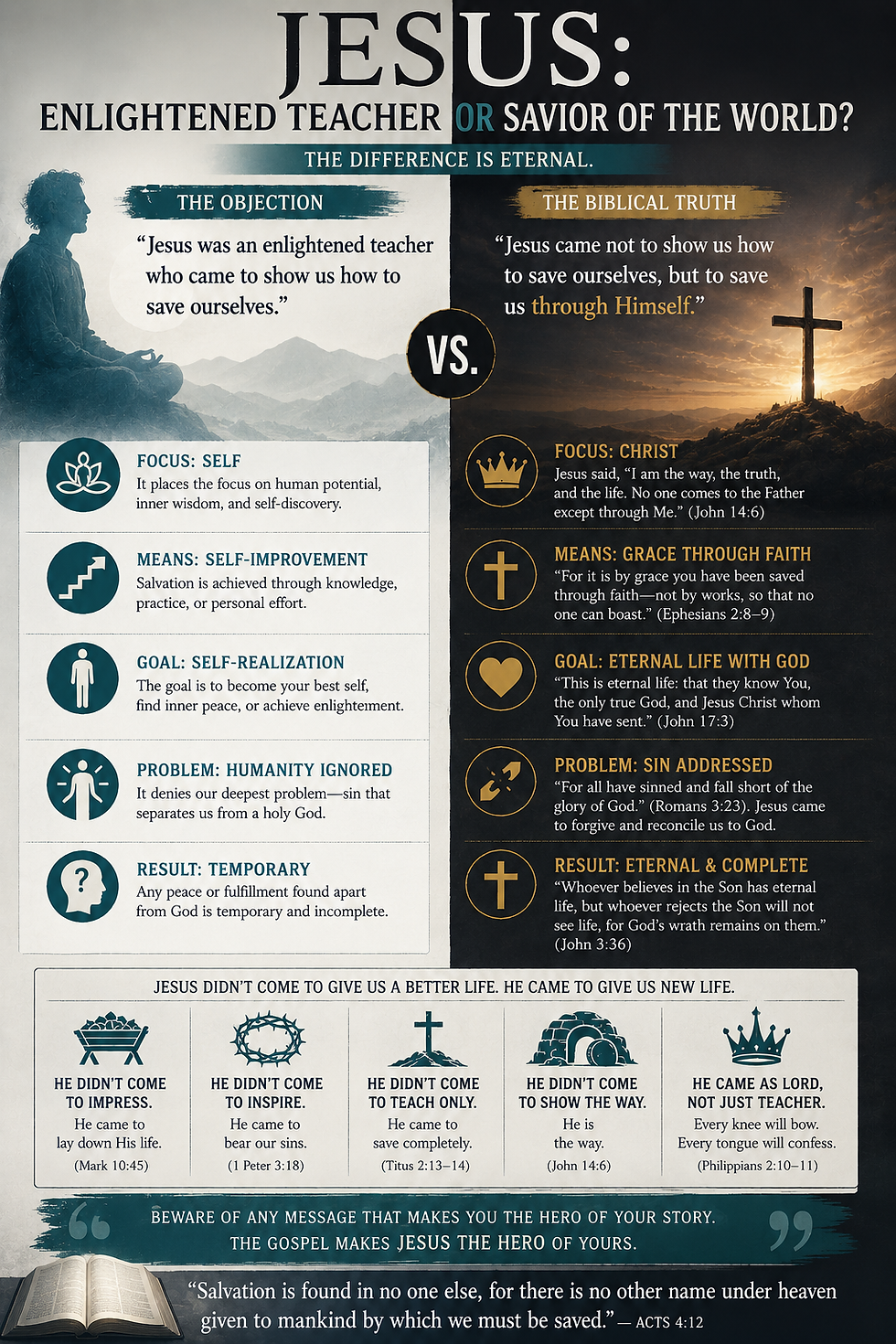
4. “Jesus is an enlightened teacher who showed us how to save ourselves.”
💬 Short answer:
Jesus did not present Himself as merely a moral teacher or spiritual guide. His words, actions, and claims consistently point beyond teaching into divine authority—specifically the authority to forgive, judge, and define salvation itself.
📋 Expanded:
🛑 1. The core issue with this view
This interpretation tends to accept:
Jesus’ ethical teachings
His moral wisdom
His influence on spirituality
👉 But it rejects or downplays:
His identity claims
His divine authority
His role in salvation
📌 The tension is that in the Gospels, Jesus’ teachings are inseparable from who He claims to be.
📌 2. Jesus’ actions go beyond “teacher” status
Jesus does things that, within the Jewish context of His time, imply divine authority:
🩸 He forgives sins directly
📖 Mark 2:5–7 👉 Religious leaders respond by saying only God can forgive sins.
🕊️ He receives worship
📖 Matthew 14:33 👉 Worship in this context is directed toward God.
⚖️ He claims unique authority
📖 John 14:6 - “I am the way and the truth and the life…”
👉 These are not statements of a neutral teacher—they are identity claims.
📌 3. The “good teacher” problem
If Jesus is only a moral teacher, then His strongest claims become difficult to reconcile:
If His divine claims are false → He is not a reliable teacher
If His claims are misunderstood → the Gospel writers misrepresent Him
If His claims are true → He is more than a teacher
👉 This is why the “just a teacher” category is unstable—it does not fit the full portrait presented in the text.
📌 4. Jesus’ own framing of salvation
Jesus does not primarily teach people how to save themselves. Instead, He describes salvation as something:
received
dependent on Him
grounded in relationship and trust
📖 John 6:29 - “The work of God is this: to believe in the one he has sent.”
👉 The emphasis is belief in Him, not self-salvation through technique or enlightenment.
📖Key takeaway:
Jesus does not present Himself as merely an enlightened teacher pointing people toward self-salvation. His claims, authority, and role in salvation consistently place Him at the center of the response He calls for.
👉 The real question is not whether His ethics are wise—but whether His identity claims are true.
✍️ “I am the way and the truth and the life. No one comes to the Father except through me.” -John 14:6
5. Jesus is not God
💬Short answer:
The Bible does explicitly and repeatedly present Jesus as God—through direct statements, titles, actions, and the way He is worshiped. While the exact phrase “Jesus is God” isn’t always used in a modern formula, the claim is clearly made throughout Scripture.

📋Expanded:
📌The core misunderstanding
This objection usually assumes:
If the exact phrase “Jesus is God” isn’t stated word-for-word, the idea isn’t there
Only one type of statement counts as proof
⚠️But in ancient writing, identity is shown through:
Titles
Actions
Authority
Worship
— not just one sentence formula.
📌Direct statements of Jesus’ divinity
The Bible does make very explicit claims:
📖 John 1:1 - “The Word was God.”
📖 John 1:14 - “The Word became flesh…”
👉 The “Word” (Logos) is identified as Jesus.
📖 John 20:28
Thomas says to Jesus: “My Lord and my God!”
👉 Jesus does not correct him—He affirms the statement.
📖 Titus 2:13
“…our great God and Savior, Jesus Christ”
👉 Directly applies “God” to Jesus.
📖 Hebrews 1:8
“But about the Son he says, ‘Your throne, O God, will last forever…’”
👉 The Father addresses the Son as God.
📌Jesus claims divine identity
📖 John 8:58 - “Before Abraham was, I AM.”
👉 “I AM” echoes God’s name in Exodus 3:14.
📌The reaction:
People attempted to stone Him (John 8:59)
👉 They understood this as a claim to divinity.
📌Jesus does what only God can do
🩸Forgives sins: 📖 Mark 2:5–7
“Who can forgive sins but God alone?”
👉 Jesus forgives sins—something understood as God’s authority.
🩸Controls nature:
📖 Mark 4:39 - He calms the storm
👉 Authority over creation is attributed to God.
🩸Receives worship:
📖 Matthew 14:33 - “They worshiped Him…”
👉 In Jewish context, worship belongs to God alone.
👉 Jesus accepts it.
📌Old Testament applied to Jesus
The New Testament applies passages about God directly to Jesus:
📖 Isaiah 44:6 (God: “the First and the Last”)
📖 Revelation 1:17 → Jesus says: “I am the First and the Last”
👉 This is a divine title.
🩸Creator, not created
📖 Colossians 1:16–17 -“All things were created through Him and for Him…”
👉 If all things were created through Jesus:
👉 He cannot be a created being.
📌Early Christian belief
From the earliest writings:
Christians worshiped Jesus
Prayed in His name
Identified Him with God’s authority and identity
👉 This belief was not invented later—it is present in the earliest texts.
📌Why the confusion exists
Some misunderstandings come from:
Jesus praying to the Father (distinction of persons)
Statements about submission during His earthly mission
Lack of one modern-style doctrinal sentence
👉 Christianity teaches:
One God
Revealed in Father, Son, and Holy Spirit (Trinity)
👉 Distinction does not mean denial of divinity.
📖Key verses:
• John 1:1 → “The Word was God”
• John 20:28 → “My Lord and my God”
Additional strong supports:
Colossians 2:9 → “All the fullness of Deity lives in Christ”
Philippians 2:6 → “Being in very nature God…”
📖Key takeaway:
The Bible does not rely on a single phrase to declare Jesus as God—it builds the case through direct statements, divine titles, actions, authority, and worship.
👉 The real question is not “Does the Bible say it in one sentence?”
👉 It is “What does the total evidence of Scripture reveal about who Jesus is?”
✍️ “I and the Father are one.” -John 10:30
6. "The Bible says God is a jealous God, this is ridiculous!"
📖 Exodus 34:14
💬 Short answer:
When the Bible describes God as “jealous,” it is not describing insecurity, envy, or emotional instability. It is describing God’s rightful commitment to protect His relationship with His people and His refusal to share worship with false gods and idols.

📋 Expanded:
📌 1. “Jealousy” does not always mean what we think it means
In modern language, jealousy often means:
Insecurity
Possessiveness
Fear of losing someone
👉 But in the Bible, the word is closer to:
Protective zeal
Covenant faithfulness
Guarding what is rightfully yours
📌 2. God’s jealousy is tied to relationship, not ego
God is not “jealous” like a human who feels threatened.
Instead, His jealousy is about:
Protecting His people from deception
Guarding them from destructive false worship
Maintaining a covenant relationship built on truth
👉 It is the jealousy of faithfulness, not insecurity.
📌 3. A healthy comparison: covenant love
🧠 The Bible often uses wedding imagery to illustrate God’s relationship with His people under the new covenant through Jesus Christ.
In that sense:
Idolatry is not just “wrong belief”
It is described as spiritual unfaithfulness
👉 So God’s “jealousy” reflects:
Commitment
Loyalty
Protection of an exclusive relationship
📌 4. God’s jealousy is morally grounded, not emotional instability
Unlike human jealousy, God’s character is:
Perfectly just
Fully self-sufficient
Not dependent on human validation
📖 Deuteronomy 4:24
“For the Lord your God is a consuming fire, a jealous God.”
👉 This highlights seriousness, not insecurity:
God is protecting truth and holiness
Not reacting emotionally like a human would
📌 5. Why this matters: false gods harm people
Biblically, idolatry is not neutral—it is destructive:
It distorts truth
It misleads worship
It pulls people away from life-giving relationship with God
👉 So God’s jealousy is also protective toward people, not just protective of honor.
📖 Key takeaway:
When the Bible calls God “jealous,” it is not describing human weakness—it is describing divine faithfulness.
👉 It means God is:
Fully committed to truth
Protective of His relationship with His people
Opposed to anything that replaces Him and harms them
✍️ “For I, the Lord your God, am a jealous God… but showing love to a thousand generations of those who love me and keep my commandments.” -Exodus 20:5-6
7. The God of the Bible is controlling — a lower being than the most high God
💬 Short answer:
This view often comes from redefining God through human expectations rather than biblical claims. The Bible presents God not as a “lower being” or arbitrary controller, but as the sovereign Creator whose authority is grounded in who He is.

📋 Expanded:
🛑 1. Where this idea often comes from
This objection is usually shaped by a mix of:
modern individualism (personal autonomy as highest value)
rejection of moral authority in general
experiences of religious misuse or harm
selective readings of Scripture
influence from alternative spiritual systems that minimize a personal Creator
👉 In some cases, it also reflects confusion between authority and control.
📌 2. Creator vs creation
A core biblical claim is:
📖 Genesis 1:1
“In the beginning God created the heavens and the earth.”
👉 If God is Creator:
He is not part of creation
He is not equal to creation
He is the source of existence itself
📌 From that perspective:
Authority is not imposed—it is inherent.
👉 Just as an author has authority over a story they write, the Creator has authority over creation.
📌 3. Is God “controlling”?
The Bible does show God:
intervening in history
guiding moral direction
judging injustice
calling people to obedience
👉 But it also consistently portrays Him as:
patient
longsuffering
merciful
willing that people repent rather than perish
📖 Ezekiel 33:11
“I take no pleasure in the death of the wicked, but rather that they turn from their ways and live.”
👉 This is not the picture of a detached or oppressive force—but of a moral, relational Creator.
📌 4. God’s authority is tied to His character
Biblically, God’s authority is never separated from His nature:
justice is not arbitrary
love is not optional
judgment is not capricious
📖 Psalms 145:17
“The Lord is righteous in all his ways and faithful in all he does.”
👉 His rule is consistently presented as morally grounded, not self-serving.
📌 5. The deeper issue
The disagreement is often not about whether God has authority—but whether humans accept the idea of any ultimate authority at all.
👉 If God is Creator, then:
truth is not self-defined
morality is not purely subjective
human autonomy is not ultimate
📖Key takeaway:
The Bible does not portray God as a “lower being” or an oppressive controller, but as the sovereign Creator whose authority is rooted in His role as the source of life and order.
👉 The real question is not whether God has authority—but whether that authority is just because He is Creator.
✍️ “Woe to those who quarrel with their Maker… Does the clay say to the potter, ‘What are you making?’” -Isaiah 45:9
-7.1 What about the Gnostic view? Old Testament God is evil, Jesus is a different God!
💬 Short answer:
Some later movements, especially Gnosticism, taught that the God of the Old Testament was a lower or even evil being separate from the God revealed by Jesus. However, this view is not found in the earliest Christian teaching, and is directly rejected by the New Testament itself.

📌 1. What the Gnostic view claimed
Certain Gnostic groups (2nd–3rd century) taught:
The material world is corrupt or evil
The Old Testament God (often called the “Demiurge”) is a lesser being
Jesus came to reveal a higher, hidden God beyond the Creator
👉 In this framework: The Old Testament God and the Father of Jesus are treated as different beings
📌 2. Why this view was rejected by early Christianity
📖 Gospel of John 1:1–3: “Through Him all things were made…”
👉 This directly identifies the God revealed in Christ as:
The same Creator of all things
Not a different or opposing deity
📖 Epistle to the Colossians 1:16 “All things were created through Him and for Him…”
👉 The New Testament consistently affirms:
One unified God
One Creator
Not competing divine beings
📌 3. The unity of God across the Bible
The Bible itself presents:
One continuous identity of God across both Testaments
Jesus not as revealing a different God, but revealing God more fully
📖 Gospel of John 14:9 “Whoever has seen me has seen the Father.”
👉 This is a direct rejection of the idea that Jesus represents a different or opposing deity.
📌 4. Why the “two different gods” idea developed
Historically, this view arose later due to:
Difficulty reconciling divine judgment with the teachings of Jesus
Influence from dualistic Greek philosophical ideas
Attempts to separate “justice” (Old Testament) from “love” (New Testament)
👉 But early Christianity did not interpret Scripture this way.
Instead, it held: The same God is both just and merciful, and both are fully revealed in Christ.
📌 5. Why this matters for the original objection
The “harsh God vs loving Jesus” objection often unintentionally borrows from a Gnostic-style framework by:
Splitting God into two moral identities
Treating the Old Testament as unrelated or inferior revelation
👉 But the biblical claim is not a contradiction—it is a progressive unfolding of the same God’s character across history.
📖 Key takeaway:
The idea that the Old Testament God is evil or different from Jesus comes from later Gnostic reinterpretations, not from early Christian teaching or the New Testament itself.
👉 The consistent biblical position is:
One God
One Creator
Fully revealed in Jesus Christ

✍️ “Jesus Christ is the same yesterday and today and forever.” – Hebrews 13:8
-7.2 What's often missed about the 10 commandments
🛑 “Why would a loving God give commandments?”

This objection and misunderstanding on the is often rooted in the belief that:
freedom means the absence of moral boundaries
authority itself is oppressive
personal desire should define truth
rules limit individuality and fulfillment
👉 But biblically, the Ten Commandments were not given as tools of oppression—they were given as protection, wisdom, and moral order.
📌 1. The commandments came after deliverance—not before
Before God gave Israel the Ten Commandments, He first rescued them from slavery in Egypt. → 📖 Exodus 20:2
“I am the Lord your God, who brought you out of Egypt, out of the land of slavery.”
👉 The commandments were not a condition for liberation—they were given after liberation. This is important.
⚠️God did not say:“Obey Me so I will rescue you.”
⚠️He rescued them first, then taught them how to live rightly.
👉 The commandments were given within a loving relationship from an all knowing God who wants the best for His creation, not as a system of tyranny.
📌 2. The commandments protect human flourishing
Many people view the commandments as restrictive rules.
👉But when examined closely, they protect foundational aspects of human life:
truth
family
life
faithfulness
justice
rest
worship
human dignity
👉For example:
“Do not murder” protects life
“Do not steal” protects security and trust
“Do not bear false witness” protects truth and justice
“Honor your father and mother” protects family structure
“Do not covet” addresses destructive envy within the human heart
👉 These are not arbitrary restrictions.
⚠️They are moral boundaries designed for human good.
📌 3. Biblical freedom is not the absence of truth
Modern culture often defines freedom as:
“I should be able to do whatever I want.”
But biblically, freedom is not the removal of all boundaries—it is living according to what is true and good.
👉A fish is free in water, not on land.
👉Likewise, humanity functions best within the moral design of its Creator.
📖 Psalm 119:45
“I will walk about in freedom, for I have sought out your precepts.”
👉 In Scripture, obedience to God is not portrayed as slavery to God—but freedom from destruction and sin.
📌 4. The commandments reflect God’s character
The Ten Commandments are not merely rules
—they reveal aspects of God’s nature:
truthfulness
justice
faithfulness
holiness
love
order
👉 God’s moral law flows from who He is.
⚠️This is why biblical morality is presented as objective rather than invented by culture or preference.
📖 Psalms 19:7-8
“The law of the Lord is perfect, refreshing the soul… the commands of the Lord are radiant, giving light to the eyes.”
📌 5. Jesus summarized the law through love
When asked about the greatest commandment, Jesus summarized the law as:
📖 Matthew 22:37-40
“Love the Lord your God with all your heart… and love your neighbor as yourself.”
👉 According to Jesus:
the commandments are rooted in love for God
and love for other people
⚠️The purpose was never cold legalism.
⚠️The deeper intent was relational love expressed through truth and moral goodness.
📌6. Real love also warns, corrects, protects, and guides away from what destroys people.
A parent who warns a child about danger is not being controlling—but caring.
Likewise, Scripture presents God’s commands as flowing from wisdom and concern for human flourishing, not from cruelty or insecurity.
📖 Hebrews 12:6
“The Lord disciplines the one he loves.”
👉 In the biblical view:
love is not separated from truth
correction is not the opposite of love
boundaries are not automatically oppression
⚠️Sometimes the most loving thing a person can do is tell the truth about what leads to life—and what leads to destruction.
📌 7. The deeper issue
The real disagreement is often not about specific commandments—but about whether humans should define morality for themselves.
👉 If morality is entirely self-defined:
truth becomes subjective
justice becomes unstable
human desire becomes the highest authority
But the Bible presents God as the source of moral truth, not humanity.
📖 Key takeaway:
The Ten Commandments were not given to oppress humanity, but to guide humanity toward truth, justice, love, and human flourishing.
👉 Biblically, God’s commands are portrayed not as burdens imposed by a tyrant—but as wisdom given by a loving Creator who understands human nature better than humans themselves.
✍️ “Oh, how I love your law! I meditate on it all day long.” — Psalm 119:97
8. Is the Trinity One God? — Understanding the Father, Son, and Holy Spirit
💬 Short answer:
Christianity does not teach belief in three gods. It teaches one God who exists eternally as three distinct persons—Father, Son, and Holy Spirit. Believing in all three is not adding requirements—it is accepting who God has revealed Himself to be.
✍️"Can you fathom the mysteries of God? Can you probe the limits of the Almighty?" -Job 11:7

📋 Expanded:
📌 1. The core misunderstanding
This objection usually assumes:
Christians believe in three separate gods
God is divided into parts
The Trinity is a later theological invention
👉 But biblical Christianity has always claimed:
One God
Revealed in three distinct persons
⭐ This is the doctrine of the Trinity.
📌 2. What the Trinity actually means
The Trinity teaches:
👉 One “what” (Being)👉 Three “who’s” (Persons)
The Father is God
The Son (Jesus) is God
The Holy Spirit is God
📌 Each person is:
Fully God (not ⅓ of God)
Eternal (not created)
Distinct (not the same person)
📌 But there is still:👉 Only one God—not three
📌 3. What the Trinity is NOT
❌ Not three gods (polytheism)
❌ Not one person wearing three “masks” (switching roles)
❌ Not God divided into parts
👉 Instead:
One divine nature
Shared fully by three distinct persons
📌 A simple way to say it:👉 One God in essence, three in person
📌 4. The Trinity hinted at from the very beginning
Even in the opening verses of Scripture, we see a pattern of distinction and unity:
📖 Genesis 1:1–3 “In the beginning God created the heavens and the earth… and the Spirit of God was hovering over the waters. And God said, ‘Let there be light,’ and there was light.”
👉 Notice:
God is the Creator
The Spirit of God is actively present
God speaks His Word to bring creation into existence
📌 From the very beginning, Scripture shows:👉 One God👉 Active in a way that is already more complex than a single-person view

📌 5. The New Testament makes this clearer
📖 John 1:1–3 “In the beginning was the Word… and the Word was with God, and the Word was God… Through Him all things were made.”
👉 This reveals:
The “Word” is not just speech or sound
The Word is personal (He is with God)
The Word is fully divine (He is God)
The Word is the agent of creation
📌 This is later understood as Jesus Christ
👉 So what was hinted at in Genesis is made explicit in the New Testament:
God speaks and creates
God’s Word is not impersonal
God’s Word is revealed as a distinct person who is still fully God

📌 6. The Bible presents all three together
📖 Matthew 28:19 “Baptizing them in the name (singular) of the Father and of the Son and of the Holy Spirit”
👉 Key detail:
“Name” is singular → one God
Three persons listed equally
📌 7. Jesus clearly shows distinction and unity
Throughout the Gospels:
Jesus prays to the Father
Speaks of being sent by the Father
Promises to send the Spirit
👉 This shows:
They are not the same person
Yet they act in complete unity
📌 Distinction without division
⸻
📌 8. Why this isn’t “optional”
If this is who God is:
📖 John 14:6 - No one comes to the Father except through the Son
📖 Romans 8:9 - Without the Spirit, one does not belong to Christ
👉 Rejecting one person is not simplifying God👉 It is rejecting how God has revealed Himself
📌 9. Why it can feel difficult to grasp
📖 Isaiah 55:8–9 “My thoughts are not your thoughts…”
👉 God’s nature is greater than human categories👉 But “beyond full understanding” ≠ contradiction
📌 The Trinity is not illogical👉 It is bigger than human analogy
📖Key takeaway:
Christians do not believe in three gods—they believe in one God who eternally exists as Father, Son, and Holy Spirit:

✍️ “Hear, O Israel: The Lord our God, the Lord is one.” -Deuteronomy 6:4
9. Why would Jesus say we will do greater things than He?
💬Short answer:
Jesus is not saying believers will surpass Him in power or divinity. He is referring to greater scope and spread of His work through the global mission of the Church after His resurrection and ascension.
One of God’s greatest revealed desires is the salvation and restoration of people.

✍️“God our Savior… wants all people to be saved and to come to a knowledge of the truth.” -1 Timothy 2:3-4
📋Expanded: 📌The key verse in question
👉 John 14:12
“Whoever believes in me will do the works I have been doing, and they will do even greater things than these…”
At first glance, this sounds like believers outperforming Jesus—but that would conflict with the rest of Scripture.
🛑What “greater” does NOT mean
It does NOT mean:
Greater power than Jesus
Greater authority than God
Miracles more divine in nature than His
Surpassing Christ in identity or ability
👉 The Bible is consistent that Jesus is unique in authority and nature:
John 1:3 → all things were made through Him
Colossians 1:16–17 → all creation holds together in Him
Hebrews 1:3 → He sustains all things by His power
👉 So “greater” cannot mean “superior to Christ.”
📌What “greater” actually means: scope, not superiority
The word “greater” (Greek: meizōn) can refer to magnitude or extent.
👉 Jesus’ earthly ministry was:
Geographically limited (mainly Israel)
Physically present in one location at a time
Carried out before the global outpouring of the Holy Spirit at Pentecost
After His ascension:
The Gospel spreads worldwide
The Church multiplies across nations
Millions come to faith across generations
👉 That is “greater” in reach and impact, not essence or power.
📌Greater works through the Holy Spirit
Jesus immediately explains the reason:
📖John 14:12
“because I am going to the Father”
📖John 14:16–17
He promises the Holy Spirit will come to empower believers.
📖And again: 👉 Acts 1:8
“You will receive power when the Holy Spirit comes on you; and you will be my witnesses to the ends of the earth.”
👉So the “greater works” are:
Carried out by the Spirit of Christ
Through the global Church
After Jesus’ ascension
📊Example comparison:
During Jesus’ earthly ministry:
Thousands directly encountered Him
Ministry centered in one region
Disciples were being trained
After Pentecost:
Thousands converted in a single day (Acts 2:41)
The Gospel spreads across continents
The message reaches billions over time
👉 Not greater than Jesus—but greater in extent of mission fulfillment
🛑A key misunderstanding: miracles vs mission
Some assume “greater things” means more spectacular miracles.
But in context, Jesus is talking about continuing His mission:
Preaching the Kingdom
Casting out darkness
Bringing salvation
Revealing God’s truth
👉 The “greater” emphasis is on expansion of the mission, not escalation of miracle power.
👉 The last thing He leaves His followers with is The Great Commission:
📖 Matthew 28:19-20
“Go therefore and make disciples of all nations, baptizing them in the name of the Father and the Son and the Holy Spirit, teaching them to observe all that I commanded you; and know that I am with you always, even to the end of the age.”
📌Historical and theological consistency
Early Christian understanding consistently held:
Christ alone is the source of power
Believers are instruments, not independent operators
The Spirit enables the continuation of Christ’s work
👉 The Church is the extension of Christ’s ministry, not a replacement or upgrade
✍️ “... you shall receive power when the Holy Spirit has come upon you; and you shall be My witnesses both in Jerusalem, and in all Judea and Samaria, and even to the remotest part of the earth.” -Acts 1:8
10. What about Christ Consciousness?
🛑Some modern spiritual frameworks reinterpret Jesus as an example of “Christ consciousness,” meaning:
a divine awareness all humans can access
an awakened state of enlightenment
a universal spiritual potential within everyone
👉 In this view:
Jesus is not unique in divine nature
His identity is symbolic rather than literal
“Christ” becomes a state of consciousness rather than God

📌The New Testament consistently presents “Christ” not as an internal human potential, but as a specific person with a unique identity and mission:
📖 John 1:1 “In the beginning was the Word, and the Word was with God, and the Word was God.” 👉 Christ is not described as an awakened idea—but as a divine person who exists eternally.
📖 John 14:6 “I am the way and the truth and the life. No one comes to the Father except through me.” 👉 This excludes the idea of a shared or universal internal “Christ state.”It presents Christ as the exclusive mediator, not an accessible inner condition.
📖 1 Timothy 2:5 “For there is one God and one mediator between God and mankind, the man Christ Jesus.” 👉 The language is relational and historical:
one God
one mediator
one identifiable person (Jesus)
📌 Why this matters
The “Christ consciousness” concept shifts:
from a person who saves
to a state humans achieve
👉 But the biblical message consistently moves in the opposite direction:
salvation is received, not achieved
Christ is the source, not a mirror of human potential
transformation comes through Him, not self-realization of Him
11. Jesus said we will be one with God like He is — what does that mean?
💬Short answer:
In John 17, Jesus is not teaching that humans become God, merge into divinity, or awaken a hidden “Christ consciousness.”
👉 He is praying for:
spiritual unity
relational oneness
shared faith and purpose among believers
—not equality with God’s nature or identity.

📋Expanded:
📌The verses in question
📖John 17:20–21
“I pray also for those who will believe in me through their message, that all of them may be one, Father, just as you are in me and I am in you…”
📖John 17:22–23
“I have given them the glory that you gave me, that they may be one as we are one— I in them and you in me…”
👉 Some modern New Age and occult interpretations claim this teaches:
humans are literally divine
all people are God in essence
Jesus was merely spiritually awakened
salvation comes through realizing our own godhood
⚠️ But this interpretation removes the verses from both their context and historic Christian understanding.
📌What Jesus is actually praying for
The central theme of John 17 is unity among believers.
Jesus repeatedly speaks about:
believers being united
sharing love
being spiritually connected
working together in truth
👉 The comparison to the Father and Son is relational unity—not ontological identity. In other words:
unity of love
unity of purpose
unity of relationship
unity through the Holy Spirit
—not humans becoming God by nature.
📌A key distinction: “one” does not mean “the same being”
The Bible often uses “one” to describe deep unity without erasing distinction.
For example: 📖 Genesis 2:24
“the two shall become one flesh”
👉 Husband and wife become “one,” yet remain distinct persons.
Likewise, believers can be “one” in Christ:
spiritually united
joined in love and truth
part of one body
without becoming identical to God Himself.
🛑What the passage does NOT teach:
humans are secretly gods
all consciousness is divine
individuality dissolves into universal oneness
enlightenment replaces repentance
salvation comes through self-realization
👉 These concepts come primarily from:
Eastern mysticism
Gnosticism
Hermeticism
modern New Age spirituality
—not from historic Christianity or the teachings of the apostles.
📌Historical Christian understanding
From the earliest centuries, Christians consistently understood John 17 referring to:
unity within the Church
fellowship with God
participation in Christ through grace
—not absorption into deity.
Early Christian writings strongly maintained the distinction between:
Creator and creation
God and humanity
Christ’s divine nature and human believers
👉 Even when early Christians spoke of being transformed by God, they never meant humans literally become God in essence.
📌The broader context of John’s Gospel
The Gospel of John repeatedly emphasizes that Jesus is uniquely distinct from humanity.
📖John 1:1
“In the beginning was the Word, and the Word was with God, and the Word was God.”
📖John 1:14
“The Word became flesh and dwelt among us.”
👉 John presents Jesus not as one awakened human among many—but as the eternal Word entering creation.
Throughout John’s Gospel:
Jesus is sent by the Father
Jesus shares glory with the Father before creation
Jesus receives worship
Jesus forgives sins
Jesus claims divine authority
👉 The entire Gospel points to Christ’s uniqueness, not universal human divinity.
📌Union with God vs becoming God
Biblical Christianity does teach spiritual union with God:
through relationship
through the Holy Spirit
through reconciliation in Christ
⚠️But union is not identity.
For example:
believers are adopted as children of God
temples of the Holy Spirit
united with Christ
👉Yet Scripture never says humans become equal with God in nature, authority, or worship.
📖 John 1:12
“To all who did receive him… he gave the right to become children of God.”
👉 Children of God are not the same as being God Himself.
📌Why this matters
If John 17 taught humans are divine:
it would contradict the rest of Scripture
Jesus would no longer be unique
worship of Christ alone would make little sense
sin would become ignorance instead of rebellion
salvation would become self-discovery instead of redemption
👉 But the consistent biblical message is:
God is Creator
humanity is creation
salvation comes through Christ, not through discovering hidden divinity within ourselves
📖Supporting passages:
Isaiah 43:10 → “Before me no god was formed…”
John 1:1–14 → Christ’s unique divine identity
Romans 3:23 → humanity’s fallen condition
Ephesians 2:8–9 → salvation by grace, not self-attainment
1 Timothy 2:5 → one mediator between God and humanity
🌍Why this objection has become popular
Modern spirituality often prefers:
inner divinity over repentance
self-empowerment over surrender
universal spirituality over exclusive truth claims
👉 The idea that “we are all divine” is emotionally appealing because it removes:
accountability
moral authority
the need for redemption
But Christianity teaches that humanity’s deepest problem is not lack of enlightenment—it is separation from God through sin
-11.1 Doesn't Jesus say "You are gods"? — Meaning we are divine?
“Jesus answered them, ‘Is it not written in your Law, “I have said you are gods”? If he called them gods, to whom the word of God came—and Scripture cannot be set aside—what about the one whom the Father set apart as his very own and sent into the world? Why then do you accuse me of blasphemy because I said, “I am God’s Son”?’” -📖John 10:34–36
👉 This is one of the most commonly cited verses in New Age and occult interpretations to argue that humans are divine by nature.
They often claim:
humans are literal gods in disguise
Jesus is confirming human divinity
spiritual awakening reveals our “true godhood”
the Bible supports universal divinity
⚠️ But to understand what Jesus is actually saying, we need to step into how Scripture was used and understood in His time, not how modern spirituality often reframes it.
1.📌First: what is happening in this moment?
Jesus is in a public confrontation with religious leaders.
In the culture of the time, arguments were not based on personal opinion the way modern conversations often are. Instead, they were built around:
quoting Scripture precisely
interpreting it in context
showing consistency with earlier writings
debating meaning within shared sacred texts
👉 So when Jesus responds, He is not giving a random mystical statement—He is engaging in a formal, text-based legal-theological argument.
2.📌What Jesus is actually quoting
Jesus points back to Psalm 82:6, where God says:
‘You are gods; you are all sons of the Most High.’”
👉At first glance, this sounds shocking to modern ears.
But in the original setting:
this is not talking about divine humans
it is speaking about human judges and leaders in Israel
people who were given authority to represent God’s justice
In ancient Hebrew thought, the word translated “gods” (elohim) is sometimes used in a functional sense, meaning:
someone acting with delegated authority under God
Think of it less like “divine beings” and more like:
“appointed representatives of divine judgment”
3.📌What Jesus is doing with this quote
Now here’s where the argument becomes important.
⚠️Jesus is essentially saying:
“Even your own Scriptures used the word ‘gods’ in a limited, representative sense for human judges who received God’s word…”
⚠️Then He builds the contrast:
📖John 10:36“…what about the one whom the Father set apart as his very own and sent into the world?”
👉 His point is not: “all humans are divine”
👉But rather: “If Scripture can use this language in a limited way for appointed human leaders, why is it suddenly considered blasphemy when I, the One directly sent by the Father, speak of My identity?”
⚠️So instead of equalizing humanity with God, Jesus is actually defending His unique identity as the Son of God. Having an understanding of the depth of Scripture and its context is essential, because meaning is found in the full message of the text—not in isolated verses taken on their own.
4.📌A key cultural insight: how quoting Scripture worked then
In Jesus’ time, quoting Scripture was not just reading a verse—it was part of a recognized method of reasoning.
A teacher would:
Quote a passage everyone accepted as authoritative
Show how it applied to the current situation
Draw a conclusion that exposed inconsistency or misunderstanding
👉 So Jesus is not “proof-texting” in a modern internet debate sense.He is engaging in a rabbinic-style argument, where the weight of the case depends on shared understanding of Scripture.
And His audience would immediately recognize:
⚠️“He is using their own accepted text to expose a flawed accusation.”
📌A deeper example of this same principle at the cross
This same reality of how Scripture is being used and understood also appears in Jesus’ final moments.
📖Matthew 27:46
“About three in the afternoon Jesus cried out in a loud voice, ‘Eli, Eli, lema sabachthani?’ (which means ‘My God, my God, why have you forsaken me?’)”
👉 At first glance, this can sound like Jesus is declaring separation from the Father in despair or abandonment.
⚠️But here again, Jesus is doing something deeply rooted in Scripture itself—He is quoting Psalm 22, a well-known Messianic psalm in Jewish tradition.
📖Psalm 22:1 begins with the same words: “My God, my God, why have you forsaken me?”
👉 In Jewish teaching and worship, it was common to reference an entire passage by quoting its opening line. This was not just a statement of emotion—it was a way of pointing the listener to the full context of the psalm.
And Psalm 22 goes on to describe:
suffering and humiliation
the piercing of hands and feet (v.16)
mocking by onlookers
and ultimately vindication and victory
👉 So Jesus is not only expressing anguish—He is directing attention to a Scripture that describes the suffering of the righteous one and ultimately points forward to deliverance.
⚠️ This is another example of why isolated verses can be misunderstood if removed from their full biblical and historical context.
👉 Even at the cross, Jesus is still speaking within Scripture, not apart from it—inviting those who hear Him to look deeper into what the text is truly revealing.
5.📌What the passage does NOT teach
Despite modern reinterpretations, Jesus is not saying:
humans are divine by nature
people share God’s eternal essence
enlightenment reveals hidden godhood
all consciousness is God
individuality dissolves into divine oneness
These ideas are drawn more from:
Eastern mysticism
Gnosticism
Hermetic traditions
modern New Age spirituality
👉 But they are not the conclusion Jesus draws from Psalm 82.
6.📌A helpful clarification: why the “you are gods” phrase exists at all
The Bible sometimes uses strong language to emphasize function or role.
For example:
judges are called “gods” because they represent God’s justice
kings are sometimes described in exalted terms because of authority
prophets speak as God’s messengers
👉 But in every case, the distinction remains:
they represent God — they are not God
7.📌Broader biblical context confirms the distinction
Scripture consistently maintains a clear line between Creator and creation:
📖Isaiah 43:10 “Before me no god was formed, nor will there be one after me.”
📖Romans 3:23 “for all have sinned and fall short of the glory of God”
📖1 Timothy 2:5 “For there is one God and one mediator between God and mankind, the man Christ Jesus”
👉 The consistent message is not human divinity—but dependence on God.
8.📌Why this objection feels convincing today
The idea “you are gods” resonates in modern spirituality because it:
feels empowering
removes moral accountability
replaces repentance with self-realization
reframes salvation as inner discovery
👉 But in the biblical worldview, the human problem is not lack of awareness of divinity—it is separation from God through sin, which requires restoration, not realization.
📖Key takeaway:
In John 10:34, Jesus is not teaching that humans are divine. He is using Scripture the way it was originally used—within a legal and theological argument—to defend His unique identity as the Son of God and expose a misunderstanding of Psalm 82.

✍️“And no wonder, for Satan himself masquerades as an angel of light.”
-2 Corinthians 11:14
12. “Jesus taught manifestation and law of attraction”
💬 Short answer:
Jesus did not teach manifestation or the idea that humans can shape reality through focused thought or spoken desire. Instead, He taught faith as trust in God’s will, not human control over outcomes.
⚠️Scripture does teach us that the devil is the god of this fallen world—he even tried tempting Jesus with riches if He would worship him.
📖Luke 4:6 - And the devil said to Jesus, "I will give you all their authority and splendor; it has been given to me, and I can give it to anyone I want. If you worship me, it will be yours."
📖2 Corinthians 4:4 “The god of this age has blinded the minds of unbelievers, so that they cannot see the light of the gospel that displays the glory of Christ, who is the image of God.” -2 Corinthians 4:4

📋 Expanded:
🛑 1. Common misunderstanding
Some modern interpretations take verses about faith and prayer and reinterpret them as:
“Speak it into existence”
“Claim it over reality”
“Create your own destiny through belief”
👉 These ideas are usually drawn from modern self-help frameworks rather than the historical or textual context of the Gospels.
📌 2. What Jesus actually teaches about prayer and faith
Jesus consistently frames prayer as:
submission to God’s will
dependence on God
trust in God’s timing and wisdom
📖 Matthew 6:10
“Your kingdom come, your will be done, on earth as it is in heaven.”
📌 This places emphasis on God’s will, not human control.
📖 John 14:13–14
“Whatever you ask in my name, I will do it…”
👉 This is often misunderstood, but in context:
“in my name” means aligned with His character and will
it is not a blank check for personal desire
📌 3. Faith in the biblical sense
Biblical faith is described more as:
trust
reliance
loyalty
surrender
Not:
mental control over reality
forcing outcomes through belief alone
📖 Hebrews 11:1
“Now faith is confidence in what we hope for and assurance about what we do not see.”
👉 Faith is confidence in God, not control over circumstances.
📌 4. Core difference in worldview
❌ Manifestation framework:
Self is central
Mind/words are seen as causal forces shaping reality
Outcome depends on personal focus or belief
✅ Biblical framework:
God is central
Reality is governed by God’s will and authority
Humans respond in trust, obedience, and prayer

📖 John 14:30 “I will not say much more to you, for the prince of this world is coming. He has no hold over me.”
👉 Jesus again describes Satan as having influence over the world system, while emphasizing Satan has no authority over Him.
-12.1 What about "moving mountains" and "mustard seed faith"?
📖 Matthew 17:20 “If you have faith as small as a mustard seed, you can say to this mountain, ‘Move from here to there,’ and it will move.”
📖 Matthew 21:21 “If you have faith and do not doubt… you can say to this mountain, ‘Go, throw yourself into the sea,’ and it will be done.”
👉 These verses are often used to support the idea that:
Faith is a force that creates outcomes
Words or belief alone can reshape reality
God is obligated to respond to human declaration
But in context, Jesus is not teaching human control over reality—He is teaching trust in God’s power and authority, even when circumstances look impossible.
📌 What “mountain” language actually means
In biblical and Jewish teaching, “mountains” are often used as imagery for:
obstacles
impossible situations
overwhelming challenges
👉 So Jesus is emphasizing:
even small genuine faith is enough to trust God with what feels impossible
God is not limited by human strength or scale of faith
📌 The focus is not human power, but God’s ability
📌 The key detail often missed: dependence, not control
In both passages, Jesus is speaking within a broader teaching context about:
prayer
forgiveness
humility before God
📖 This is reinforced by: Mark 11:22–24 “Have faith in God…”
👉 The command is not “have faith in your words”👉 It is “have faith in God”
📌 Consistency with the rest of Jesus’ teaching
This interpretation fits directly with:
📖 Matthew 6:10“ Your will be done…”
📖 John 5:19 “The Son can do nothing by himself; he can do only what he sees his Father doing.”
👉 Jesus consistently teaches:
dependence on the Father
rejection of self-originating power

🌍 Clarifying takeaway:
“Mustard seed faith” is not about humans creating reality through belief or speech. It is about:
trusting God even with very small faith
believing that God can do what is impossible for humans
removing doubt in God’s ability, not activating a power within ourselves
👉 The emphasis is not on the size of human faith as a force👉 It is on the sufficiency of God’s power to act
✍️ “as also in all his epistles, speaking in them of these things, in which are some things hard to understand, which untaught and unstable people twist to their own destruction, as they do also the rest of the scriptures.” -2 Peter 3:16

Comments