
Why the divide? Part 3 — Catholics, Mormons, Jehovah’s Witnesses, Ethiopian Bible & Denominations
Note: Due to margins from the dropdown list, this blog is easier to read on tablet or computer.
One of the biggest challenges for many people exploring Christianity is not simply whether Christianity is true—but why Christians themselves seem so divided.
→Why are there so many denominations?
→Why does the Ethiopian Bible contain additional books?
→Why do Catholics, Protestants, Orthodox Christians, Jehovah’s Witnesses, and Latter-day Saints all claim to follow Jesus while teaching very different things?
→And if Christianity is true, why do so many Christians act hypocritically or contribute to harm, division, and conflict?
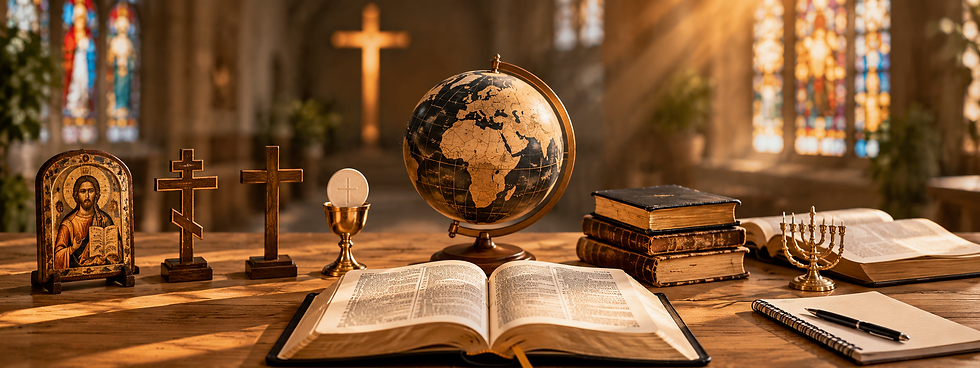
These questions often create confusion, skepticism, and distrust toward Christianity itself. This article examines some of the most common questions surrounding Christian divisions, alternative movements, church traditions, hypocrisy, and the historical development of different branches of Christianity.
The goal is not to attack people or denominations, but to understand where these differences came from, what they believe, and how they compare to historic biblical Christianity.
In This Article
Why is the Ethiopian Bible different?
Why do Jehovah’s Witnesses have different beliefs?
Why do Mormons have different beliefs?
Why do Catholics have more books in their Bible?
What do Catholics believe differently?
Why are there so many Christian denominations?
Why are some Christians so hypocritical?
Is religion responsible for wars and violence?
Is Christianity oppressive and controlling?
Crusades, Inquisitions, and residential schools,
🧠 Quick Definitions (for clarity)
Manuscripts → handwritten copies of ancient texts
Textual variants → differences between copies
Textual criticism → comparing manuscripts to recover original wording
Scripture → sacred writings regarded as inspired by God and authoritative for faith
Canon → the recognized books of Scripture
AD → after death of Jesus Christ—we mark our current year from this event
Sin → Anything that goes against God’s nature, will, or commands—whether in action, thought, or intention.
Repent → A deliberate turning away from sin and turning toward God—resulting in a real change of mind, heart, and direction.
1. "The Ethiopian Bible is one of the oldest and least edited"—why do most Christians not use it?
💬 Short answer:
The Ethiopian Orthodox Bible is an important and ancient Christian tradition, but it is not “more original” or universally older than other biblical canons. It includes additional books not accepted in most other Christian traditions because the canon developed differently in different regions of early Christianity—not because other churches “removed” parts of Scripture.
📋 Expanded:
📌 What the claim assumes
This objection usually assumes:
The Ethiopian Bible is the “pure original Bible”
Other Bibles are “edited down versions”
More books = more authenticity
👉 But historically, canon size differences come from regional development, not editing or loss.
📌 What the Ethiopian Bible actually is
The Ethiopian Orthodox Tewahedo Church has one of the largest biblical canons:
Includes books like Enoch, Jubilees, and others
Has a broader Old Testament than Protestant or Catholic Bibles
Developed in relative geographic isolation in East Africa
👉 It is an ancient Christian canon, but not identical to Jewish, Catholic, or Protestant canons.
📌 Key historical fact: different early Christian regions had different canons
Early Christianity was not centralized. Different regions developed slightly different collections:
📌 Examples:
Rome / North Africa → canon affirmed in councils (Hippo, Carthage)
Greek-speaking East → Septuagint-based tradition
Ethiopia → preserved additional books in local usage
👉 This reflects diversity of transmission, not a single lost “original Bible.”
📌 Why the Ethiopian canon includes extra books
Books like 1 Enoch & Jubilees were:
Valued in some Jewish and early Christian circles
Quoted or referenced in early writings (e.g., Jude references Enoch)
But not consistently treated as Scripture across all regions
👉 So inclusion ≠ universal acceptance.
📌 Why most Bibles do NOT include those books
Across most of early Christianity, books were evaluated by:
Apostolic connection
Eyewitness proximity
Consistent doctrinal alignment
Widespread church usage
👉 Many books in the Ethiopian canon:
Were written later than the Old Testament period
Lack universal early acceptance
Were not used across all major Christian centers
📌 Important clarification: “older” doesn’t always mean “more authoritative”
The Ethiopian tradition is:
Ancient (yes)
Valuable historically (yes)
But not automatically “closer to original Scripture”
👉 Age alone does not determine canonicity.
Example:
A very early writing can still be:
Regional
Non-canonical
Theologically debated
📖 Key takeaway:
The Ethiopian Bible is an ancient and respected Christian canon, but it reflects a regional development of Scripture collection, not a “more original Bible that others removed.”
👉 The real issue is not:
“Why aren’t we using the Ethiopian Bible?”
👉 But:
“Why did different early Christian communities preserve slightly different collections of writings—and how did the broader church recognize which books were universally recognized as Scripture?”
✍️ “Do not add to what I command you and do not subtract from it, but keep the commands of the Lord your God that I give you.” -Deuteronomy 4:2
2. Why do Jehovah’s Witnesses have a different name and perspective?
💬 Short answer:
Jehovah’s Witnesses are a modern religious movement (originating in the late 1800s) that developed distinct interpretations of Christianity, including a different translation of Scripture and unique doctrines. Their differences come from later doctrinal development, not from a separate ancient branch of early Christianity.
📋 Expanded:
📌 1. Who are Jehovah’s Witnesses?
Jehovah’s Witnesses began in the United States in the late 19th century under the Bible Student movement led by Charles Taze Russell.
👉 They formally became “Jehovah’s Witnesses” in 1931.
📌 2. Why the name “Jehovah”?
They emphasize the name:
👉 “Jehovah” (an English rendering of the Hebrew divine name YHWH)
They strongly focus on:
Using God’s name in worship
Distinguishing themselves from mainstream Christianity
📌 Important note:
Most scholars agree “Jehovah” is a hybrid pronunciation that developed in medieval scholarship, while the original Hebrew is closer to “Yahweh.”
📌 3. Why their Bible translation is different
Jehovah’s Witnesses use the:
👉 New World Translation (NWT)
Key differences include:
Rendering John 1:1 as “the Word was a god” instead of “the Word was God”
Emphasis on God the Father alone as Almighty God
Different translation choices that reflect different doctrinal views
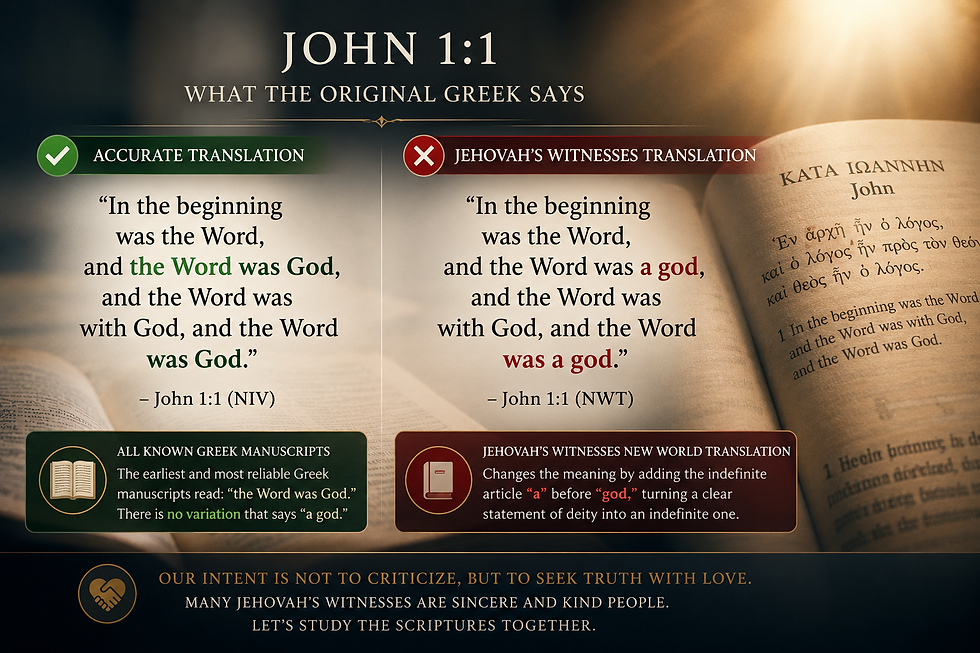
👉 Critics argue some translation decisions reflect theology rather than neutral translation.
⚠️In John 1:1 - in the original Greek, the phrase kai theos ēn ho logos literally reads ‘and the Word was God,’ and many scholars argue the absence of the definite article before theos describes the nature of the Word rather than making Jesus ‘a god’ separate from God.
📌 4. Why their beliefs differ from mainstream Christianity
Jehovah’s Witnesses teach:
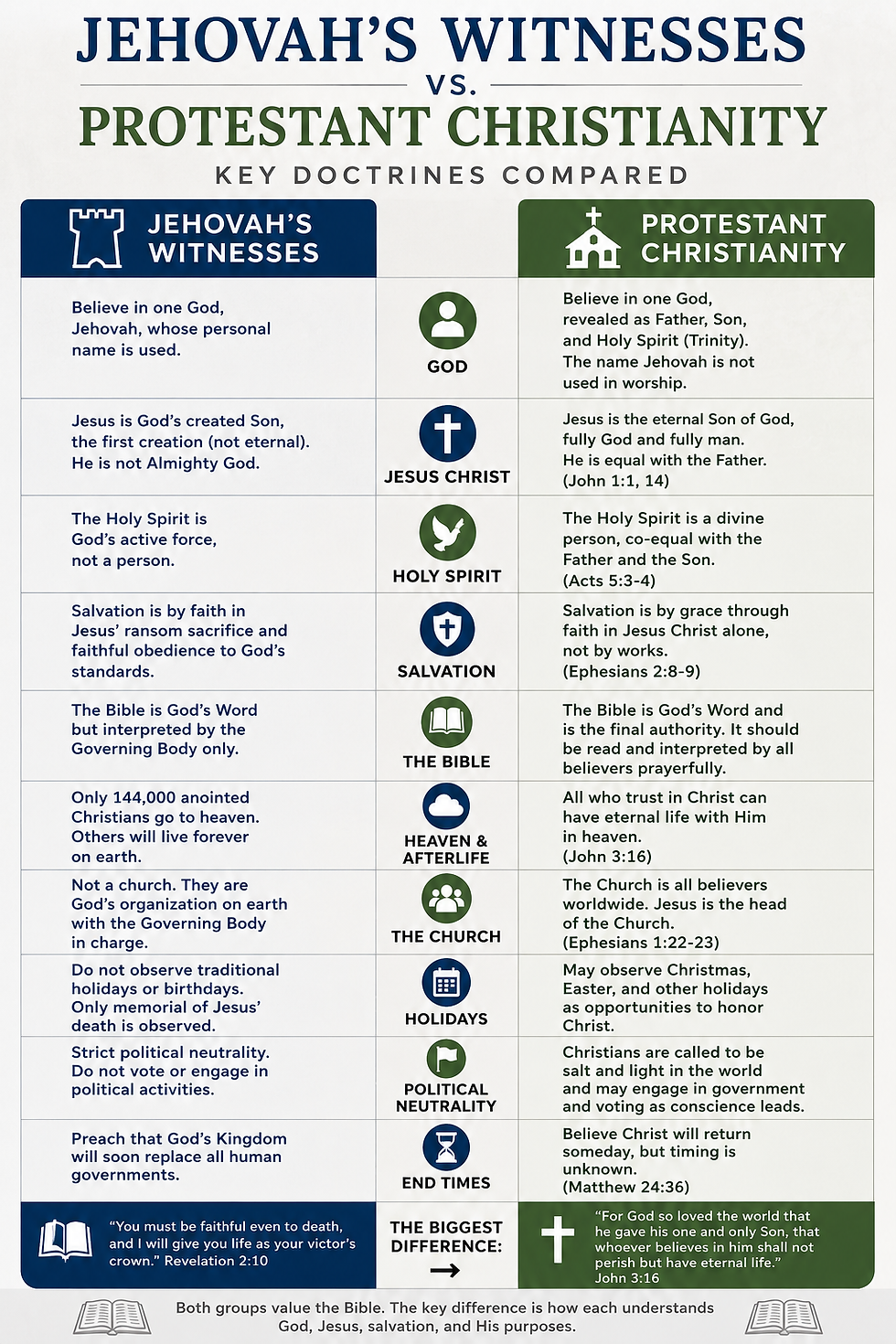
Jesus is not Almighty God (but a created being, identified with Michael the Archangel)
The Holy Spirit is not a person, but God’s active force
The Trinity is rejected
Only 144,000 go to heaven (literal interpretation)
Evangelism and end-times emphasis are central
👉 These differ significantly from historic Christian doctrine established in early creeds.
📌 5. Why these differences exist historically
Jehovah’s Witness beliefs developed through:
Late 19th-century Bible reinterpretation movement
Rejection of traditional creeds (like Nicene Creed)
Focus on restoring what they believed was “original Christianity”
👉 This makes them a restorationist movement, not a continuation of early apostolic Christianity.
⚠️Key historical distinction
Mainstream Christianity (Catholic, Orthodox, Protestant):
Traces doctrine through early church councils and creeds (1st–4th centuries)
Jehovah’s Witnesses:
Emerge ~1,800 years later
Reject key early doctrinal developments (especially Trinity)
👉 So the difference is not just interpretation—it is historical development timeline.
📌 6. Why the “different perspective” matters
Jehovah’s Witnesses:
Read Scripture through a distinct doctrinal framework
Translate key passages differently
Reject established creedal formulations
👉 Therefore, differences are not just minor variations—they are foundational worldview differences.
📌7. Important clarification
This is not about attacking individuals. Jehovah’s Witnesses:
Are sincere in belief
Strong in evangelism and moral discipline
See themselves as restoring biblical truth
👉 The discussion is about doctrinal history and interpretation differences, not intent.
📖 Key takeaway:
Jehovah’s Witnesses have a different name and perspective because they are a modern restorationist movement that developed distinct doctrinal interpretations and translation choices, especially regarding the nature of God, Jesus, and the Trinity.
👉 The real question is not simply “Why are they different?”
👉 But “Do their interpretations align with the earliest historical Christian teachings and the broader manuscript and doctrinal tradition of the early Church?” —the answer to this question is no.
✍️ “Do not believe every spirit, but test the spirits to see whether they are from God…” -1 John 4:1
3. Why do Latter-day Saints (Mormons) have a different perspective?”
💬 Short answer:
The Church of Jesus Christ of Latter-day Saints (commonly called Mormons) is a 19th-century restorationist movement founded by Joseph Smith. It developed additional scriptures and doctrines beyond the Bible, based on later claimed revelations. Their differences come from new foundational texts and teachings introduced in the 1800s, not from early historic Christianity.
📋 Expanded:
📌 Who are Latter-day Saints (Mormons)?
The Church of Jesus Christ of Latter-day Saints was founded in the 1820s–1830s in the United States by Joseph Smith.
👉 Joseph Smith claimed to restore the “original church” through divine revelation.
🧠 1. What Joseph Smith actually claimed
According to his own accounts:
He was visited by an angel named Moroni
This angel told him about a set of buried gold plates
The plates were said to contain an ancient record written in a form of Egyptian
Smith later retrieved them and translated them into what became Book of Mormon
📜 2. The process he described
Smith said:
the angel directed him to the plates’ location (in New York)
he was allowed to take them after several visits
he translated them by divine assistance (often described as using “seer stones” or interpreters)
So the sequence is: 👉 angelic visitation → discovery of plates → translation → published scripture
🌎 3. How this is viewed
Within Latter-day Saint belief:
• This is a true historical and divine event
• The plates were real, and the translation was inspired
Outside that tradition:
• Historians generally treat it as a religious claim made by Joseph Smith
• Interpretations vary (sincere visionary, religious innovator, etc.)
📌 Mormons additional scriptures
In addition to the Bible, they accept:
The Book of Mormon
Doctrine and Covenants
Pearl of Great Price
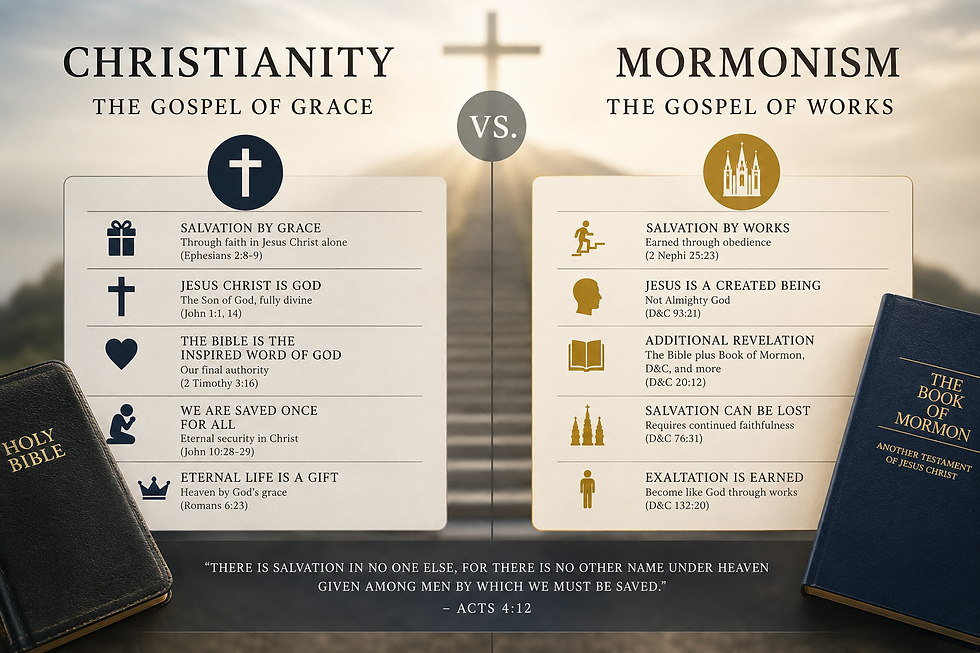
👉 These are considered equally authoritative with the Bible in LDS teaching.
📌 How their beliefs differ from mainstream Christianity
Latter-day Saints teach:
God the Father, Jesus Christ, and the Holy Spirit are distinct beings (rejecting the Trinity)
God the Father has a physical body (in LDS theology)
Humans can progress toward exaltation (becoming like God in a qualitative sense)
Salvation includes faith in Christ plus ordinances and covenant practices
👉 These teachings differ significantly from historic Christian doctrine found in early creeds.
📌 Why the differences exist historically
LDS beliefs developed through:
Claims of new revelation beginning in the 1820s
The publication of the Book of Mormon (1830)
Restorationist theology (belief that Christianity had been corrupted and needed restoring)
👉 This places Mormonism as a modern restoration movement, not a continuation of early apostolic Christianity.
📌 Why the differences matter
Latter-day Saints:
Read the Bible alongside additional teachings
Interpret key doctrines through Joseph Smith’s revelations
Reconstruct core Christian teachings (God, salvation, revelation)
👉 So differences are not just interpretive—they come from an expanded foundation of teachings not found in scripture.
⚠️ Key historical distinction
Mainstream Christianity (Catholic, Orthodox, Protestant):
Bases doctrine on the Bible and early creeds (1st–4th centuries)
Latter-day Saints:
Add 19th-century revelations and teachings
Reframe core doctrines through restoration theology
👉 This creates a fundamentally different doctrinal framework rather than a variation within early Christianity.
📖 Key takeaway:
Latter-day Saints have a different name and perspective because they are a 19th-century restorationist movement built on additional teachings and later revelations that significantly reshape core Christian doctrines.
👉 The central question becomes:
👉 “Do these later revelations and additional teachings align with or redefine the teachings of early Christianity preserved in the New Testament and early Church tradition?”
⚠️ No—traditional Christianity does not see those later revelations as consistent with the New Testament faith.
✍️ “... Evidently some people are throwing you into confusion and are trying to pervert the gospel of Christ. But even if we or an angel from heaven should preach a gospel other than the one we preached to you, let them be under God’s curse!” -Galatians 1:7-8
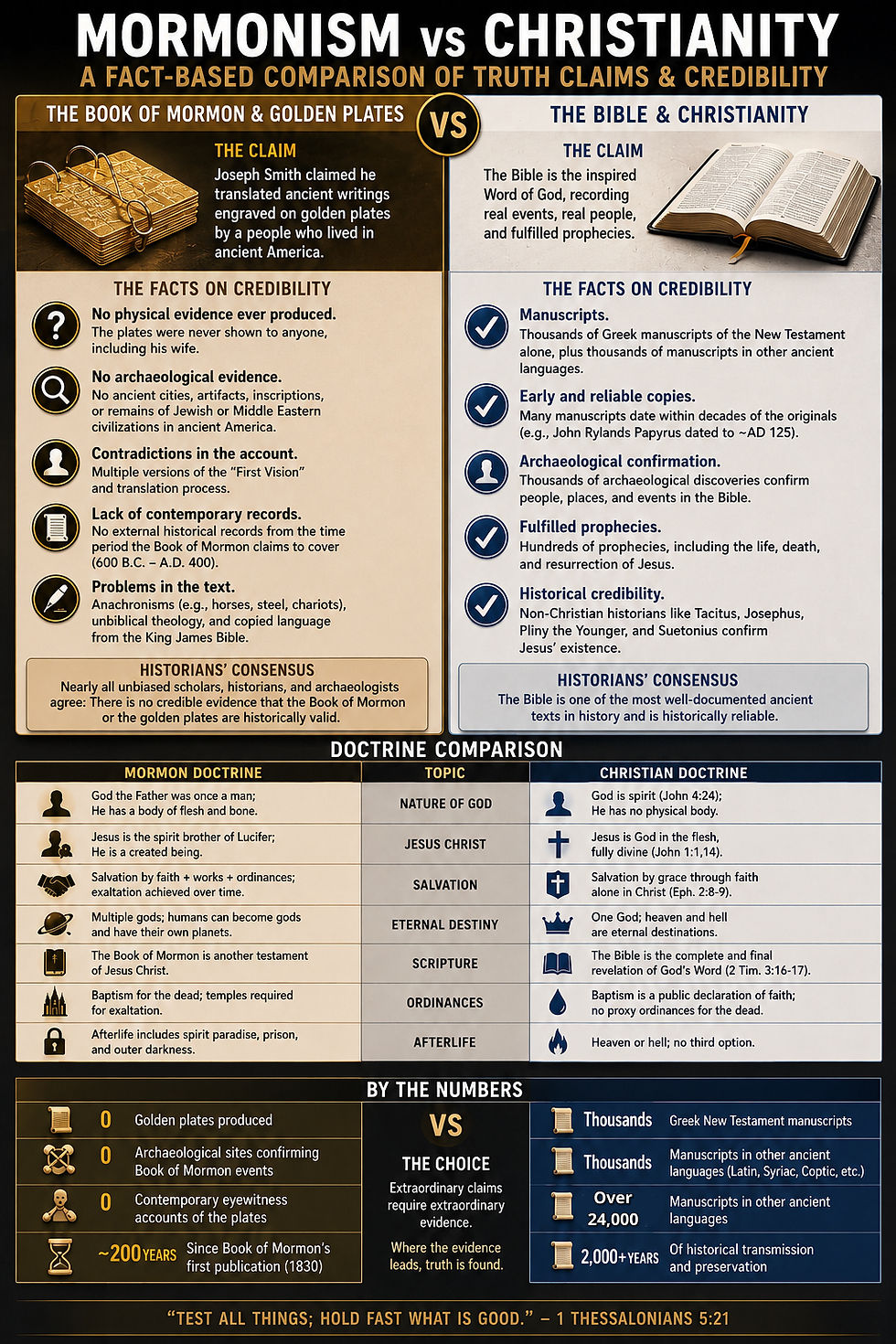
-3.1 Did the gold plates described by Joseph Smith actually exist, and is there proof?
🧠 1. What Joseph Smith claimed
Smith said an angel—Moroni—directed him to buried metal plates, which he translated into the Book of Mormon.
He also said:
the plates were returned to the angel after translation
therefore, they are not available for inspection today
📜 2. The primary historical evidence: witness testimony
A. The Three Witnesses
Three associates (Oliver Cowdery, David Whitmer, Martin Harris) signed a statement saying:
an angel showed them the plates
they heard God affirm the translation
B. The Eight Witnesses
Eight others signed a separate statement saying:
they physically handled the plates
they saw and lifted them
👉 These statements were printed in early editions of the Book of Mormon and are still included today.
⚖️ 3. How historians evaluate these testimonies
Historians note:
✔️ Strengths
multiple named witnesses
written statements close in time to events
some witnesses reaffirmed their testimony later in life
❗ Limitations
witnesses were close associates or believers
no independent or hostile verification
accounts differ in how the experience occurred (visionary vs physical emphasis)
So: 👉 the evidence is testimonial, not physical
🏺 4. Physical / archaeological evidence
❌ What we do NOT have:
no surviving gold plates
no confirmed archaeological record matching the described plates
no inscriptions verified as the language Smith described
✔️ What exists:
early manuscripts of the translation
printing history of the Book of Mormon
artifacts related to Smith’s life (not the plates themselves)
🧠 5. Scholarly consensus
Most historians (religious and secular) agree:
There is no empirical proof of the plates’ existence
The claim rests on Joseph Smith’s account and witness testimony
The event cannot be independently verified using standard historical methods
📖 6. Important distinction: history vs belief
Historical method asks:
Is there physical evidence?
Are there independent sources?
Can the claim be tested?
Religious belief asks:
Is the testimony trustworthy?
Is the experience spiritually credible?
So conclusions differ:
Within Latter-day Saint belief:
witnesses are considered credible
plates are accepted as real historical objects
In academic history:
the plates are considered an unverified claim
not demonstrable as a historical artifact
📌 7. Clear conclusion
There is no independently verifiable physical or archaeological evidence for the gold plates described by Joseph Smith. The historical record consists of early witness testimonies and Smith’s own accounts, which are significant as documents of belief but do not constitute empirical proof. As a result, historians classify the existence of the plates as a matter of religious claim rather than established historical fact.
📚 8. Key sources
Primary:
Witness statements in early editions of the Book of Mormon
Joseph Smith’s own histories and accounts
Scholarly:
Richard L. Bushman — Joseph Smith: Rough Stone Rolling
Grant Palmer — An Insider’s View of Mormon Origins
Terryl Givens — By the Hand of Mormon
4. Why do Catholics have additional books in their Bible?
💬 Short answer:
Catholicism is not a later “different version” of Christianity—it is one of the original historical branches of the early Church. The difference in their Bible comes from which ancient collection of Old Testament books they recognized, not from adding new writings later.
📋 Expanded:
📌 Are Catholics a later development?
No—this is an important distinction.
The Catholic Church traces its roots directly to the early Christian community of the 1st century.
👉 Unlike groups like Jehovah’s Witnesses or Latter-day Saints:
Catholicism did not begin in the 1800s
It developed continuously from the earliest church
👉 So the question is not:“Why did Catholics change the Bible?”
⚠️ But:“Which collection of books did different branches of Christianity recognize?”
📌 What are the “additional books”?
Catholic Bibles include what are called the Deuterocanonical books, such as:
Tobit
Judith
Wisdom of Solomon
Sirach (Ecclesiasticus)
Baruch
1 & 2 Maccabees
👉 These books are often referred to by Protestants as the Apocrypha.
📌 Where did these books come from?
These writings were part of an ancient Greek translation of the Old Testament called the Septuagint (LXX), produced between the 3rd–2nd centuries BC.
👉 Key historical point:
The Septuagint was widely used by Greek-speaking Jews
It was the most commonly used Old Testament in the time of Jesus
Many Old Testament quotations in the New Testament align with it
👉 This means early Christians were already familiar with these books.
📌 Why do Protestants have fewer books?
During the Protestant Reformation, Reformers chose to follow a different Old Testament tradition. They aligned more closely with the Hebrew canon used in later Jewish tradition, which did not include the Deuterocanonical books.
👉 Reasons included:
Preference for Hebrew over Greek texts
Questions about whether these books were part of the original Jewish canon
Concerns about certain teachings in those books
📌 Important historical clarification
⚠️ The Catholic Church did not “add” books in the 1500s.
Instead, at the Council of Trent (1546):
👉 The Church formally affirmed the books it had already been using for centuries.
✔️ These books had been:
Included in many early Christian manuscripts
Used in church readings
Accepted in earlier regional councils
👉 Trent was a response to the Reformation, not a new addition.
📌 What about early Christianity?
In the early centuries, there was some variation in which Old Testament books were listed, but:
Many early Christians used the Septuagint
Some church leaders accepted these books, others questioned them
The New Testament canon itself took time to be universally recognized
👉 This shows the process was one of recognition over time, not sudden invention.
📌 Do Catholics and Protestants differ on the New Testament?
❌ No.
Both Catholic and Protestant Bibles contain:
The same 27 New Testament books
👉 The difference is only in part of the Old Testament.
📌 Why the difference matters
Catholics:
Accept the Deuterocanonical books as Scripture
See them as part of the Church’s historical tradition
Protestants:
Consider them useful historically or devotionally
But not equal to Scripture
👉 So the difference is about authority and tradition, not hidden or newly discovered texts.
📌 Common misconception
❌ “Catholics added extra books to the Bible”
✅ These books were part of an ancient tradition used before the Reformation
📖 Key takeaway:
Catholicism is not a modern reinterpretation—it is a historically continuous branch of early Christianity.
👉 The difference in their Bible comes from:
Which ancient Old Testament tradition they followed
How they understand the authority of Church tradition
⚠️ Not from adding new or “lost” books later in history.
-4.1 Key doctrinal differences (Catholicism & salvation)
While Catholics and Protestants share many core Christian beliefs (such as the Trinity, the divinity of Christ, and the authority of Scripture), there are important differences in how certain doctrines—especially salvation—are understood.
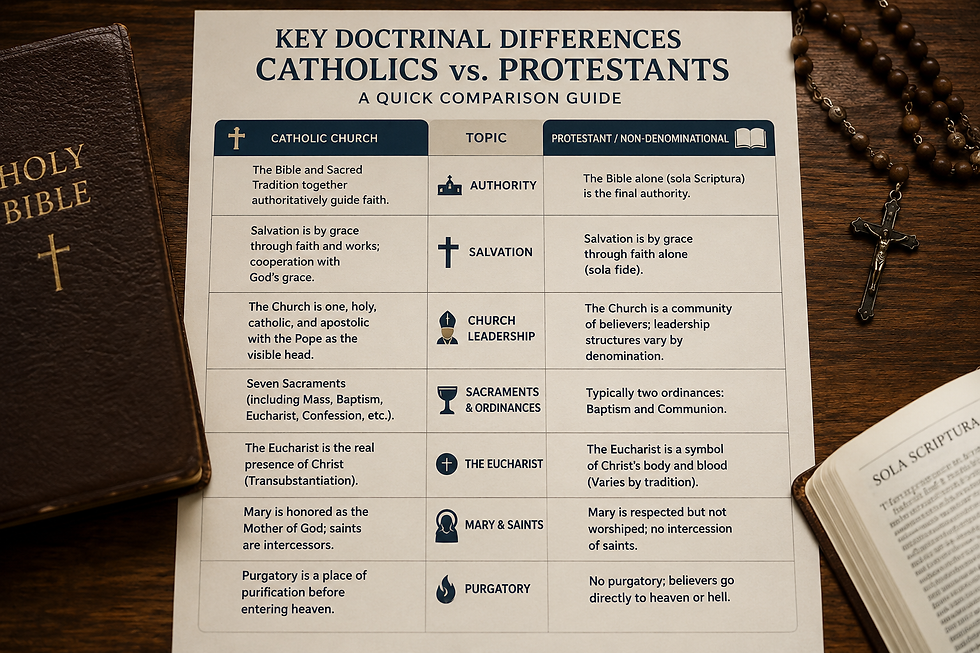
🛑 1. Salvation: faith and works
Catholic teaching emphasizes:
Salvation begins with God’s grace
Faith is essential
But must be lived out through obedience, sacraments, and good works
👉 Salvation is seen as a process (justification + ongoing sanctification)
In many Protestant traditions:
Salvation is by grace through faith alone (sola fide)
Good works are the result of salvation, not a contributing cause
👉 This reflects a key theological divide that became central during the Protestant Reformation.
🛑 2. Authority: Scripture and tradition
The Catholic Church teaches that authority comes from:
Scripture
Sacred Tradition
The teaching authority of the Church (Magisterium)
👉 These are seen as working together.
Most Protestant traditions hold to:
Scripture alone (sola scriptura) as the final authority
👉 This affects how doctrine is interpreted and developed.
🛑 3. Role of the Church and sacraments
Catholicism teaches that:
The Church plays a central role in dispensing grace
Sacraments (like baptism and the Eucharist) are means of grace necessary in the life of the believer
👉 There are traditionally seven sacraments
Many Protestant traditions:
Recognize fewer sacraments (usually 2: baptism and communion)
See them more as symbols or ordinances, rather than channels of saving grace
🛑 4. Confession and forgiveness
Catholics practice confession through a priest:
Seen as a means of receiving forgiveness and reconciliation
Many Protestants emphasize:
Direct confession to God through Christ as mediator
👉 Based on passages like 1 Timothy 2:5
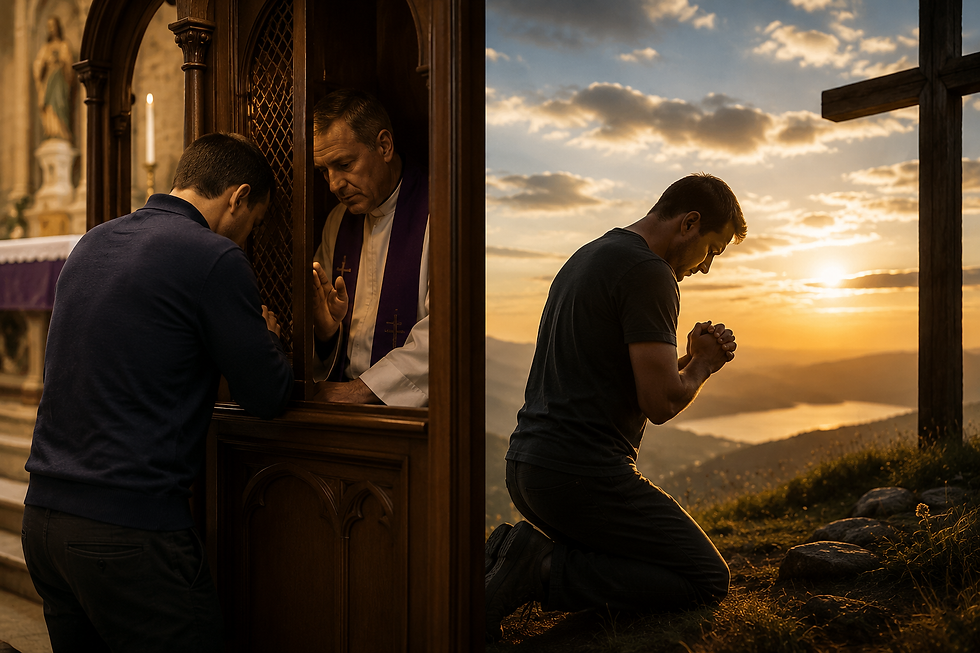
"For there is one God and one mediator between God and mankind, the man Christ Jesus." -1 Timothy 2:5
🛑 5. Additional doctrines
Catholic teaching includes beliefs such as:
Purgatory (a state of purification after death)
Veneration of saints (not worship, but honor and intercession)
A distinct role for Mary
👉 These developed over time within Church tradition.
Most Protestant traditions:
Do not accept these doctrines as biblically supported
Emphasize Christ alone as mediator
📖 Key takeaway:
Catholics and Protestants agree on many foundational truths of Christianity, but differ on:
How salvation is understood (faith alone vs. faith expressed through works and sacraments)
What authority defines doctrine (Scripture alone vs. Scripture + tradition)
The role of the Church in mediating grace
👉 These differences developed over centuries and became clearly defined during the Reformation.
⚠️ The discussion is not about sincerity—but about how doctrine is historically understood and interpreted.
✍️ Ephesians 2:8–9
“For by grace you have been saved through faith. And this is not your own doing; it is the gift of God, not a result of works, so that no one may boast.”
✍️ Ephesians 2:10
“For we are his workmanship, created in Christ Jesus for good works, which God prepared beforehand, that we should walk in them.”
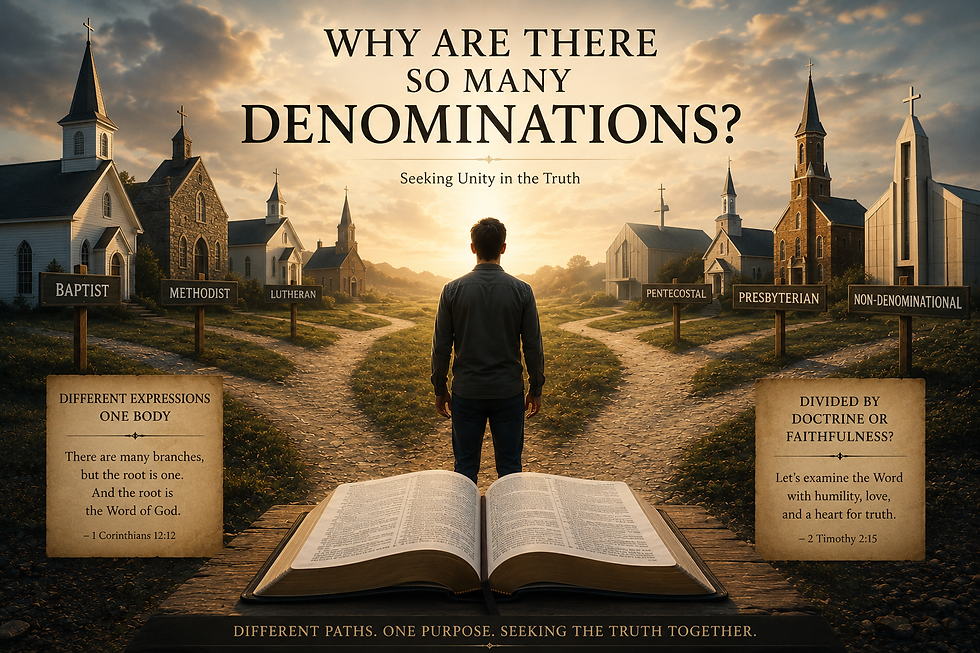
5. Why are there so many denominations if the Bible is clear?
💬Short answer:
Most Christian divisions are over secondary or interpretive issues, not the core message of the gospel. While Christians differ on certain doctrines and practices, there is broad agreement on central truths about Jesus, salvation, and Scripture. These divisions reflect human interpretation, historical development, and spiritual disagreement—not necessarily confusion in the core message itself.
📋Expanded:
📌1. Core Christian beliefs are widely shared
Across most major Christian traditions, there is strong agreement on foundational doctrines such as:
The existence of one God
The deity and resurrection of Jesus
Salvation through Christ
The authority of Scripture (in varying expressions)
👉 The differences usually emerge around secondary issues, such as:
Church structure
Baptism methods
Spiritual gifts
End-times interpretation
Worship style
📌2. Distinction between essential and non-essential doctrines
A key clarification:
👉 Not all theological differences are equal in weight.
Essential: salvation, identity of Christ, resurrection
Secondary: interpretive and structural differences
Tertiary: practices and preferences
👉 Most denominational differences fall outside the core message of the gospel.
📌3. Human interpretation plays a major role
Even with the same text, differences arise because:
Language and translation nuances
Historical and cultural context
Theological tradition and emphasis
Different methods of interpretation
👉 This reflects human limitation, not necessarily textual contradiction.
👉Many would argue this also reflects the work of evil forces set out to divide and conquer believers and potential believers of Christ.
📌4. Biblical expectation of unity
📖Ephesians 4:4–6 → emphasizes one body, one Spirit, one faith
📖1 Corinthians 1:10 → calls believers to agreement and unity
👉 The biblical ideal is unity in the core message, even amid diversity in expression.
📌5. Why division still exists
The New Testament also acknowledges tension within the church:
Disagreements existed even in the earliest communities
Paul addresses doctrinal and relational conflicts repeatedly
👉 This shows that division is not new—it has been present from the beginning due to human disagreement and maturity levels.
📌6. Spiritual and human factors together
From a biblical worldview, division is often explained through both:
Human fallibility (misinterpretation, pride, cultural influence)
Spiritual opposition to unity and truth
👉 These are not mutually exclusive explanations—they operate together in the biblical framework.
📚Scholarly framing:
N.T. Wright: emphasizes that early Christianity already contained diversity within unity around core apostolic claims
F. F. Bruce: highlights strong agreement on central Christian texts and beliefs despite later institutional divisions
📖Key takeaway:
The existence of denominations does not necessarily mean the Bible is unclear.
👉 It reflects differences in interpretation, tradition, and emphasis—while core Christian beliefs remain widely shared.
So the real question becomes:
👉 “Are the central teachings of Christianity actually unclear—or are they widely agreed upon while secondary issues vary?”
And historically, the evidence points to strong agreement on the essentials.
📖Biblical foundation:
Ephesians 4:4–6 → unity in one faith and one body
1 Corinthians 1:10 → call for unity and agreement
✍️ “And no wonder, for Satan himself masquerades as an angel of light.” -2 Corinthians 11:14
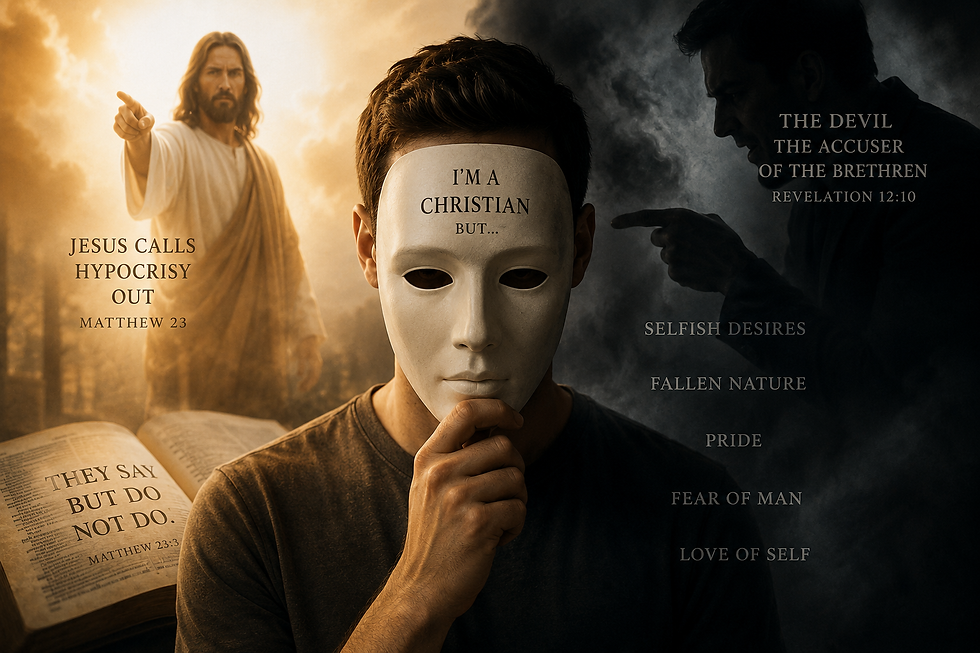
6. Why do some Christians act so hypocritically?
💬Short answer:
The Bible openly acknowledges and condemns hypocrisy. Christianity does not claim its followers are perfect—rather, it teaches that believers are in a process of transformation. Hypocrisy occurs when people fail to live consistently with what they profess, not because the message itself promotes it.
📋Expanded:
📌1. The Bible explicitly condemns hypocrisy
Jesus Himself strongly critiques religious hypocrisy:
📖Matthew 23:27–28 → He rebukes outward appearances of righteousness without inward integrity
👉 This shows:
Hypocrisy is not excused in Christianity
It is directly confronted within the teachings of Jesus
📌2. Christianity distinguishes between message and messengers
A key clarification:
👉 The truth of Christianity is not dependent on perfect behavior from Christians.
The message is about God and salvation
The followers are people in progress
📌So failure of individuals does not equal failure of the belief system.
📌3. Christians are described as imperfect and in process
📖Romans 3:23 → “All have sinned and fall short of the glory of God”
👉 This establishes:
No follower of Christ is morally perfect
Transformation is ongoing, not instant
📌4. Hypocrisy happens when belief and behavior don’t align
In practical terms, hypocrisy is not unique to Christianity:
👉 It occurs whenever someone:
Claims a standard
But fails to live by it consistently
📌Christianity actually defines this gap as something to be addressed, not ignored.
📌5. The Bible anticipates internal failure
Scripture repeatedly acknowledges that:
Believers will struggle with sin
Churches will contain imperfect people
Leaders are accountable to higher standards
👉 This realism is part of the biblical worldview, not a contradiction of it.
📌6. Transformation is the intended direction, not instant perfection
Christianity presents spiritual growth as a process:
Awareness of sin
Repentance and change
Gradual alignment with Christ-like character
👉 Hypocrisy is what happens when that process is resisted or incomplete—not when Christianity is functioning as intended.
📚Scholarly framing:
N.T. Wright: emphasizes that early Christian ethics were centered on transformation of behavior, not instant moral perfection
Craig Keener: notes that early Christian communities were realistic about internal struggles and moral failure
📖Key takeaway:
Hypocrisy in Christianity does not come from the teachings themselves, but from the gap between belief and practice in imperfect people.
👉 The Bible does not excuse hypocrisy—it names it, confronts it, and calls people toward consistency and transformation.
📖Biblical foundation:
Matthew 23:27–28 → direct condemnation of hypocrisy
Romans 3:23 → universal human imperfection
✍️ “ Woe to you, scribes and Pharisees, hypocrites! For you are like whitewashed tombs which on the outside appear beautiful, but inside they are full of dead men’s bones and all uncleanness. So you, too, outwardly appear righteous to men, but inwardly you are full of hypocrisy and lawlessness.” -Matthew 23:27-28
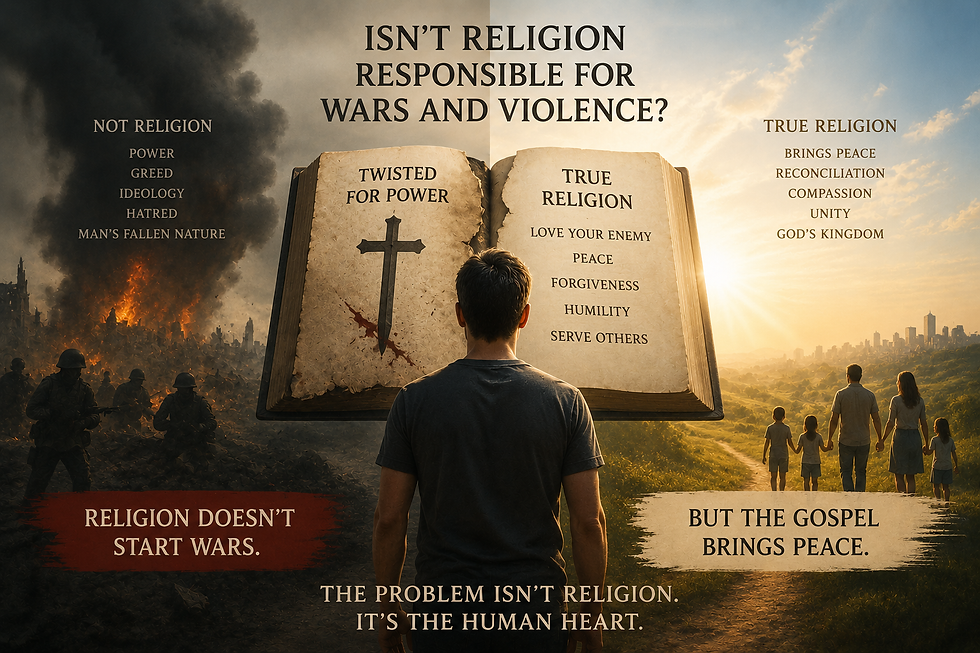
7. Isn’t religion responsible for wars and violence?
💬 Short answer:
Violence is rooted in human sin—religion is often a channel people use to justify it, but not its ultimate source. Throughout history, political power, ethnic conflict, and ideology have all produced violence as well. In contrast, Jesus consistently taught peace, love of enemies, and self-sacrifice.
📋 Expanded:
📌 1. The real source of violence in the biblical view
The Bible does not locate the root of conflict in religion itself, but in the human condition:
📖 James 4:1
“What causes fights and quarrels among you? Don’t they come from your desires that battle within you?”
👉 The emphasis is internal:
pride
greed
fear
power struggles
unchecked desire
📌 In this framework, external systems (including religion) can become vehicles for what is already in the human heart.
📌 2. Religion as a tool vs religion as a cause
Across history, religious language has sometimes been:
used to justify wars
tied to political expansion
mixed with national identity
👉 But the same pattern exists outside religion:
political ideologies
ethnic nationalism
economic systems
revolutionary movements
📌 This is why many historians distinguish between:
the cause of violence (human motives)
the justification used for violence (ideology, religion, politics, etc.)
📌 3. What Jesus actually taught about conflict
Jesus’ teaching consistently moves in the opposite direction of violence and coercion:
📖 Matthew 5:9
“Blessed are the peacemakers, for they will be called children of God.”
📖 Matthew 5:44
“Love your enemies and pray for those who persecute you.”
📌 These teachings emphasize:
restraint over retaliation
love over revenge
reconciliation over domination
👉 This stands in contrast to the idea that Christianity itself promotes violence.
📌 4. The life of Jesus as a model
Jesus does not advance His message through force:
He rejects political revolution by violence
He refuses to call down destruction on His opponents
He ultimately submits to suffering rather than inflicting it
📌 Central Christian claim: His death is presented as self-sacrifice, not coercion.
📌 5. The distinction often missed in this debate
A key distinction in the biblical framework is:
👉 Human misuse of a system
≠
👉 The core teaching of the system itself
📌 So the question becomes:
Does the misuse of religion reflect its core message? Or…
Does it reflect human distortion of it?
📖Key takeaway:
The Bible locates the root of violence in human desire and sin, not in religion itself. While religion can be misused, Jesus’ central teachings emphasize peace, love, and self-sacrifice rather than coercion or violence.
✍️ “If it is possible, as far as it depends on you, live at peace with everyone.” -Romans 12:18
-7.1 What about God ordering war and violence?
💬 Short answer:
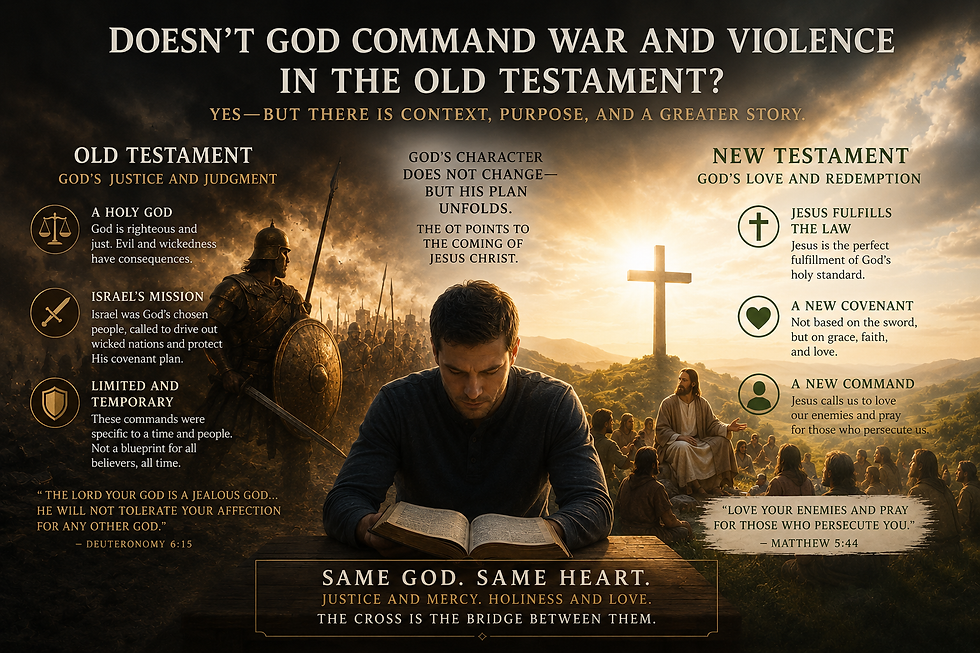
This is one of the hardest questions in the Bible and deserves careful treatment. In the Old Testament, certain wars are presented not as ordinary human aggression, but as unique historical judgments within a specific covenant context. Christians differ on how to fully understand these passages, but they are not presented as open-ended commands for believers to spread faith through violence.
📋 Expanded:
📌 1. The Old Testament describes specific moments where God judges nations involved in extreme wickedness, violence, and oppression.
📌 These events are presented as:
limited in scope
tied to a particular historical period
connected to Israel’s role in redemptive history
👉 They are not portrayed as universal commands for all believers or all nations.
📌 2. Christians also note that Jesus does not command His followers to spread Christianity through warfare or forced conversion.
Instead, His teachings emphasize:
loving enemies
forgiveness
peacemaking
voluntary faith rather than coercion
📌 This is why most Christians distinguish between:
descriptive historical judgments in the Old Testament
and
the ongoing ethical teachings Christians are called to follow through Jesus.
📌 3. These passages remain difficult and debated, even among Christians. But they are not equivalent to saying “violence is good” or that Christianity authorizes unlimited religious warfare.
📖Key takeaway:
The Bible’s difficult war passages are presented as specific historical judgments, not a general command for Christians to use violence. Jesus’ central teachings move toward peace, mercy, and love of enemies.
Christians understand the Old Testament and New Testament as part of one continuous story rather than two disconnected moral systems. The Old Testament describes humanity in a deeply fallen world marked by violence, tribal conflict, and harsh realities, while also beginning God’s gradual work of revealing justice, holiness, mercy, and redemption through history.
The New Testament then presents the fuller revelation of that restoration through Jesus, moving humanity away from its fallen tendencies toward hatred, revenge, and violence, and toward transformation into Christ-like character.
📖 Ephesians 4:22–24 “Put off your old self… and put on the new self, created to be like God in true righteousness and holiness.”
📖 Galatians 5:22–23 “The fruit of the Spirit is love, joy, peace, patience, kindness, goodness, faithfulness, gentleness and self-control.”
👉 In this framework, the Bible’s overall trajectory moves toward restoration, reconciliation, and peace—not the glorification of human violence.
For a fuller discussion of Old Testament violence and judgment passages, see Part-2 of this series.
✍️“Do not conform to the pattern of this world, but be transformed by the renewing of your mind.” -Romans 12:12
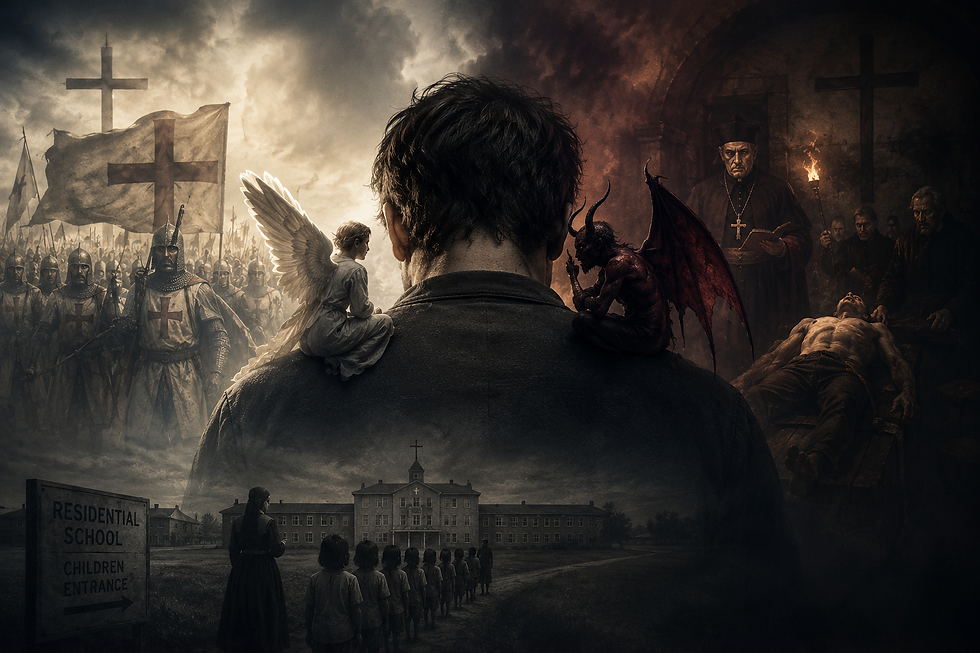
-7.2 What about the Crusades, Inquisitions, residential schools, and violence done in Christianity’s name?
💬 Short answer:
Many actions done in the name of Christianity throughout history caused real harm and deserve honest acknowledgment. Christians generally distinguish between the teachings of Jesus and the actions of individuals, institutions, or governments that acted contrary to those teachings.
📋 Expanded:
📌 Historical events such as:
parts of the Crusades
certain inquisitions
forced conversions
abuses connected to state churches
and some residential school systems
⚠️have left deep wounds and remain serious moral concerns.
📌 In many cases, political power, nationalism, colonization, fear, and institutional control became intertwined with religion.
👉 Critics argue this shows Christianity is harmful.
👉 Christians respond that these actions often reflected departures from Jesus’ teachings rather than faithful obedience to them.
📌 Jesus consistently taught:
love of enemies
mercy
humility
care for the vulnerable
voluntary faith rather than coercion
📖 Matthew 20:25–28 - Jesus rejects domineering leadership and teaches servant leadership instead.
📖 John 18:36 “My kingdom is not of this world.”
📌 Because of this, many Christians argue that coercion, abuse, and violence done in Christ’s name contradict the model Jesus Himself demonstrated.
📌 The New Testament also repeatedly warns that religious hypocrisy and corruption will exist even among people who outwardly claim to follow God.
📖 Matthew 7:15–16
“Watch out for false prophets… By their fruit you will recognize them.”
📖 Titus 1:16
“They claim to know God, but by their actions they deny him.”
👉 In this framework, abuses committed under religious labels are understood not as proof of Christianity’s truthfulness or falsehood, but as evidence of humanity’s ongoing capacity to corrupt even good things.
📖Key takeaway:
Christians do not need to deny or excuse historical wrongs committed in Christianity’s name, nor should they. The central question is whether those actions reflected the teachings of Jesus—or violated them.
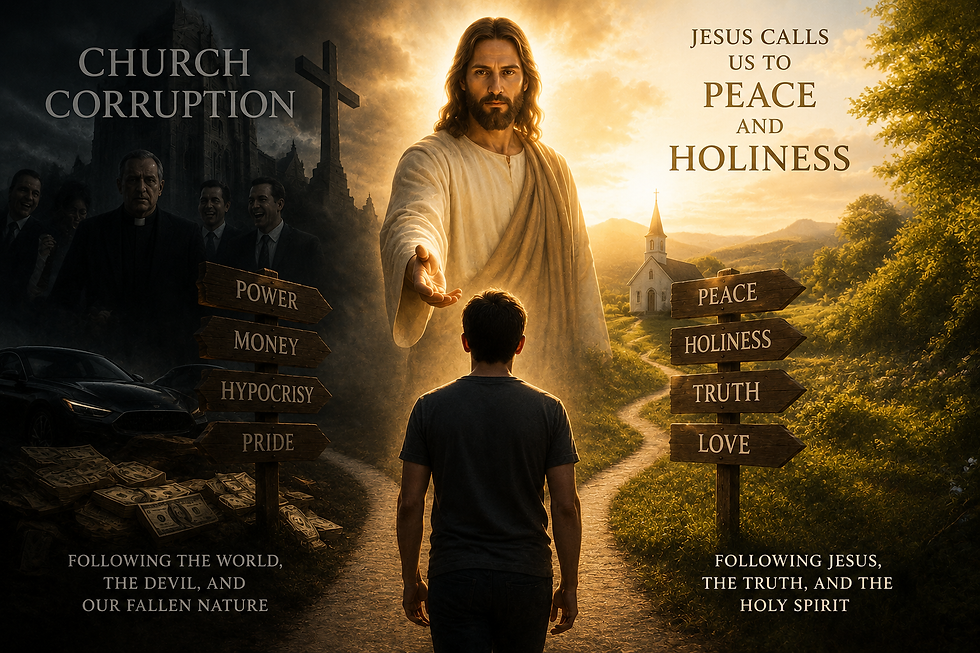
👉Christianity ultimately points people back to Christ Himself as the standard, not the failures of every person or institution claiming to represent Him.
✍️ “For our struggle is not against flesh and blood, but against the rulers, against the authorities, against the powers of this dark world and against the spiritual forces of evil in the heavenly realms.” - Ephesians 6:12
8. "Christianity is oppressive and controlling.”
💬Short answer:
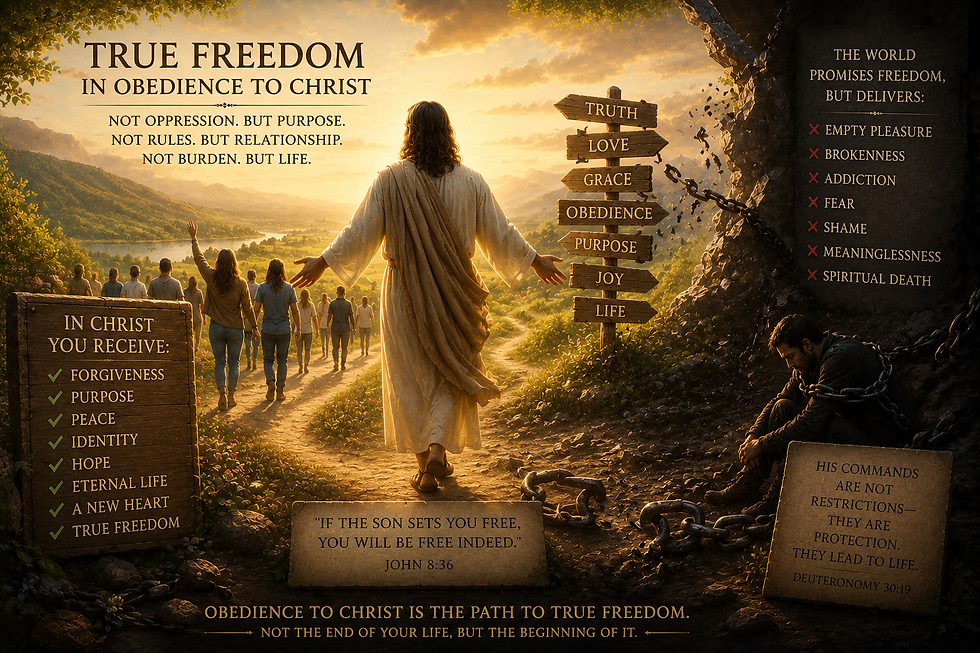
Christianity, at its core, does not present itself as a system of human control, but as freedom from sin and restoration to God. The Bible distinguishes between human misuse of religion and the message of Christ, which emphasizes willing faith, love, and inner transformation rather than coercion.
📋Expanded:
📌What people usually mean by this claim
This objection often comes from:
Historical abuses done in the name of Christianity
Religious institutions exerting control over people
Personal experiences with legalism or manipulation
The assumption that “religion = restriction”
👉 Important distinction:
Criticism of human behavior ≠ critique of the core message.
📌What Christianity actually claims about freedom
Biblical Christianity repeatedly frames faith as freedom—not control.
📖 John 8:36 - “So if the Son sets you free, you will be free indeed.”
👉 This “freedom” refers to:
Freedom from sin’s control
Freedom from guilt and condemnation
Freedom to live in restored relationship with God
Freedom to be what you were created to be
📌Freedom vs. autonomy confusion
A key misunderstanding is equating freedom with:
Doing anything you want
Rejecting all moral structure
But biblically:
Not all choices lead to life or wholeness
Some “freedoms” become forms of bondage (addiction, harm, destruction)
👉 Christianity defines freedom as:
“Being restored to what you were created for.”
📌Control vs transformation
Christianity does not present God as forcing obedience, but transforming the heart:
📖 2 Corinthians 3:17
“Where the Spirit of the Lord is, there is freedom.”
👉 The emphasis is:
Inner change, not external coercion
Willing obedience, not forced compliance
Transformation of desires, not suppression of personality
📌Jesus’ model of leadership
Jesus consistently rejects coercion:
🩸He invites rather than forces:
• “Follow me” (invitation, not compulsion)
🩸He critiques religious legalism:
• Condemns leaders who “tie up heavy burdens” on others (Matthew 23:4)
🩸He emphasizes love as motivation:
• John 14:15 → “If you love me, keep my commandments”
👉 The model is relational, not authoritarian control.
🛑Where the “oppressive” perception often comes from
Historically and practically, oppression often comes from:
Human institutions misusing authority
Legalistic interpretations of faith
Cultural or political power structures tied to religion
Individuals enforcing rules without compassion
👉 Christianity itself acknowledges this problem: Jesus directly criticizes religious leaders who distort God’s law for control.
📌Biblical distinction: message vs misuse
The Bible separates:
The teaching of Christ
The behavior of those who claim to represent Him
📖 Matthew 23:27–28
Jesus rebukes religious leaders for outward control with inward corruption.
👉 So even within Scripture, “religious oppression” is condemned—not endorsed.
📌True Christian freedom is not lack of structure
Christianity does not define freedom as absence of boundaries, but as:
Being freed from destructive patterns
Being aligned with truth and love
Being restored to right relationship with God and others
👉 Like any moral framework, it includes direction—but not coercion.
📖Supporting verses:
Galatians 5:1 → “It is for freedom that Christ has set us free”
Romans 8:1 → “No condemnation for those in Christ Jesus”
Matthew 11:28 → “I will give you rest”
🌍Why this matters:
This objection often assumes:
All religion functions as control
Authority automatically equals oppression
But Christianity claims something different:
Freedom through transformation, not enforcement
Love as the motivating force
Voluntary response rather than compulsion
📖Key takeaway:
Christianity distinguishes itself from coercive systems by presenting freedom as liberation from sin and restoration to God, not control over people’s lives. When it is practiced contrary to that, it is a distortion of its own stated message.
👉 The real question is not whether religion can be misused (it can), but whether the core teaching of Christ is fundamentally controlling—or freeing.
✍️ “So if the Son sets you free, you will be free indeed.” -John 8:36
✍️ "If you abide in my word, you are truly my discipes. Then you will know the truth, and the truth will set you free." - John 8:31–32
✍️ ..."whoever looks intently into the perfect law of liberty and continues in it… they will be blessed in what they do.” -James 1:25
Comments