
Hell, Violence, Sexuality, Slavery & Free Will: Part 2 — Wrestling with Christianity’s Hardest Questions
- May 8
- 30 min read
Note: Due to margins from the dropdown list, this blog is easier to read on tablet or computer.
For many people, the greatest obstacle to Christianity is not science or history
—it is morality.
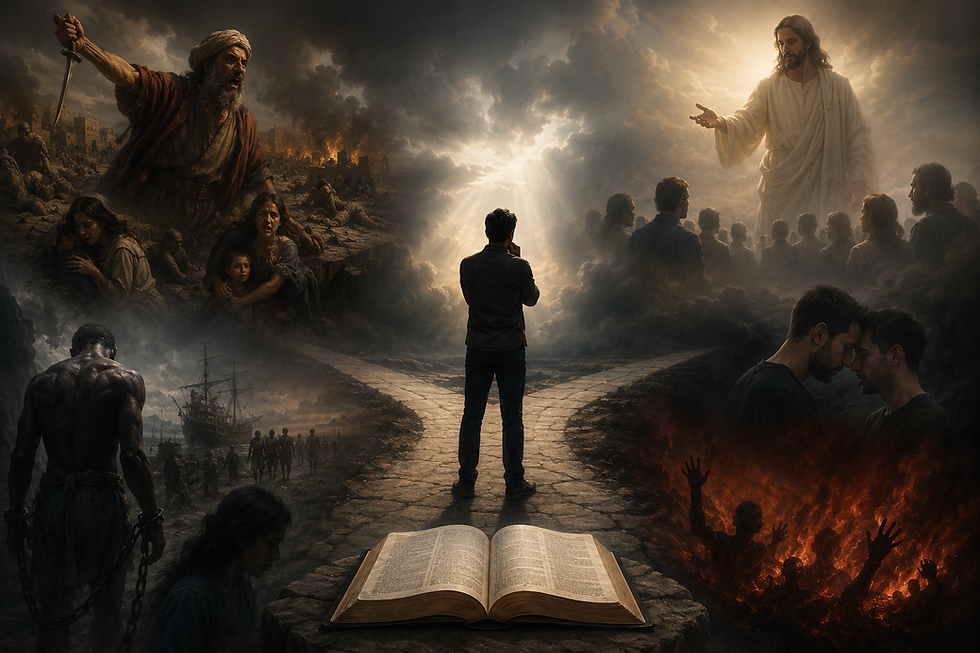
→Why would a loving God allow suffering?
→Why does the Old Testament contain violence and judgment?
→Why would hell exist?
→Why the difficult teachings on slavery, sexuality, authority, and sacrifice?
These are not shallow questions.
They are deeply emotional, philosophical, and personal.
This article (part two out of a six part series) explores some of the most difficult moral objections raised against Christianity and the Bible—not by avoiding the hard passages, but by examining them carefully in their historical, theological, and cultural context.
In This Article
How could God allow such evil?
Old Testament God vs New Testament God
How could a loving God kill women and children?
Why does the Bible condone slavery?
Why are women treated as inferior in the Bible?
Why does the Bible condemn homosexuality?
How could hell be real with a God that is love?
Why would God need animal sacrifices?
Why does God need worship?
If God knows all, do we truly have free will?
🧠 Quick Definitions (for clarity)
Manuscripts → handwritten copies of ancient texts
Textual variants → differences between copies
Textual criticism → comparing manuscripts to recover original wording
Scripture → sacred writings regarded as inspired by God and authoritative for faith
Canon → the recognized books of Scripture
AD → after death of Jesus Christ—we mark our current year from this event
Sin → Anything that goes against God’s nature, will, or commands
Repent → A deliberate turning away from sin and turning toward God—resulting in a real change of mind, heart, and direction.
1. How can a loving God allow evil and suffering?
💬Short answer:
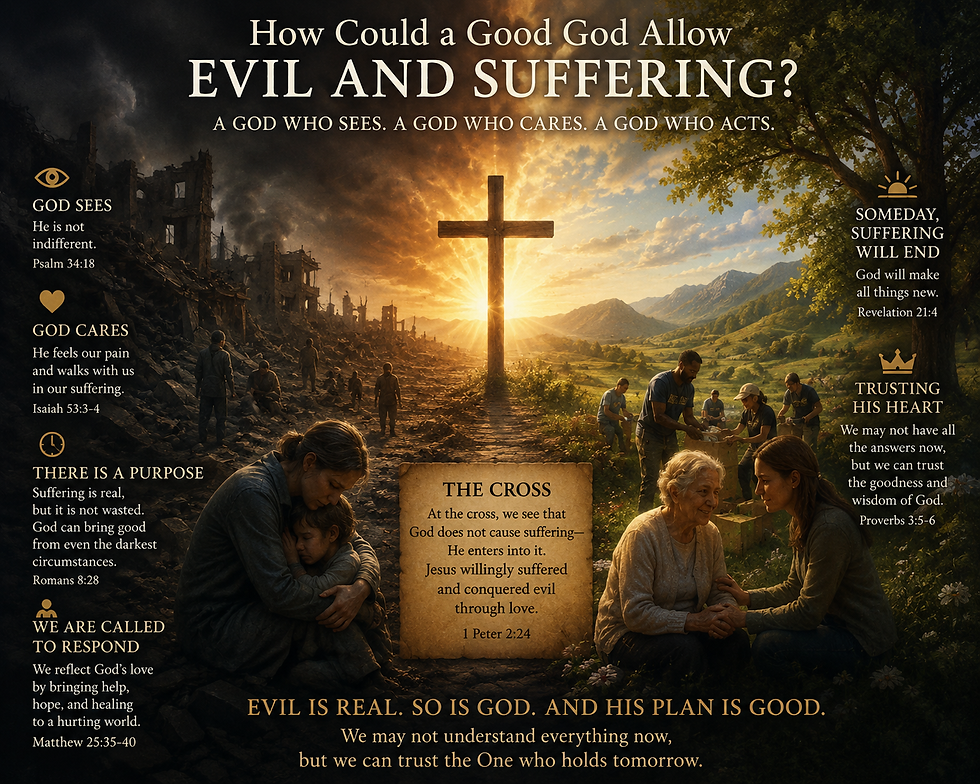
The Bible tells us that God created us, and granted us the blessing of experiencing love, and love requires free will, and free will allows the possibility of evil.

📋Expanded:
The Bible presents evil not as something God created, but as something that results from humanity turning away from God.
(Romans 5:12)
Scripture consistently presents God as:
wanting us to do no evil (Psalm 5:4)
loving us, thus honouring free will (Deuteronomy 30:19)
allowing evil only temporarily (Matthew 13:24-30)
limiting evil (1 Corinthians 10:13)
working through it (Genesis 50:20)
using it for good (Romans 8:28)
ultimately removing it (Revelation 21:4)
Most importantly, God does not remain distant—He enters suffering to arguably the greatest degree through Jesus Christ, because He loves us, and wants us to turn away from evil.
👉 Why this matters:
This reframes suffering not as proof against God—but as part of a larger story that includes justice and restoration.
✍️ “I have no pleasure in the death of the wicked, but that the wicked turn from his way and live.” -Ezekiel 33:11
✍️”For I am sure that neither death nor life, nor angels nor rulers, nor things present nor things to come, nor powers, nor height nor depth, nor anything else in all creation, will be able to seperate us from the love of God into Christ Jesus our Lord.” -Romans 8:38-39
2. Why does God in the Old Testament seem harsh or violent? Like a totally different God than Jesus Christ?
This is one of the most difficult questions and most important objections.
💬 Short answer:
These events are presented as acts of judgment within a specific historical context involving extreme moral corruption—not random or unprovoked violence.
📋 Expanded:
📌 1. Context often missed
The nations under judgment in the Old Testament are consistently described as engaging in:
Extreme violence and war practices
Severe injustice and oppression
Ritual child sacrifice (e.g., worship of Molech)
📚 Source: Ancient Near Eastern studies (e.g., John H. Walton)
👉 The biblical framing is not that these societies were “neutral,” but that they had become deeply entrenched in practices that destroyed human life and dignity.
📌 2. Judgment comes after long periods of patience
Example: 📖 Genesis 15:16
“For the sin of the Amorites has not yet reached its full measure.”
👉 This shows:
Judgment is not immediate
It follows long historical delay
There is a “filled measure” of sustained wrongdoing
📌 3. The hardest question: commands involving killing women and children
This must be acknowledged directly and not softened — many consider this Christianity’s Hardest Question.
There are several main interpretive approaches:
📑 A) Ancient war language
Some scholars note that ancient Near Eastern warfare language often used totalizing phrases like “destroy all,” even when:
Not every individual in a population was literally killed
The phrase functioned as conquest language 📚 (Paul Copan and others)
👉 However, this explanation alone does not remove every moral tension, because the text still describes real, severe destruction.
📑 B) Corporate judgment within deeply corrupted societies
Another major biblical argument is that these nations are portrayed as:
Structurally violent
Intergenerationally corrupt
Practicing systems (like child sacrifice) that directly attack human life
👉 In this framework, the judgment is not random punishment of innocent neutrality, but the collapse of a system described as profoundly evil in its practices.
Still, this raises the hard moral question of collateral suffering, which the text does not fully explain in modern ethical categories.
📑 C) Divine judgment vs. human moral framing
The Bible presents these events as:
Rare
Historically specific
Bound to God’s role as judge of nations
👉 The claim being made is not that humans can replicate this, but that: God has authority over life and history in a way humans do not.
📑 D) Personal reflection
This is not a simple issue, and it should not be treated lightly or explained away with easy answers.
But within the biblical framework, a consistent picture does emerge:
God is portrayed as patient, not impulsive
Judgment is tied to sustained and extreme evil, not random violence
Human understanding is limited when evaluating divine justice from a distance in history
📖 Romans 11:33
“Oh, the depth of the riches of the wisdom and knowledge of God! How unsearchable his judgments…”
📖 Job 38:4
“Where were you when I laid the foundations of the earth?”
👉 These passages don’t remove tension—they establish perspective.
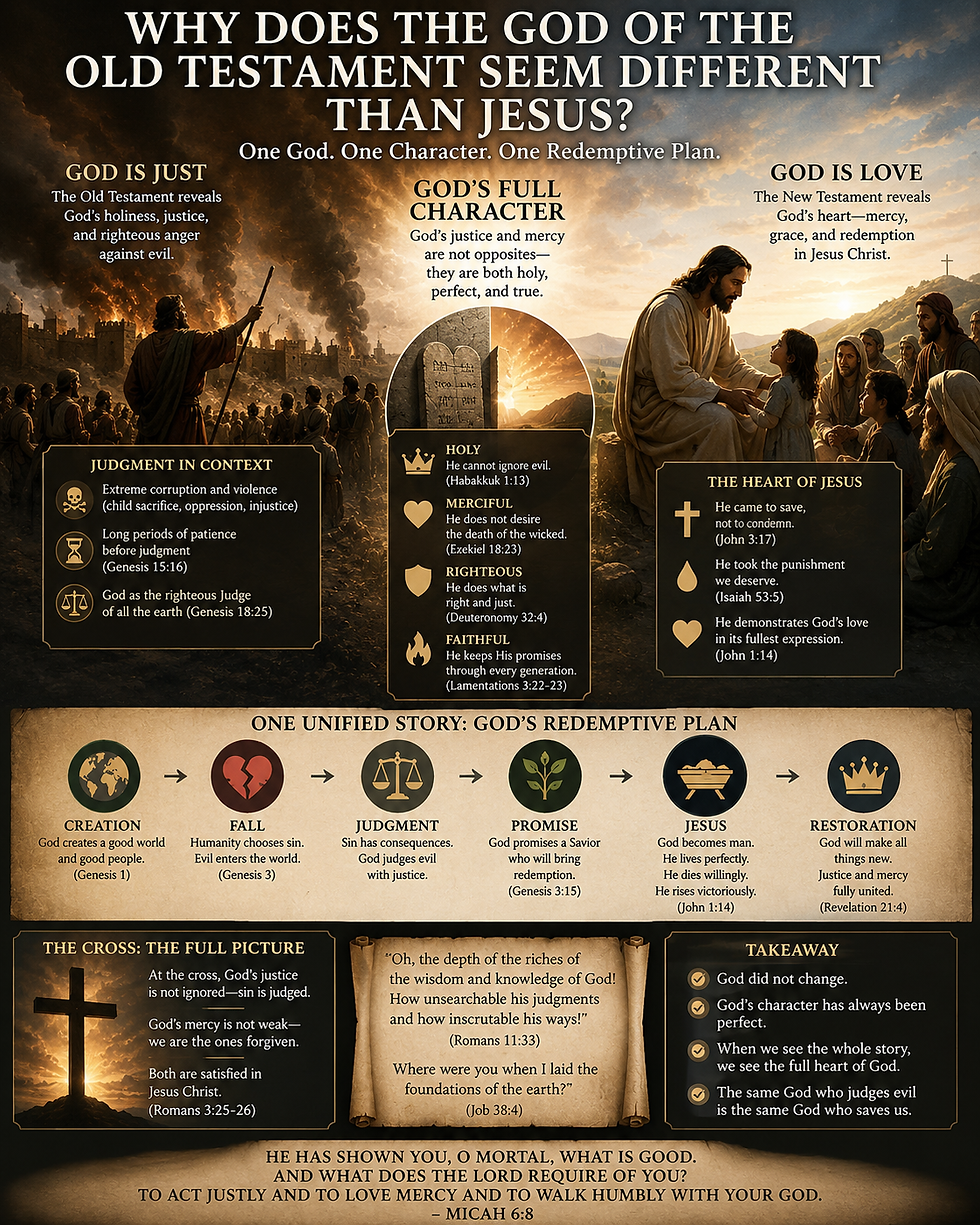
📌Most importantly, the Bible does not present a shift in God’s character between the Old and New Testaments. It presents one unified account of justice and mercy that reaches its clearest expression in Jesus Christ. —This can be difficult to see without studying the Bible in its entirety to grasp a deeper understanding.
🩸At the cross, the seriousness of sin is not reduced—it is fully confronted. And instead of humanity bearing that judgment directly, Christ bears it Himself.
📖 Romans 3:25-26
“God presented Christ as a sacrifice of atonement… to demonstrate his righteousness…”
👉 This brings the entire tension into focus:
God’s justice is not ignored
God’s mercy is not sentimental
Both are fully expressed in Christ
🛑So the question is not ultimately whether God changed between Testaments, but whether the full picture of justice and mercy is understood only when the Bible is read as a whole.
✍️ “He has shown you, O mortal, what is good. And what does the Lord require of you? To act justly and to love mercy and to walk humbly with your God.” -Micah 6:8
3. Why does the Bible condone slavery?
💬Short answer:
The Bible does not present slavery as an ideal or command it as a moral good. Instead, it regulates an existing ancient system within a broken world and introduces principles that move society toward dignity, accountability, and ultimately equality.
📋Expanded:
📌1. The Bible is describing and regulating an ancient social reality
In the ancient world, slavery was a widespread economic and social institution across nearly all cultures—not unique to Israel.
👉 The laws in the Old Testament often function to:
Limit abuse
Restrict exploitation
Protect vulnerable people
Set boundaries on masters’ power
📌In other words: regulation, not endorsement of slavery as an ideal.
📌2. The type of “slavery” is not identical to modern chattel slavery
This is a key distinction often missed in modern readings.
Ancient “servanthood” could include:
Debt repayment arrangements
Voluntary servitude due to poverty
Household employment structures
Time-limited service contracts
⚠️This does NOT mean it was always fair or good—but it was structurally different from race-based, lifelong, hereditary slavery seen in later history.
📌3. The biblical trajectory moves toward human dignity
Across Scripture, there is a consistent ethical progression:
Protection of slaves from abuse (Exodus laws limiting violence)
Equal moral accountability before God
Sabbath rest extended even to servants
Commands to treat servants justly and fairly
📖New Testament development:
Masters are told to treat servants justly (Colossians 4:1)
Spiritual equality is emphasized (Galatians 3:28)
The gospel redefines human identity beyond social class
👉 The direction of the text is constraint of power and elevation of human worth, not endorsement of oppression.
📌4. The radical shift introduced by the Gospel
The early Christian message introduced a worldview that slowly undermined slavery at its root:
All humans are made in the image of God
All stand equal in moral standing before God
Authority is reframed through service rather than domination
👉 This worldview eventually became one of the major intellectual foundations used in abolition movements centuries later.
📌5. Why doesn’t the Bible directly abolish slavery?
This is where historical and theological context matters.
👉The biblical text was written into ancient societies where slavery was deeply embedded in economics, warfare, and social structure. Rather than overturning every institution instantly by force, Scripture often works through gradual moral transformation — reshaping how people understand human dignity, justice, and authority.
📖The Bible introduces principles that ultimately undermine slavery itself: all humans bear God’s image, masters and slaves are spiritually equal before God, and love of neighbor replaces domination as the moral ideal.
⚠️This reflects a broader biblical pattern: God works within imperfect human societies while moving people toward higher moral understanding, rather than eliminating human evil by overriding human freedom and social structures all at once.
📚Scholarly framing (balanced):
N.T. Wright: emphasizes that the New Testament undermines hierarchical status distinctions through the gospel’s redefinition of identity
Many historians of the ancient world note that biblical law is comparatively more restrictive toward slave abuse than surrounding ancient legal codes
📖Biblical foundation:
Slavery is regulated, not idealized (various Old Testament laws limiting harm)
Ephesians 6:9 → masters warned that God shows no favoritism
Galatians 3:28 → “neither slave nor free… you are all one in Christ Jesus”
📖Key takeaway:
The Bible does not present slavery as a moral good—it engages a deeply embedded ancient institution by restricting harm and introducing ethical principles that ultimately undermine it.
👉 The trajectory of Scripture is not toward preserving slavery, but toward reshaping human relationships around dignity, justice, and equality before God.
✍️ “You intended to harm me, but God intended it for good to accomplish what is now being done, the saving of many lives.” -Genesis 50:20
4. Why are women treated as inferior in the Bible?
💬Short answer:
The Bible does not teach that women are inferior in worth or value. It affirms equal human dignity between men and women, while some role distinctions and cultural practices reflect the ancient historical context—not a statement of lesser value.
📋Expanded:
📌1. Equal value is established from the beginning
From the opening chapters of Scripture, equality in human worth is explicit:
📖Genesis 1:27 → “Male and female He created them”
👉 Both men and women are:
Created in the image of God
Given equal dignity and value
Equally accountable before God
📌This foundational idea sets the tone for the rest of the biblical worldview.
📌2. Biblical narrative vs biblical prescription
A key issue in this objection is confusion between:
What the Bible describes (cultural practices of ancient societies)
What the Bible teaches as ideal
👉 Ancient societies were patriarchal in structure—but the Bible records this reality rather than endorsing every aspect of it.
📌3. Jesus’ treatment of women was culturally disruptive
In the context of 1st-century Jewish and Greco-Roman society, Jesus’ behavior toward women was notably countercultural:
He engaged women in public teaching conversations
Women were among His close followers
Women were the first witnesses of the resurrection
📖Luke 8:1–3 → women financially supported Jesus’ ministry and traveled with Him
👉 In that cultural setting, this was highly significant and elevating.
📌4. Women as active participants in the early church
The New Testament consistently shows women in meaningful roles:
House church leaders and hosts
Co-workers in ministry
Students of Jesus
Recognized witnesses of the resurrection
👉 This reflects participation, not exclusion from spiritual significance.
📖In addition:
Beyond the basic examples, the New Testament shows women participating in a wide range of meaningful spiritual and communal roles that go beyond passive presence:
Women hosted and led house churches (e.g., Lydia in Acts 16)
Women served as co-labourers in ministry and mission work alongside Paul
Women acted as financial supporters and patrons of early Christian communities
Women were among the first evangelists of the resurrection message (the first witnesses of Jesus’ resurrection were women)
Women are named as recognized workers, messengers, and servants in the church network
👉 These roles show that women were not sidelined from spiritual function or influence in the early church, but were active participants in its growth and structure.
📌5. Equality in spiritual standing
One of the clearest theological statements comes from Paul:
📖Galatians 3:28 → “There is neither male nor female… you are all one in Christ Jesus”
👉 This is not about abolishing biological differences, but about equal access to:
Salvation
God’s grace
Spiritual identity and worth
📌6. Role distinctions vs value hierarchy
Some passages describe different roles in family or church structure.
⚠️Important distinction:
Role differences ≠ value differences
Function ≠ worth
👉 The text consistently maintains equality in value while sometimes describing ordered relationships within specific cultural or organizational contexts.
📌7. What about Paul’s “women should not teach” passages?
Two passages are often cited:
📖 First Epistle to Timothy
2:12 → “I do not permit a woman to teach or to assume authority over a man…”
📖 First Epistle to the Corinthians
14:34–35 → “Women should remain silent in the churches…”
👉 At first glance, these seem to prohibit women from speaking or teaching in church.
However, several important contextual points are often overlooked:
Paul also affirms women speaking in church
📖 First Epistle to the Corinthians
11:5 → women are praying and prophesying publicly
Women are described as ministry leaders and co-workers
📖 Epistle to the Romans
16 → Phoebe (deacon), Priscilla (teacher), Junia (noted among the apostles)
These letters address specific local issues
👉 First Epistle to Timothy deals with false teaching and disorder in Ephesus
👉 First Epistle to the Corinthians addresses chaos and interruptions in worship
👉 Because of this, many scholars understand these passages as:
Addressing specific problems, not universal bans
Regulating order and sound teaching, not declaring women inferior
👉 These instructions are best understood as addressing specific issues of disorder, false teaching, and cultural disruption within certain congregations—particularly in Ephesus—rather than as a universal statement of women’s value or capability in the church.
⚠️Key point:
Even in these debated passages, the issue is authority, order, or false teaching—not value or worth.
📚Scholarly framing:
Craig Keener: emphasizes that many “problem passages” reflect ancient cultural context more than timeless inequality
N.T. Wright: highlights the radical inclusion of women as witnesses and participants in early Christianity
📖Key takeaway:
The Bible does not teach that women are inferior in worth.
👉 It consistently affirms equal human dignity while operating within ancient cultural structures—and in many places, it significantly elevates women compared to surrounding societies.
✍️”“So God created mankind in His own image, in the image of God He created them; male and female He created them.” -Genesis 1:27
5. Why does the Bible say the man is the head of the household?
📖 Epistle to the Ephesians 5:23
“For the husband is the head of the wife as Christ is the head of the church, his body, of which he is the Savior.”
💬 Short answer:
The Bible’s idea of “headship” is not about superiority or control, but about responsibility, unity, and sacrificial leadership modeled after Christ.

📋 Expanded:
📌1. Leadership is given in the context of mutual submission
Paul does not begin with hierarchy—he begins with mutual submission:
📖 Epistle to the Ephesians 5:21
“Submit to one another out of reverence for Christ.”
👉 This sets the tone: the relationship is defined by humility on both sides, not domination.
📌2. “Headship” is defined by Christ, not culture or power
Paul immediately defines what “head” means:
📖 Epistle to the Ephesians 5:25
“Husbands, love your wives, just as Christ loved the church and gave himself up for her.”
👉 The model is not authority through force, but:
sacrifice
service
responsibility for the well-being of others
⚠️So whatever “headship” means, it cannot contradict Christ-like self-giving love.
📌3. The passage is about order and responsibility, not superiority
The text does not say:
men are more valuable
women are less capable
leadership is based on strength or intelligence
Instead, it presents a functional structure within a theological framework of unity.
👉 The emphasis is on:
shared unity in marriage
clear responsibility in decision-making
accountability before God
-5.1 Why should there be a head of the household at all? Why not both be equal in decision making?
The Bible does affirm equality in value—but it does not always prescribe identical roles.
👉 The issue is not worth, but order and responsibility.
In any close partnership, especially marriage:
Decisions must sometimes be made when there is disagreement
Without a final point of responsibility, conflict can remain unresolved
Equal authority can lead to tension without clarity
👉 Biblical headship provides:
A clear line of responsibility
A structure for unity rather than stalemate
Accountability before God for leadership decisions
This does not mean:
The husband makes decisions alone
The wife’s wisdom, input, or discernment is secondary
In fact, the model of Ephesians 5:21 (mutual submission) still applies:
👉 Decisions are meant to be:
Discussed
Weighed together
Pursued in unity
But in cases where agreement cannot be reached, the husband carries the final responsibility before God—not as privilege, but as burden.
👉 This reflects how Jesus Christ leads:
Not by insisting on His own way
But by laying down His life for the good of others
📌1. Biblical authority is always morally constrained
In Scripture, authority is never independent—it is always accountable to God and expressed through service.
👉 This prevents “headship” from being interpreted as control or self-interest.
📌2. Equality in value is never removed
Even within structured roles, the Bible consistently affirms equal worth:
📖 Epistle to the Galatians 3:28
“There is neither male nor female, for you are all one in Christ Jesus.”
👉 This means:
equality in salvation
equality in dignity
equality in spiritual standing before God
📖Key takeaway:
Biblical “headship” is best understood as:
👉 responsibility without superiority
👉 order without inequality of worth
👉 leadership defined by sacrifice, not control
✍️ “In the same way husbands ought to love their wives as their own bodies. He who loves his wife loves himself. After all, no one ever hated their own body, but they feed and care for it, just as Christ does the church.” -Ephesians 5:28-29
6. Why does the Bible condemn homosexuality?
“If a man lies with a male as he lies with a woman, both of them have committed an abomination...” -Leviticus 20:13
💬 Short answer:
The Bible’s sexual ethic is grounded in its creation-based understanding of marriage as a covenant between a man and a woman. Within that framework, it addresses same-sex sexual behavior in both Old and New Testament texts as part of its broader moral vision of holiness, while also consistently extending repentance and transformation to all people without distinction.
📋 Expanded:
📌1. The foundation is creation-based marriage design
The biblical sexual ethic begins with creation:
📖 Book of Genesis 2:24
“Therefore a man shall leave his father and his mother and hold fast to his wife, and they shall become one flesh.”
👉 This is presented as the foundational pattern for:
marriage
sexual union
family structure
Later sexual ethics in Scripture are consistently evaluated in relation to this framework.
📌2. The Bible addresses sexual ethics broadly, not in isolation
Across Scripture, sexual behavior is placed within a wider moral framework that includes:
adultery
lust
exploitation
idolatry-linked sexual practices
general sexual immorality
📖 First Epistle to the Corinthians 6:9–11
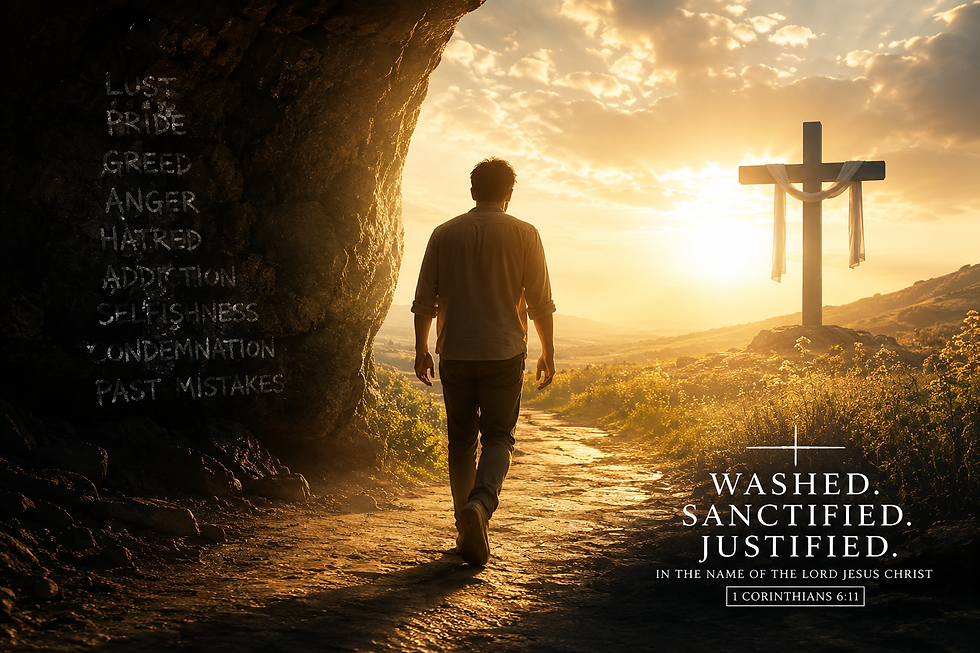
“Do you not know that the unrighteous will not inherit the kingdom of God? Do not be deceived. Neither fornicators, nor idolaters, nor adulterers, nor homosexuals, nor sodomites, nor thieves, nor covetous, nor drunkards, nor revilers, nor extortioners will inherit the kingdom of God. And such were some of you. But you were washed, but you were sanctified, but you were justified in the name of the Lord Jesus and by the Spirit of our God."
👉 The emphasis is not only moral evaluation, but also transformation and new identity in Christ.

📌3. Key passages addressing same-sex sexual behavior
The Bible contains explicit texts on the topic:
📖 Book of Leviticus 18:22
“You shall not lie with a male as with a woman; it is an abomination.”
📖 Book of Romans 1:26-27
“…For even their women exchanged the natural use for what is against nature…”
📖 Book of Leviticus 20:13
“If a man lies with a male as with a woman, both of them have committed an abomination…”
📖 Epistle to the Romans 1:26–27
Paul describes same-sex relations within his broader argument about humanity turning away from God’s design.
👉 These passages are understood in two main ways:
Traditional interpretation: They prohibit same-sex sexual behavior as inconsistent with the biblical creation-based sexual ethic.
Contextual interpretation: They address exploitative, idolatrous, or culturally specific forms of sexual behavior rather than modern committed relationships.
📌4. The New Testament emphasis includes both moral clarity and transformation
📖 First Epistle to the Corinthians 6:11
“But you were washed, you were sanctified, you were justified…”
👉 The consistent pattern is:
moral evaluation within a theological framework
followed by the offer of repentance and transformation
without excluding any group from redemption
📌5. The universal scope of moral accountability
Scripture consistently frames moral responsibility as universal:
📖 Epistle to the Romans 3:23
“For all have sinned and fall short of the glory of God.”
👉 The text does not single out one group as uniquely beyond redemption or uniquely targeted—it places all humanity under the same moral and spiritual condition.
📌6. Distinction between human value and moral behavior
Across Scripture, a consistent distinction is maintained:
Human worth → grounded in being made in the image of God
Human behavior → evaluated within God’s moral framework
👉 Even where actions are described as sin within the text, human dignity is not revoked.
📖Key takeaway:
The Bible’s teaching on sexuality is part of a broader moral vision rooted in creation, covenant, and holiness.
👉 Within that framework, it does describe same-sex sexual behavior as outside of God’s design.
👉 But at the same time, it places all people under the same reality of sin and extends the same offer to everyone: repentance, transformation, and new life.
So the question is not simply:
“Does the Bible condemn homosexuality?”
But rather:
👉 Are we willing to let God define what is good—even when it challenges our desires—and trust that His call to transformation is ultimately for our good?
✍️ “Do you not know that wrongdoers will not inherit the kingdom of God? …
And such were some of you. But you were washed, you were sanctified, you were justified in the name of the Lord Jesus Christ and by the Spirit of our God.” - 1 Corinthians 6:9-11
-6.1 What about Leviticus 20:13 saying ‘put to death’?
“If a man has sexual relations with a man as one does with a woman, both of them have done what is detestable. They are to be put to death; their blood will be on their own heads.” -Leviticus 20:13
💬 Short answer:
Leviticus 20:13 describes a civil penalty in ancient Israel’s theocratic law, not a command for Christians to harm people. It belongs to the judicial laws governing Israel as a nation, not a license for hatred or violence.
📋 Expanded:
This verse is often cited as though the Bible is commanding believers to execute homosexual people, but that is not what the passage is doing.
In The Holy Bible Leviticus 20:13, “put to death” is judicial language from the Mosaic Law. Ancient Israel functioned as a covenant nation with civil laws, including penalties for various serious sins such as adultery (Leviticus 20:10), incest, blasphemy, and Sabbath-breaking. The phrase describes a legal penalty within that national covenant structure.
Importantly:
It was not permission for personal violence or hatred.
It was part of Israel’s civil law, not a universal command for Christians.
Christians are not called to enforce Old Testament civil penalties.
The New Testament shifts the emphasis from civil punishment to repentance and redemption through God brutally dying for our sins on the cross and rising again for us to have new life in His transformative love—to bring us to wholeness as He wants us to be so both Him and we can benefit to the greatest degree in love.
📖The Holy Bible- Ezekiel 33:11
“I have no pleasure in the death of the wicked, but that the wicked turn from his way and live.”
📖The Holy Bible- 1 Timothy 2:4
God “desires all men to be saved…”
And Jesus consistently moved toward sinners with truth and mercy.
In The Holy Bible John 8, when a woman caught in sexual sin was brought for condemnation, Jesus did not endorse mob justice. He exposed hypocrisy, showed mercy, and said: “Go and sin no more.”
👉That captures the Christian posture: neither affirming sin nor condemning people as beyond grace.
📌Important distinction:
Many Christians summarize this as:
The Bible may call certain behavior sinful
That does not mean people who struggle with that sin are hated by God
God hates evil, but He calls sinners—including all of us—to repentance and salvation through Christ.
📖The Holy Bible- Romans 5:8
“While we were still sinners, Christ died for us.”
⚠️That includes everyone.
-6.2 Why does Leviticus have laws and punishments Christians don’t follow today?
💬 Short answer:
The Old Testament contains moral, ceremonial, and civil laws given to ancient Israel as a covenant nation. Christians believe the moral truth continues, but the civil/judicial system does not apply to the church today.
📋 Expanded:
To understand passages like Leviticus 20:13 correctly, it helps to see that the Bible’s laws were not all the same type.
1. Moral Law (enduring principles)
These reflect God’s character and are reaffirmed in the New Testament:
Do not murder
Do not steal
Sexual ethics rooted in marriage and fidelity
Love your neighbor
2. Ceremonial Law (ritual and worship system)
These included sacrifices, dietary laws, and purity regulations that pointed forward to Christ.
📖The Holy Bible- Hebrews 10:1
“The law is only a shadow of the good things that are coming…”
Christians believe these were fulfilled in Jesus and are no longer binding in the same way.
3. Civil / Judicial Law (national Israel law)
This is where passages like Leviticus 20:13 belong.
📌Ancient Israel was not just a religious community—it was a theocratic nation, with courts, penalties, and laws governing civil order. “Put to death” language refers to legal sentencing within that national system, not instructions for individuals to carry out punishment today.
This is why you see the same structure elsewhere in Leviticus:
Adultery → civil penalty
Blasphemy → civil penalty
Incest → civil penalty
These were governmental laws for Israel under the Mosaic covenant, not universal commands for all societies or religions.
📌 Leviticus does not single out one category of sin
A helpful clarification is that Leviticus 20 does not isolate one type of wrongdoing—it lists multiple behaviors under the same covenant framework, each treated with the same seriousness within ancient Israel’s civil law system.
For example, the same chapter includes penalties for:
adultery (Leviticus 20:10)
child sacrifice (Leviticus 20:2–5)
incest (Leviticus 20:11–12)
same-sex sexual behavior (Leviticus 20:13)
bestiality (Leviticus 20:15–16)
📌 The point is not hierarchy or targeting, but covenant order within ancient Israel’s legal system as a whole.
📌 Why did God give covenant laws like this at all?
The Mosaic law was not given as a random list of rules, but as part of God forming Israel into a distinct covenant people in a specific historical context.
It served multiple purposes:
Establishing justice and order in a national society
Setting Israel apart from surrounding nations
Revealing God’s holiness and moral seriousness
Preparing the world for the coming of Christ
📖The Holy Bible- Galatians 3:24
“So the law was our guardian until Christ came…”
From this perspective, the law functioned as a temporary covenant structure pointing forward to Jesus, who fulfills its moral purpose while establishing a new covenant centered on internal transformation rather than national legal enforcement.
-6.3 What changes in the New Testament?
💬 Short answer:
In the New Testament, Jesus establishes a new covenant where the focus shifts from Israel’s civil law system to spiritual transformation, personal repentance, and God’s ultimate authority in judgment.
📋 Expanded:
📌1. The New Testament does not erase the moral seriousness of sin, but it changes how God’s people relate to the law and how judgment is handled in the community of faith.
Jesus shifts judgment away from human enforcement
Under the Old Covenant, Israel functioned as a theocratic nation with legal penalties.
In the New Testament, Jesus consistently redirects judgment away from individuals acting as enforcers.
📖The Holy Bible- John 8:7
“Let him who is without sin cast the first stone…”
📌2. Here, Jesus is not denying sin or justice—He is confronting self-righteous judgment and showing that moral accountability belongs ultimately to God, not human retaliation.
📌3. The New Covenant replaces the old legal system as the governing framework. With the coming of Christ, the law is fulfilled in Him rather than enforced through Israel’s civil structure.
📖The Holy Bible- Romans 6:14
“You are not under law but under grace.”
📌4. This means believers are no longer part of a national covenant with civil penalties, but part of a global spiritual body (the Church) defined by grace, repentance, and faith.
📌5. The Church is not a state or judicial authority. Unlike ancient Israel, the Church is not called to administer legal punishments or enforce criminal penalties.
Instead, its role is spiritual:
Teaching truth
Calling people to repentance
Practicing church discipline in a restorative (not civil) sense
Leaving final judgment to God
📖The Holy Bible- John 3:17
“For God did not send his Son into the world to condemn the world, but to save the world through him.”
📌6. This clarifies that the central mission of the New Covenant is redemption, not civil enforcement.
📌7. God remains the final judge. Even though human enforcement is removed, the seriousness of sin is not reduced—judgment is simply relocated to God’s authority rather than human courts.
📖The Holy Bible- Romans 12:19
“Do not take revenge, my dear friends, but leave room for God’s wrath…”
📌8. This reinforces that justice still exists, but it is ultimately God’s responsibility, not ours to carry out.
📖Key takeaway
The New Testament does not ignore sin or abolish moral truth—it redefines how God’s people respond to it. The civil laws of ancient Israel no longer apply as a governing system, and the focus shifts from external enforcement to internal transformation, grace, and leaving ultimate judgment in God’s hands.
👉 Christians are not under the law as a means of earning salvation, because Christ fulfilled it perfectly on their behalf. However, this does not remove obedience—it redefines it. Obedience is no longer a way to earn God’s approval, but the natural response of a heart changed by Him. God’s law reflects His character, and when the Holy Spirit transforms a person, obedience becomes the fruit of that transformation rather than a legal requirement.
📖The Holy Bible- John 14:15
“If you love me, keep my commandments.”
✍️ “By calling this covenant ‘new,’ he has made the first one obsolete; and what is obsolete and outdated will soon disappear.” -Hebrews 8:13
7. How is eternal hell a just punishment?
“Then they will go away to eternal punishment, but the righteous to eternal life.” -Matthew 25:46
💬Short answer:
In the biblical framework, hell is not portrayed as arbitrary punishment, but as the just outcome of rejecting God—who is understood as the source of life, goodness, and truth. God offers salvation freely, but does not force relationship with Him, and ultimately honors human choice.

📋Expanded:
📌1. Justice is tied to the value of the One being rejected
In biblical theology, God is not just “a being among others,” but:
The source of life
The foundation of moral order
The giver of goodness and truth
👉 Therefore, rejection of God is treated not as a minor decision, but as rejection of the ultimate source of life itself.
📌2. Hell is described as separation from God
Across Scripture, hell is consistently framed in relational and existential terms:
📖2 Thessalonians 1:8–9 → “away from the presence of the Lord”
👉 The emphasis is not only on physical imagery, but on:
Separation from God’s presence
Separation from life and goodness
Separation from restoration
📌3. Human choice is central to the framework
A key biblical theme is that God does not force relationship:
📖Ezekiel 18:23 → God takes no pleasure in the death of the wicked, but desires repentance
👉 The pattern is:
God offers restoration
Humans can accept or reject it
God respects that decision
📌In this framework, hell is not “forced separation,” but confirmed separation chosen over time
📌4. The moral weight is tied to eternal consequences
A common question is why consequences are described as eternal.
Within the biblical worldview:
The value of the rejection is tied to the infinite worth of God
The seriousness of sin is not only in actions, but in what (or who) is being rejected
Final judgment reflects ultimate moral reality, not temporary imbalance
📖Matthew 25:46 → uses parallel language for “eternal life” and “eternal punishment”
👉 The same word is used for both outcomes, showing symmetry in the framework.
📌5. God’s justice and mercy are held together
The Bible consistently presents two truths at once:
God desires repentance and restoration
God also respects moral accountability and final judgment
👉 Justice is not opposed to mercy—it coexists with it throughout the biblical narrative.
📌6. Hell is not presented as God’s desire
A key clarification often missed:
📖Ezekiel 18:23 → God does not delight in judgment
👉 The consistent biblical tone is:
Invitation to life
Warning of consequence
Grief over rejection
📚Scholarly framing:
N.T. Wright: emphasizes judgment in the New Testament is tied to relational separation from God and moral responsibility
C.S. Lewis: famously framed hell as the “final result of a person saying ‘my will be done’” (interpretive framing, not Scripture)
📖Key takeaway:
In the biblical worldview, hell is not arbitrary punishment, but the final outcome of rejecting God—who is understood as the source of life and goodness.
👉 God offers salvation freely, but does not override human will, and judgment reflects both justice and the reality of that choice.
📖Biblical foundation:
Matthew 25:46 → eternal life vs eternal punishment
2 Thessalonians 1:8–9 → separation from God’s presence
Ezekiel 18:23 → God’s desire for repentance, not destruction
✍️”’Do I have any pleasure at all that the wicked should die?’ Says the Lord God, ‘and not that he should turn from his ways and live?’” -Ezekiel 18:23
8. Why would God create people He knows will go to hell?
💬Short answer:
The Bible teaches that God desires all people to be saved and provides real opportunity for everyone to respond to Him. Judgment is presented as the result of human rejection of God, not a lack of access or desire on God’s part. Human freedom is necessary for genuine love and relationship.
📋Expanded:
📌1. God’s stated desire is universal salvation
📖1 Timothy 2:4 → God “desires all people to be saved and to come to the knowledge of the truth”
📖2 Peter 3:9 → God is “not willing that any should perish, but that all should come to repentance”
👉 These passages establish a clear principle:
God’s posture toward humanity is not selective exclusion
His desire is for repentance and salvation
📌2. God provides real opportunity, not forced outcome
In the biblical framework, God:
Reveals Himself through creation, conscience, and revelation
Sends messages through prophets and ultimately Christ
Invites response rather than forcing compliance
👉 The emphasis is on genuine response, not coercion.
📌3. Human freedom is necessary for real love
A key theological idea is that love cannot be forced.
👉 If humans were created without the ability to reject:
Love would not be voluntary
Relationship would not be authentic
Moral choice would not exist
📌In this framework:
Freedom makes love possible
Freedom also makes rejection possible
📌4. Judgment is tied to rejection, not lack of information
A common assumption is that people are judged due to ignorance.
The biblical framework instead emphasizes:
Accountability for response to revealed truth
Rejection of God’s invitation
Moral responsibility
👉 Judgment is presented as a consequence of refusal, not absence of opportunity.
At the heart of this rejection, Scripture often identifies pride.
📖 Romans 1:21 → “Although they knew God, they did not honor Him as God or give thanks…”
📖 John 3:19–20 → People “loved darkness rather than light”
📖 James 4:6 → “God opposes the proud but gives grace to the humble”
👉 Pride, in the biblical sense, is not just arrogance—it is:
A refusal to submit to God
A desire for autonomy over dependence
A resistance to truth when it confronts the self
📌In this framework:
People are not condemned because they lacked access to truth.
They are condemned because they resist, suppress, or reject it
📌5. God’s knowledge does not equal causation
The objection often assumes:
“If God knows the outcome, He caused it.”
But biblically:
Foreknowledge ≠ forcing a decision
Knowing a choice ≠ making the choice
👉 Human decisions remain meaningful within the framework of divine knowledge.
📌6. The tension the Bible presents intentionally remains
Scripture holds two truths together:
God desires salvation for all
Not all respond to that invitation
👉 The text does not fully resolve this tension philosophically—it presents both as real.
📚Scholarly framing:
N.T. Wright: emphasizes that New Testament judgment language is relational and tied to response to God’s revelation in Christ
C.S. Lewis: often described human freedom as the basis for meaningful love and moral choice (interpretive explanation, not Scripture)
📖Key takeaway:
In the biblical worldview, God does not create people for destruction. He desires salvation for all, offers genuine opportunity, and allows human freedom—even when that freedom includes rejection.
👉 Judgment is presented as the outcome of that response, not the absence of God’s desire or effort to save.
📖Biblical foundation:
1 Timothy 2:4 → God desires all to be saved
2 Peter 3:9 → God’s patience and desire for repentance
(Supporting theme throughout Scripture: invitation + response framework)
✍️ “For this is good and acceptable in the sight of God our Saviour, who desires all men to be saved and to come to the knowledge of the truth.” -1 Timothy 2:3-4
9. Why would an all-powerful God need animal sacrifices?
💬Short answer:
The Bible does not present God as needing animal sacrifices. Sacrifices were part of a symbolic system in the Old Testament that taught the seriousness of sin, provided a way for atonement within that covenant, and ultimately pointed forward to a final fulfillment in Christ.
📋Expanded:
📌1. God does not “need” sacrifices
Scripture is clear that God is not dependent on human offerings:
👉 The sacrificial system is not about supplying God with something He lacks, but about establishing a structured way for humans to relate to holiness and sin.
📌2. Sacrifices function as a symbolic teaching system
In the Old Testament, sacrifices served multiple purposes:
A visible picture of the seriousness of sin
A tangible way to express repentance
A structured means of maintaining covenant relationship
A reminder that sin has consequences
👉 In that sense, sacrifices are symbolic and instructional, not transactional in the sense of “God needing food or payment.”
📌3. The principle: life is given for life
At the core of the system is the idea that sin carries moral consequence.
👉 The sacrificial animal represents:
Substitution
Cost
The seriousness of wrongdoing
📌It is not about value to God, but about illustrating moral reality in physical form.
📌4. Sacrifices were always pointing forward
The sacrificial system is not presented as the final solution.
Instead, it functions as a forward-looking framework:
Temporary coverings for sin
Repeated rituals showing ongoing need
Foreshadowing of a final resolution
👉 This is why later biblical theology interprets it as pointing toward ultimate fulfillment—pointing to Jesus Christ and His gift of salvation for us to accept and receive.
📌5. Fulfillment in Christ (Christian interpretation)
In the New Testament understanding:
Sacrifices are fulfilled, not continued
Jesus is described as the final atonement
Christ is portrayed as the “Lamb of God” who fulfills the purpose of sacrificial imagery
📖 “Behold, the Lamb of God, who takes away the sin of the world!” — John 1:29
📖 “For Christ, our Passover lamb, has been sacrificed.” — 1 Corinthians 5:7
📌 This is why the sacrificial system is understood by Christians as temporary and symbolic within the larger biblical narrative, ultimately pointing toward Christ.
📌6. Why animal sacrifice specifically?
In the ancient world:
Livestock represented economic value and survival
Sacrifice involved real cost, not symbolic gesture only
It created a tangible expression of repentance and consequence
👉 The point was not brutality, but seriousness.
📚Scholarly framing:
N.T. Wright: emphasizes that sacrifice language in the New Testament is fulfilled in Christ rather than continuing as a requirement
John Walton: highlights that ancient sacrificial systems functioned as covenantal and symbolic frameworks rather than divine “food requirements”
📖Key takeaway:
The Bible does not teach that God needs animal sacrifices.
👉 Instead, sacrifices function as a symbolic, covenant-based system that teaches the seriousness of sin and points toward a greater fulfillment in the biblical narrative.
📖Biblical foundation (conceptual support):
Repeated theme: God is not served as though He needed anything (see Acts 17:25 principle applied broadly)
Sacrifices are consistently tied to atonement, not divine need
✍️ “... I have no pleasure in the blood of bulls and lambs and goats...” Isaiah 1:11-17
10. Why does God require worship?
💬Short answer:
The Bible does not present God as needing worship. Rather, worship is portrayed as something humans need—because it aligns us with truth, humility, and reality by recognizing God as the source of life and existence.
📋Expanded:
📌1. God is not dependent on human worship
📖Acts 17:25 → God “is not served by human hands, as if He needed anything”
👉 This directly addresses the idea that:
God lacks something humans supply
Worship is for God’s benefit
📌Instead, Scripture presents God as self-sufficient.
📌2. Worship is about right orientation, not divine need
In biblical framework, worship functions as:
Recognition of what is ultimate
Alignment of human perspective with reality
A response to the source of life
👉 In other words: Worship is less about “giving God something” and more about “seeing things correctly.”
📌3. Humans are always oriented toward something “ultimate”
A key idea in biblical thought is that everyone worships something:
Success
Power
Self
Relationships
Greed
Lust
Drunkenness
Or God
👉 Worship is simply the act of placing ultimate value on something.
📌The biblical claim is that God is the only proper “ultimate object” because He is the source of all things.
📌4. Worship is tied to human flourishing
Biblically, worship is not just obligation—it is connected to well-being:
It shapes values
It directs priorities
It forms identity
👉 What a person “ultimately values” shapes how they live.
📌5. Worship is response, not transaction
A common misunderstanding is that worship is something God demands for His benefit.
But biblically it is:
A response to who God is
Recognition of reality
Expression of relationship
📌6. Biblical imagery of worship as acknowledgment
📖Psalm 95:6 → “Come, let us bow down in worship”
👉 This reflects:
Humility
Recognition of authority
Alignment with truth
Not obligation to meet God’s need—but response to God’s reality.
📚Scholarly framing:
C.S. Lewis: often described worship as the “natural response” to ultimate worth and reality
N.T. Wright: emphasizes worship in early Christianity as a recognition of Jesus’ lordship, not divine need
📖Key takeaway:
In the biblical worldview, God does not require worship because He lacks anything.
👉 Worship exists because humans need proper orientation toward what is ultimately real and worthy.
So the real question becomes:
👉 “What are humans built to center their lives around?”
And the biblical answer is: the source of life itself.
✍️“The God who made the world and everything in it is the Lord of heaven and earth and does not live in temples built by human hands. And He is not served by human hands, as if he needed anything, because he himself gives all people life and breath and everything else.” -Acts 17:24-25
11. If God knows everything, do we really have free will?
💬Short answer:
God’s knowledge of future choices does not mean He causes or forces those choices. Knowing what someone will freely choose is not the same as determining what they must choose. God’s knowledge describes reality—it does not override human agency.
📋Expanded:
📌1. Knowledge is not the same as control
A key distinction in this question is:
Knowing something will happen
Causing something to happen
👉 These are not the same thing.
Example:
A weather forecast can accurately predict rain
But the forecast does not cause the rain
👉 In the same way, knowledge of a choice does not equal control over that choice.
📌2. God’s relationship to time is different from ours
Scripture portrays God as not limited by human time perception:
📖Psalm 139:1–4 → God “knows” actions before they occur in human experience
👉 One common theological explanation is that:
Humans experience time sequentially (past → present → future)
God is not limited to that same framework
📌So God’s “foreknowledge” is not presented as guessing—it is a complete awareness of reality.
📌3. Human responsibility is still consistently affirmed
Even with God’s foreknowledge, Scripture still places real responsibility on human choice:
📖Deuteronomy 30:19 → “I have set before you life and death… choose life”
👉 The language of choice is meaningful and direct, not symbolic.
📌4. Biblical framework holds both truths together
The Bible consistently holds two ideas at once:
God knows all things
Humans are responsible for their decisions
👉 It does not present foreknowledge as cancelling moral responsibility.
📌5. Foreknowledge ≠ predetermination (important distinction)
A common assumption is:
“If God knows it, it must be forced.”
But the biblical framework distinguishes:
Foreknowledge: God sees/knows what will happen
Determinism: God forces what will happen
👉 The text affirms the first, and only sometimes affirms the second in unique circumstances.
📌6. Human choices are still treated as real choices
Throughout Scripture:
People are called to repent
People are held accountable
People are warned, invited, and judged based on response
👉 These only make sense if choices are meaningful within the system.
📚Scholarly framing:
William Lane Craig: argues that divine foreknowledge does not logically negate human freedom (compatibilist / Molinist discussions)
N.T. Wright: emphasizes biblical language assumes real human agency within God’s sovereignty rather than mechanistic determinism
📖Key takeaway:
In the biblical worldview, God’s complete knowledge of reality does not cancel human freedom.
👉 Knowing a choice does not equal forcing a choice.
So the real distinction is: 👉 “Is reality known in advance?”
⚠️not: 👉 “Is reality being forced?”
And Scripture consistently affirms both divine knowledge and genuine human responsibility.
📖Biblical foundation:
Psalm 139:1–4 → God’s complete knowledge of human life
Deuteronomy 30:19 → real human choice is affirmed
✍️ “I call heaven and earth as witnesses today against you, that I have set before you life and death, blessing and cursing; therefore choose life, that both you and your descendants may live;” -Deuteronomy 30:19

Comments